Kingdom
Pseudomonadati
Phylum
Pseudomonadota
Class
Betaproteobacteria
Order
Neisseriales
Family
Neisseriaceae
Genus
Neisseria
Description
Taxonomy
| Kingdom | Pseudomonadati |
|---|---|
| Phylum | Pseudomonadota |
| Class | Betaproteobacteria |
| Order | Neisseriales |
| Family | Neisseriaceae |
| Genus | Neisseria |
| Species | Neisseria gonorrhoeae |
| Strain | strain GC-186 |
Profile
| Physiology | |
|---|---|
| Gram staining properties | Negative |
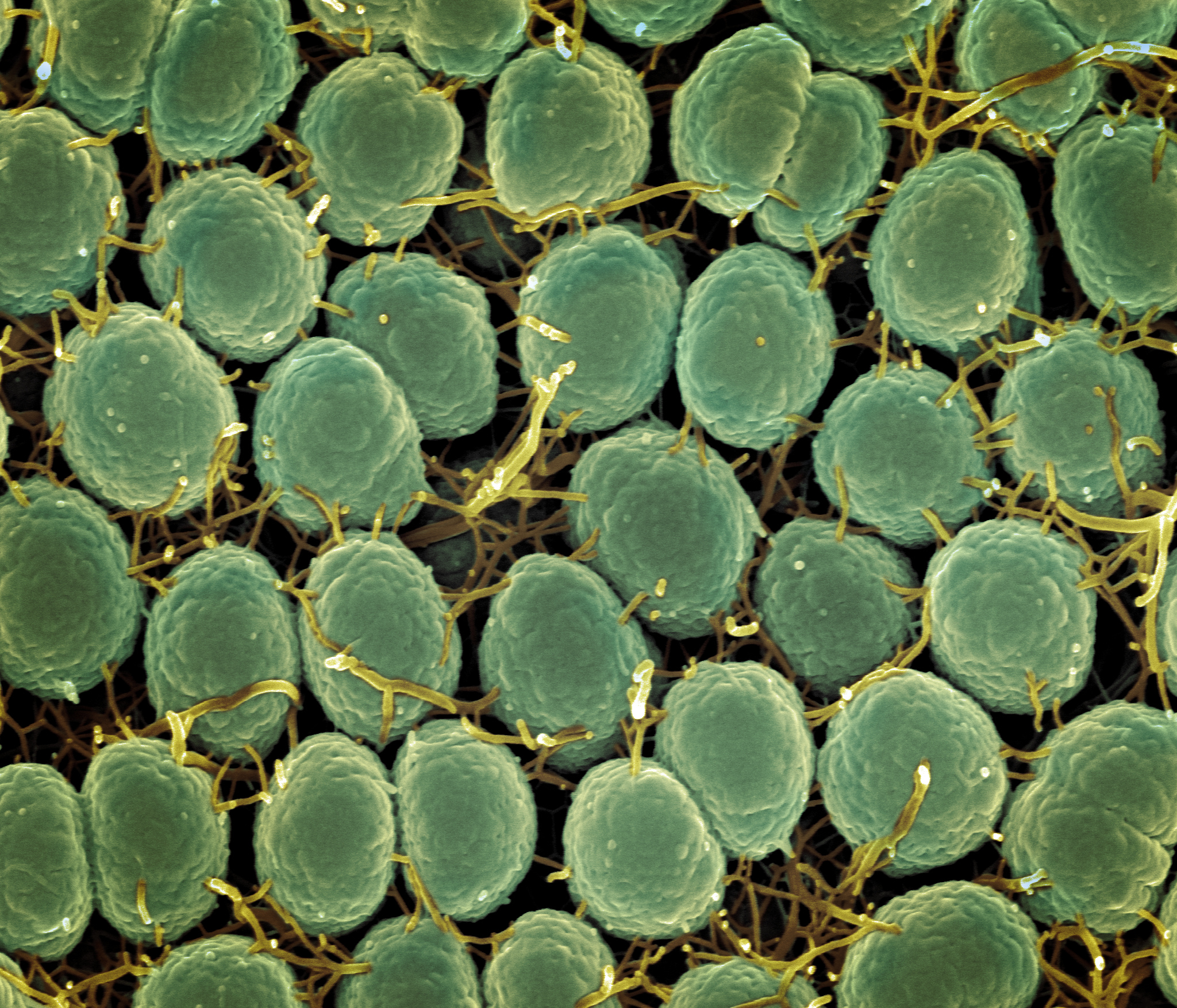
| Shape | Cocci |
| Mobility | No |
| Flagellar presence | Yes |
| Number of membranes | 2 |

Image source: Wikipedia/Wikimedia
| Ecology, Host, and Life Cycle | |
|---|---|
| Oxygen requirements | Aerobe |
| Optimal temperature | 35 |
| Temperature range | Mesophilic |
| Habitat | HostAssociated |
| Biotic relationship | Free living |
| Host(s) | Homo sapiens, Mammalia |
| Cell arrangement | Singles - Pairs |
| Sporulation | Not Available |
| Energy source | Not Available |
| Pathogenicity | Not Available |
Gene Summary
Adenine Count
509815 bp
Thymine Count
516233 bp
Guanine Count
565420 bp
Cytosine Count
563069 bp
Genome Length
2162646 bp
Protein-coding Genes
2231 genes
Non-Coding Genes
94 genes
# of Chromosomes/Plasmids
1
Genes
| Name | Locus Tag | UniProt ID | Strand Orientation | Gene Start/End | Protein Molecular Weight |
|---|---|---|---|---|---|
| aspartate carbamoyltransferase | EPH26_10430 | Not Available | Negative | 1800026 - 1800946 | 34137.8 |
| gnat family n-acetyltransferase | EPH26_10435 | Not Available | Positive | 1801181 - 1802023 | 31567.6 |
| hypothetical protein | EPH26_10440 | Not Available | Positive | 1802541 - 1802777 | 9205.94 |
| peptidase c39 | EPH26_10445 | Not Available | Positive | 1802825 - 1803415 | 22511.3 |
| hypothetical protein | EPH26_10450 | Not Available | Negative | 1803680 - 1804231 | 19501.4 |
| pilin | EPH26_10460 | Not Available | Positive | 1805108 - 1805245 | 4560.42 |
| histone deacetylase family protein | EPH26_10465 | Not Available | Negative | 1805311 - 1806429 | 41119.4 |
| preprotein translocase subunit yajc | EPH26_10470 | Not Available | Positive | 1806560 - 1806826 | 9681.13 |
| protein translocase subunit secd | EPH26_10475 | Not Available | Positive | 1807035 - 1808891 | 66851.2 |
| protein translocase subunit secf | EPH26_10480 | Not Available | Positive | 1808895 - 1809830 | 34403.7 |
Pathways
0 pathways
No pathways found
No metabolic pathways have been associated with this bacterium yet.
Health Effects
| Health Condition | Relation | Reference |
|---|---|---|
| Gonorrhea | Causes | PMC11658436 |
| Eye infections | Causes | PMC11658436 |
| Conjunctivitis | Causes | PMC11658436 |
| Septicemia | Causes | PMC11658436 |
| Male urethritis | Causes | PMC13191610 |
| Gonorrhea | Causes | PMC1538595 |
| Disseminated gonococcal infections | Causes | PMC1538595 |
| Gonorrhoea | Causes | PMC3943661 |
| Gonorrhea | Causes | PMC9657967 |
| Disseminated infections | Causes | PMC9657967 |