Kingdom
Pseudomonadati
Phylum
Pseudomonadota
Class
Betaproteobacteria
Order
Neisseriales
Family
Neisseriaceae
Genus
Neisseria
Description
Taxonomy
| Kingdom | Pseudomonadati |
|---|---|
| Phylum | Pseudomonadota |
| Class | Betaproteobacteria |
| Order | Neisseriales |
| Family | Neisseriaceae |
| Genus | Neisseria |
| Species | Neisseria gonorrhoeae |
| Strain | strain GC-184 |
Profile
| Physiology | |
|---|---|
| Gram staining properties | Negative |
| Shape | Cocci |
| Mobility | No |
| Flagellar presence | Yes |
| Number of membranes | 2 |

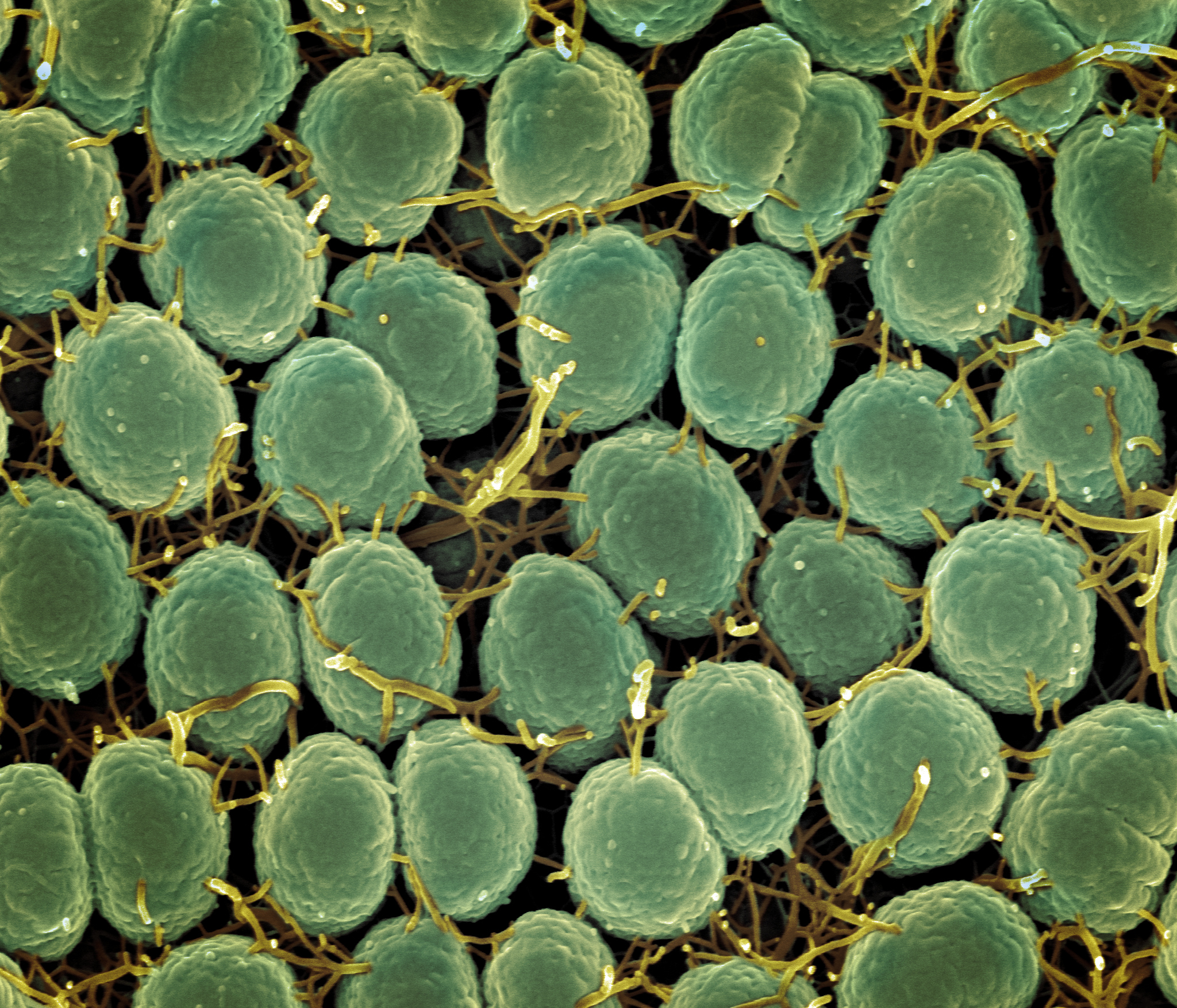
Image source: Wikipedia/Wikimedia
| Ecology, Host, and Life Cycle | |
|---|---|
| Oxygen requirements | Aerobe |
| Optimal temperature | 35 |
| Temperature range | Mesophilic |
| Habitat | HostAssociated |
| Biotic relationship | Free living |
| Host(s) | Homo sapiens, Mammalia |
| Cell arrangement | Singles - Pairs |
| Sporulation | Not Available |
| Energy source | Not Available |
| Pathogenicity | Not Available |
Gene Summary
Adenine Count
Not Available
Thymine Count
Not Available
Guanine Count
Not Available
Cytosine Count
Not Available
Genome Length
Not Available
Protein-coding Genes
2233 genes
Non-Coding Genes
95 genes
# of Chromosomes/Plasmids
1
Genes
| Name | Locus Tag | UniProt ID | Strand Orientation | Gene Start/End | Protein Molecular Weight |
|---|---|---|---|---|---|
| Is1016c2 transposase | EPH25_02830 | Not Available | Positive | 490509 - 490684 | 6707.17 |
| Hypothetical protein | EPH25_02835 | Not Available | Positive | 490739 - 490951 | 8379.05 |
| mucin | EPH25_02840 | Not Available | Positive | 490924 - 491046 | 4524.55 |
| Baseplate wedge subunit | EPH25_02845 | Not Available | Positive | 491057 - 491959 | 34221.0 |
| Putative phage tail protein | EPH25_02850 | Not Available | Positive | 492286 - 492774 | 17540.3 |
| Gp25, tail fiber | EPH25_02855 | Not Available | Positive | 492865 - 493428 | 21229.2 |
| hypothetical | EPH25_02860 | Not Available | Positive | 493468 - 493973 | 17533.8 |
| Tail fibers | EPH25_02865 | Not Available | Positive | 494202 - 495655 | 51353.1 |
| hypothetical protein | EPH25_02870 | Not Available | Negative | 495596 - 495787 | 6486.89 |
| hypothetical protein | EPH25_02875 | Not Available | Positive | 495767 - 496096 | 12198.3 |
Pathways
0 pathways
No pathways found
No metabolic pathways have been associated with this bacterium yet.
Health Effects
| Health Condition | Relation | Reference |
|---|---|---|
| Gonorrhea | Causes | PMC11658436 |
| Eye infections | Causes | PMC11658436 |
| Conjunctivitis | Causes | PMC11658436 |
| Septicemia | Causes | PMC11658436 |
| Male urethritis | Causes | PMC13191610 |
| Gonorrhea | Causes | PMC1538595 |
| Disseminated gonococcal infections | Causes | PMC1538595 |
| Gonorrhoea | Causes | PMC3943661 |
| Gonorrhea | Causes | PMC9657967 |
| Disseminated infections | Causes | PMC9657967 |