Kingdom
Pseudomonadati
Phylum
Pseudomonadota
Class
Betaproteobacteria
Order
Neisseriales
Family
Neisseriaceae
Genus
Neisseria
Description
Taxonomy
| Kingdom | Pseudomonadati |
|---|---|
| Phylum | Pseudomonadota |
| Class | Betaproteobacteria |
| Order | Neisseriales |
| Family | Neisseriaceae |
| Genus | Neisseria |
| Species | Neisseria gonorrhoeae |
| Strain | strain GC-184 |
Profile
| Physiology | |
|---|---|
| Gram staining properties | Negative |
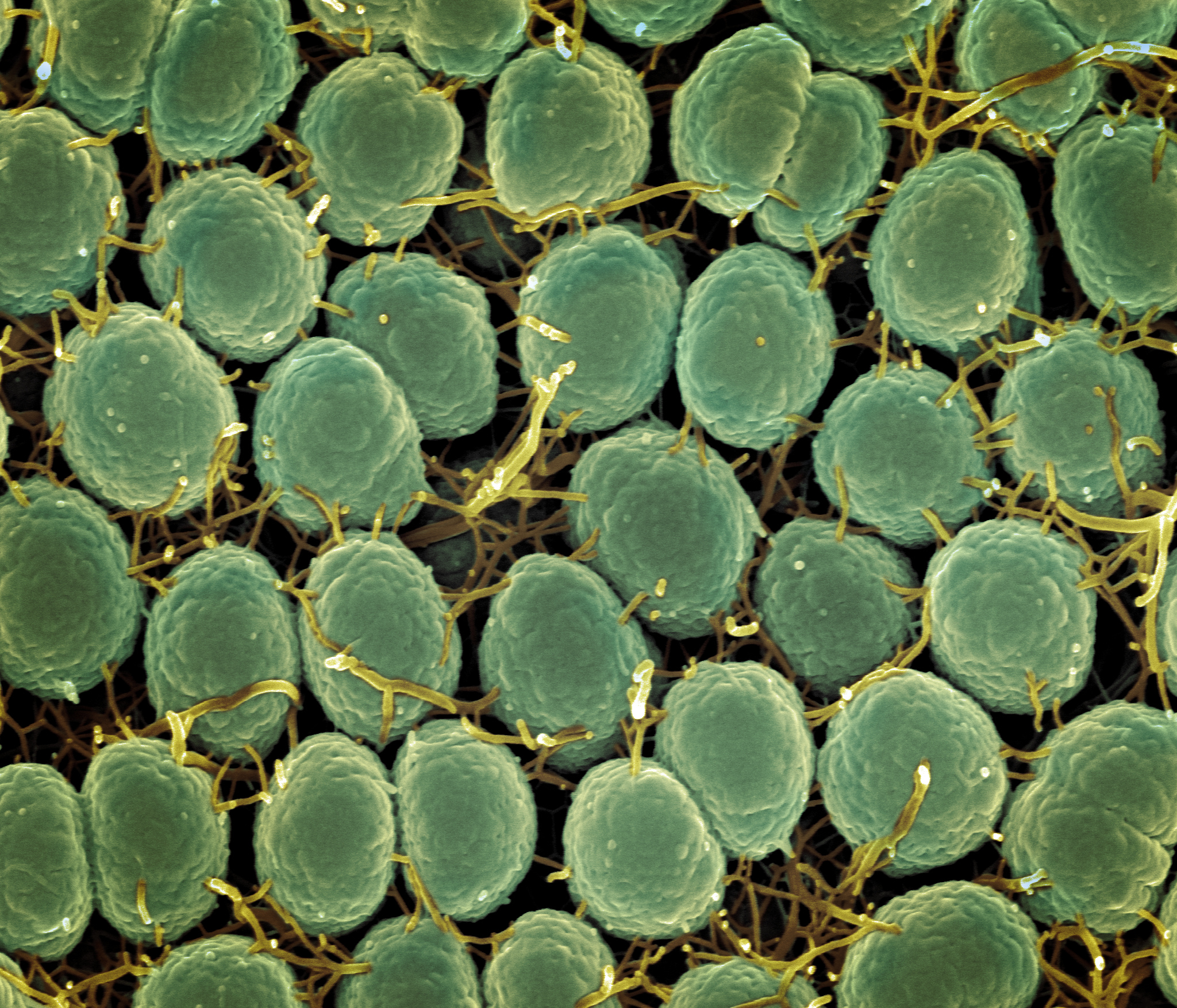
| Shape | Cocci |
| Mobility | No |
| Flagellar presence | Yes |
| Number of membranes | 2 |

Image source: Wikipedia/Wikimedia
| Ecology, Host, and Life Cycle | |
|---|---|
| Oxygen requirements | Aerobe |
| Optimal temperature | 35 |
| Temperature range | Mesophilic |
| Habitat | HostAssociated |
| Biotic relationship | Free living |
| Host(s) | Homo sapiens, Mammalia |
| Cell arrangement | Singles - Pairs |
| Sporulation | Not Available |
| Energy source | Not Available |
| Pathogenicity | Not Available |
Gene Summary
Adenine Count
Not Available
Thymine Count
Not Available
Guanine Count
Not Available
Cytosine Count
Not Available
Genome Length
Not Available
Protein-coding Genes
2233 genes
Non-Coding Genes
95 genes
# of Chromosomes/Plasmids
1
Genes
| Name | Locus Tag | UniProt ID | Strand Orientation | Gene Start/End | Protein Molecular Weight |
|---|---|---|---|---|---|
| cytochrome bc complex cytochrome b subunit | EPH25_03655 | Not Available | Negative | 639867 - 641216 | 50363.4 |
| ubiquinol-cytochrome c reductase iron-sulfur subunit | EPH25_03660 | Not Available | Negative | 641235 - 641816 | 20633.5 |
| nif3-like dinuclear metal center hexameric protein | EPH25_03665 | Not Available | Negative | 641939 - 642688 | 27442.6 |
| lysr family transcriptional regulator | EPH25_03670 | Not Available | Positive | 642817 - 643746 | 34815.3 |
| hypothetical protein | EPH25_03675 | Not Available | Positive | 643939 - 644433 | 18911.2 |
| hypothetical protein | EPH25_03680 | Not Available | Negative | 644629 - 644817 | 7247.87 |
| 30s ribosomal protein s9 | EPH25_03685 | Not Available | Negative | 644814 - 645206 | 14380.4 |
| 50s ribosomal protein l13 | EPH25_03690 | Not Available | Negative | 645219 - 645650 | 16238.7 |
| cell division protein zapa | EPH25_03700 | Not Available | Negative | 646013 - 646318 | 10951.3 |
| hypothetical protein | EPH25_03705 | Not Available | Negative | 646329 - 646658 | 12718.1 |
Pathways
0 pathways
No pathways found
No metabolic pathways have been associated with this bacterium yet.
Health Effects
| Health Condition | Relation | Reference |
|---|---|---|
| Gonorrhea | Causes | PMC11658436 |
| Eye infections | Causes | PMC11658436 |
| Conjunctivitis | Causes | PMC11658436 |
| Septicemia | Causes | PMC11658436 |
| Male urethritis | Causes | PMC13191610 |
| Gonorrhea | Causes | PMC1538595 |
| Disseminated gonococcal infections | Causes | PMC1538595 |
| Gonorrhoea | Causes | PMC3943661 |
| Gonorrhea | Causes | PMC9657967 |
| Disseminated infections | Causes | PMC9657967 |