Kingdom
Pseudomonadati
Phylum
Pseudomonadota
Class
Betaproteobacteria
Order
Neisseriales
Family
Neisseriaceae
Genus
Neisseria
Description
Taxonomy
| Kingdom | Pseudomonadati |
|---|---|
| Phylum | Pseudomonadota |
| Class | Betaproteobacteria |
| Order | Neisseriales |
| Family | Neisseriaceae |
| Genus | Neisseria |
| Species | Neisseria gonorrhoeae |
| Strain | strain GC-184 |
Profile
| Physiology | |
|---|---|
| Gram staining properties | Negative |
| Shape | Cocci |
| Mobility | No |
| Flagellar presence | Yes |
| Number of membranes | 2 |

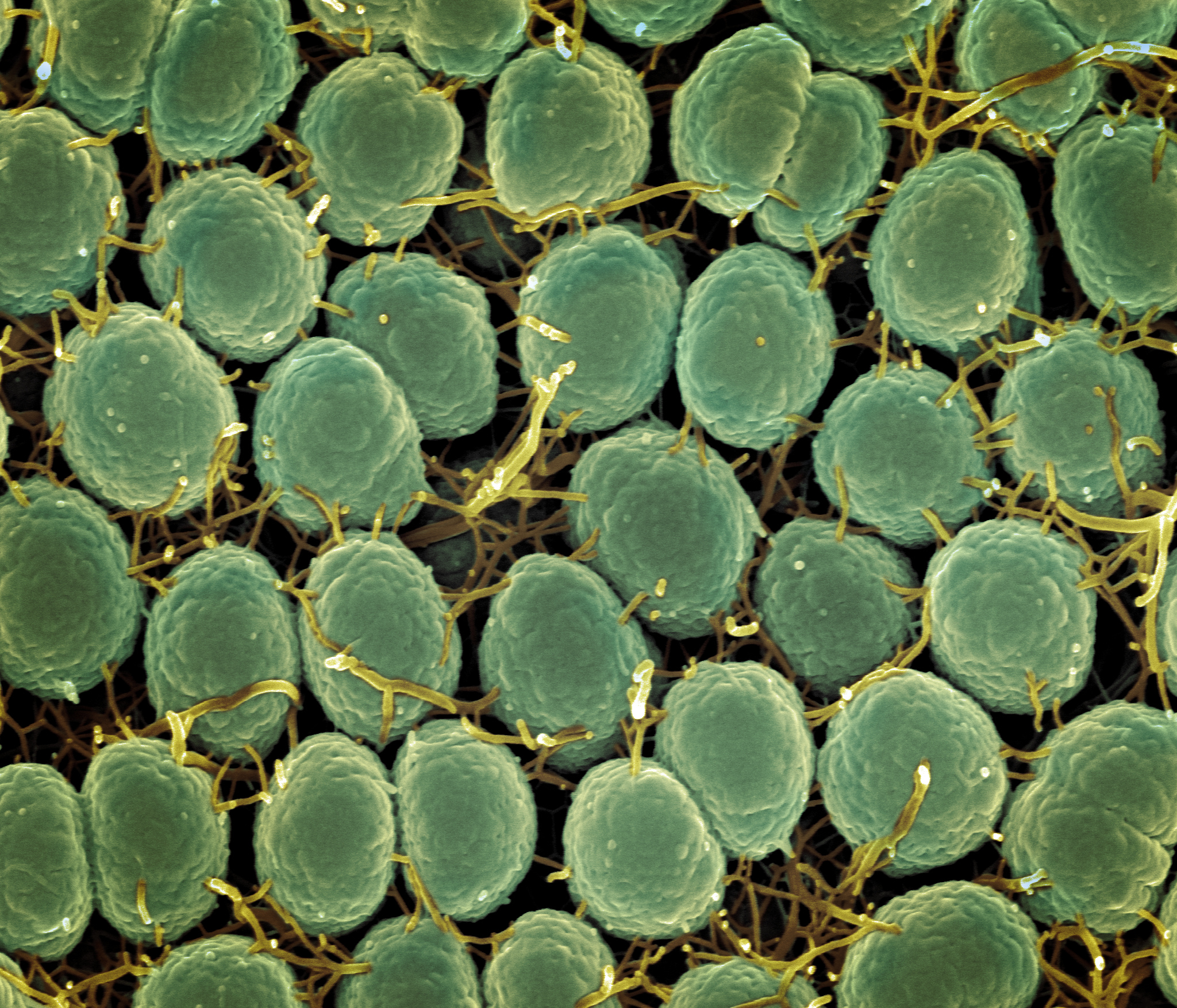
Image source: Wikipedia/Wikimedia
| Ecology, Host, and Life Cycle | |
|---|---|
| Oxygen requirements | Aerobe |
| Optimal temperature | 35 |
| Temperature range | Mesophilic |
| Habitat | HostAssociated |
| Biotic relationship | Free living |
| Host(s) | Homo sapiens, Mammalia |
| Cell arrangement | Singles - Pairs |
| Sporulation | Not Available |
| Energy source | Not Available |
| Pathogenicity | Not Available |
Gene Summary
Adenine Count
Not Available
Thymine Count
Not Available
Guanine Count
Not Available
Cytosine Count
Not Available
Genome Length
Not Available
Protein-coding Genes
2233 genes
Non-Coding Genes
95 genes
# of Chromosomes/Plasmids
1
Genes
| Name | Locus Tag | UniProt ID | Strand Orientation | Gene Start/End | Protein Molecular Weight |
|---|---|---|---|---|---|
| cytosine deaminase | EPH25_08165 | Not Available | Negative | 1410460 - 1411179 | 25919.4 |
| trna (adenosine(37)-n6)-dimethylallyltransferase miaa | EPH25_08170 | Not Available | Negative | 1411183 - 1412124 | 34856.1 |
| hypothetical protein | EPH25_08175 | Not Available | Positive | 1412126 - 1412437 | 11696.3 |
| hypothetical protein | EPH25_08180 | Not Available | Positive | 1412445 - 1412753 | 11781.9 |
| elongation factor p maturation arginine rhamnosyltransferase earp | EPH25_08185 | Not Available | Positive | 1412772 - 1413923 | 44186.4 |
| elongation factor p | EPH25_08190 | Not Available | Positive | 1413966 - 1414526 | 20866.9 |
| hypothetical protein | EPH25_08195 | Not Available | Negative | 1415313 - 1415504 | 6456.51 |
| methionine biosynthesis protein metw | EPH25_08200 | Not Available | Negative | 1415621 - 1416202 | 21845.4 |
| homoserine o-acetyltransferase | EPH25_08205 | Not Available | Negative | 1416199 - 1417338 | 42176.9 |
| hypothetical protein | EPH25_08210 | Not Available | Negative | 1417286 - 1417726 | 16064.0 |
Pathways
0 pathways
No pathways found
No metabolic pathways have been associated with this bacterium yet.
Health Effects
| Health Condition | Relation | Reference |
|---|---|---|
| Gonorrhea | Causes | PMC11658436 |
| Eye infections | Causes | PMC11658436 |
| Conjunctivitis | Causes | PMC11658436 |
| Septicemia | Causes | PMC11658436 |
| Male urethritis | Causes | PMC13191610 |
| Gonorrhea | Causes | PMC1538595 |
| Disseminated gonococcal infections | Causes | PMC1538595 |
| Gonorrhoea | Causes | PMC3943661 |
| Gonorrhea | Causes | PMC9657967 |
| Disseminated infections | Causes | PMC9657967 |