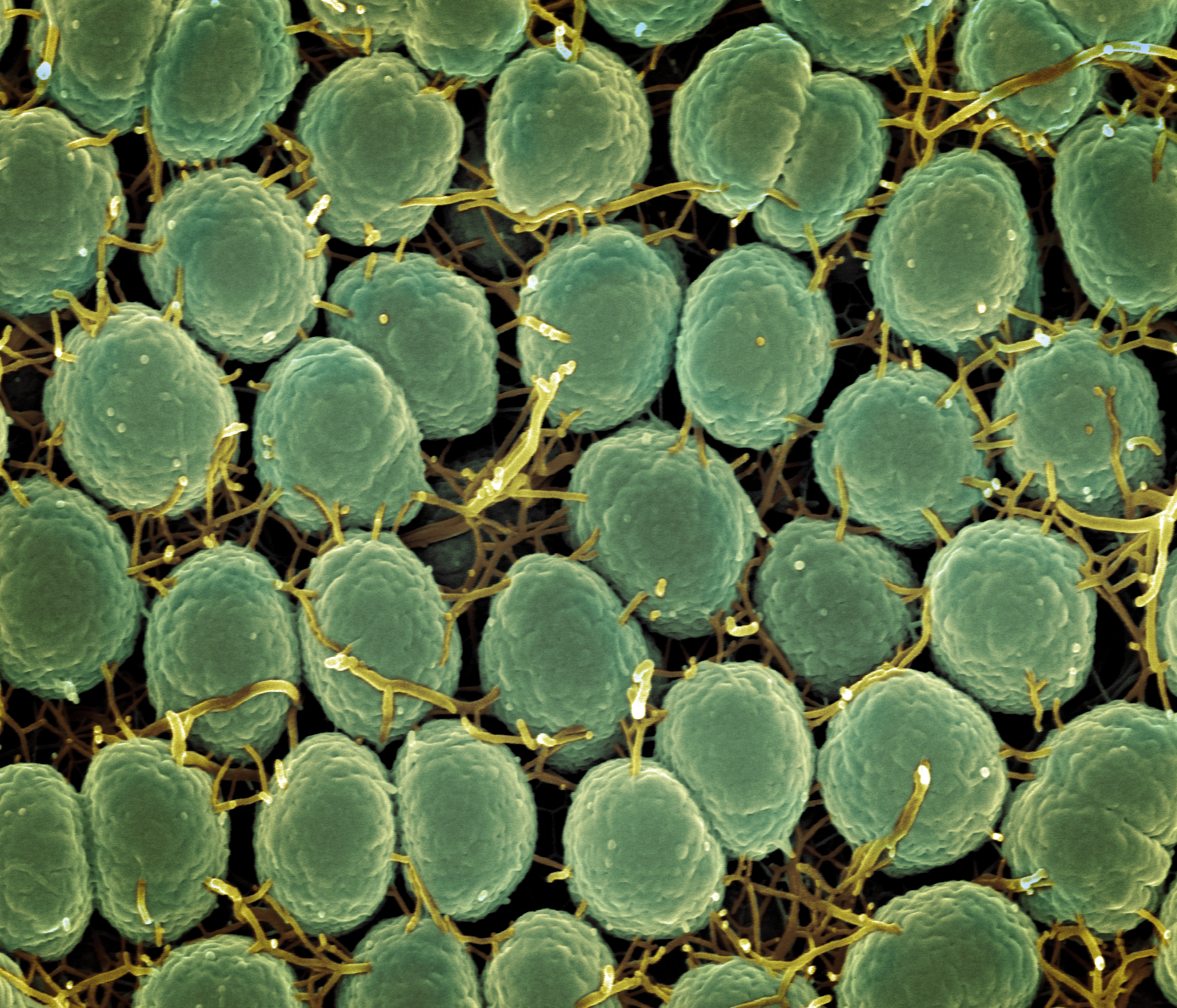
Kingdom
Pseudomonadati
Phylum
Pseudomonadota
Class
Betaproteobacteria
Order
Neisseriales
Family
Neisseriaceae
Genus
Neisseria
Description
Taxonomy
| Kingdom | Pseudomonadati |
|---|---|
| Phylum | Pseudomonadota |
| Class | Betaproteobacteria |
| Order | Neisseriales |
| Family | Neisseriaceae |
| Genus | Neisseria |
| Species | Neisseria gonorrhoeae |
| Strain | strain gc-178 |
Profile
| Physiology | |
|---|---|
| Gram staining properties | Negative |
| Shape | Cocci |
| Mobility | No |
| Flagellar presence | Yes |
| Number of membranes | 2 |

Image source: Wikipedia/Wikimedia
| Ecology, Host, and Life Cycle | |
|---|---|
| Oxygen requirements | Aerobe |
| Optimal temperature | 35 |
| Temperature range | Mesophilic |
| Habitat | HostAssociated |
| Biotic relationship | Free living |
| Host(s) | Homo sapiens, Mammalia |
| Cell arrangement | Singles - Pairs |
| Sporulation | Not Available |
| Energy source | Not Available |
| Pathogenicity | Not Available |
Gene Summary
Adenine Count
495491 bp
Thymine Count
496289 bp
Guanine Count
547736 bp
Cytosine Count
553630 bp
Genome Length
2101096 bp
Protein-coding Genes
2159 genes
Non-Coding Genes
95 genes
# of Chromosomes/Plasmids
1
Genes
| Name | Locus Tag | UniProt ID | Strand Orientation | Gene Start/End | Protein Molecular Weight |
|---|---|---|---|---|---|
| Hypothetical protein | EPH20_08470 | Not Available | Positive | 1464435 - 1464920 | 17728.3 |
| Structural protein | EPH20_08475 | Not Available | Positive | 1464917 - 1465591 | 24948.2 |
| hypothetical | EPH20_08480 | Not Available | Positive | 1465594 - 1465793 | 7742.11 |
| Putative antirepressor protein ant | EPH20_08485 | Not Available | Negative | 1465780 - 1466625 | 31074.3 |
| Hypothetical protein | EPH20_09000 | Not Available | Positive | 1549410 - 1549643 | 8719.84 |
| hypothetical protein | EPH20_09005 | Not Available | Positive | 1549687 - 1550094 | 15587.5 |
| Hypothetical protein | EPH20_09010 | Not Available | Positive | 1550185 - 1551345 | 43926.9 |
| Putative antirepressor protein ant | EPH20_09015 | Not Available | Positive | 1551626 - 1552495 | 31477.8 |
| Terminase small subunit | EPH20_09020 | Not Available | Positive | 1552788 - 1553237 | 16845.0 |
| Hypothetical protein | EPH20_09025 | Not Available | Positive | 1553299 - 1554720 | 52465.1 |
Pathways
1087 pathways
Health Effects
| Health Condition | Relation | Reference |
|---|---|---|
| Gonorrhea | Causes | PMC11658436 |
| Eye infections | Causes | PMC11658436 |
| Conjunctivitis | Causes | PMC11658436 |
| Septicemia | Causes | PMC11658436 |
| Male urethritis | Causes | PMC13191610 |
| Gonorrhea | Causes | PMC1538595 |
| Disseminated gonococcal infections | Causes | PMC1538595 |
| Gonorrhoea | Causes | PMC3943661 |
| Gonorrhea | Causes | PMC9657967 |
| Disseminated infections | Causes | PMC9657967 |