Kingdom
Pseudomonadati
Phylum
Pseudomonadota
Class
Betaproteobacteria
Order
Neisseriales
Family
Neisseriaceae
Genus
Neisseria
Description
Taxonomy
| Kingdom | Pseudomonadati |
|---|---|
| Phylum | Pseudomonadota |
| Class | Betaproteobacteria |
| Order | Neisseriales |
| Family | Neisseriaceae |
| Genus | Neisseria |
| Species | Neisseria gonorrhoeae |
| Strain | strain gc-167 |
Profile
| Physiology | |
|---|---|
| Gram staining properties | Negative |
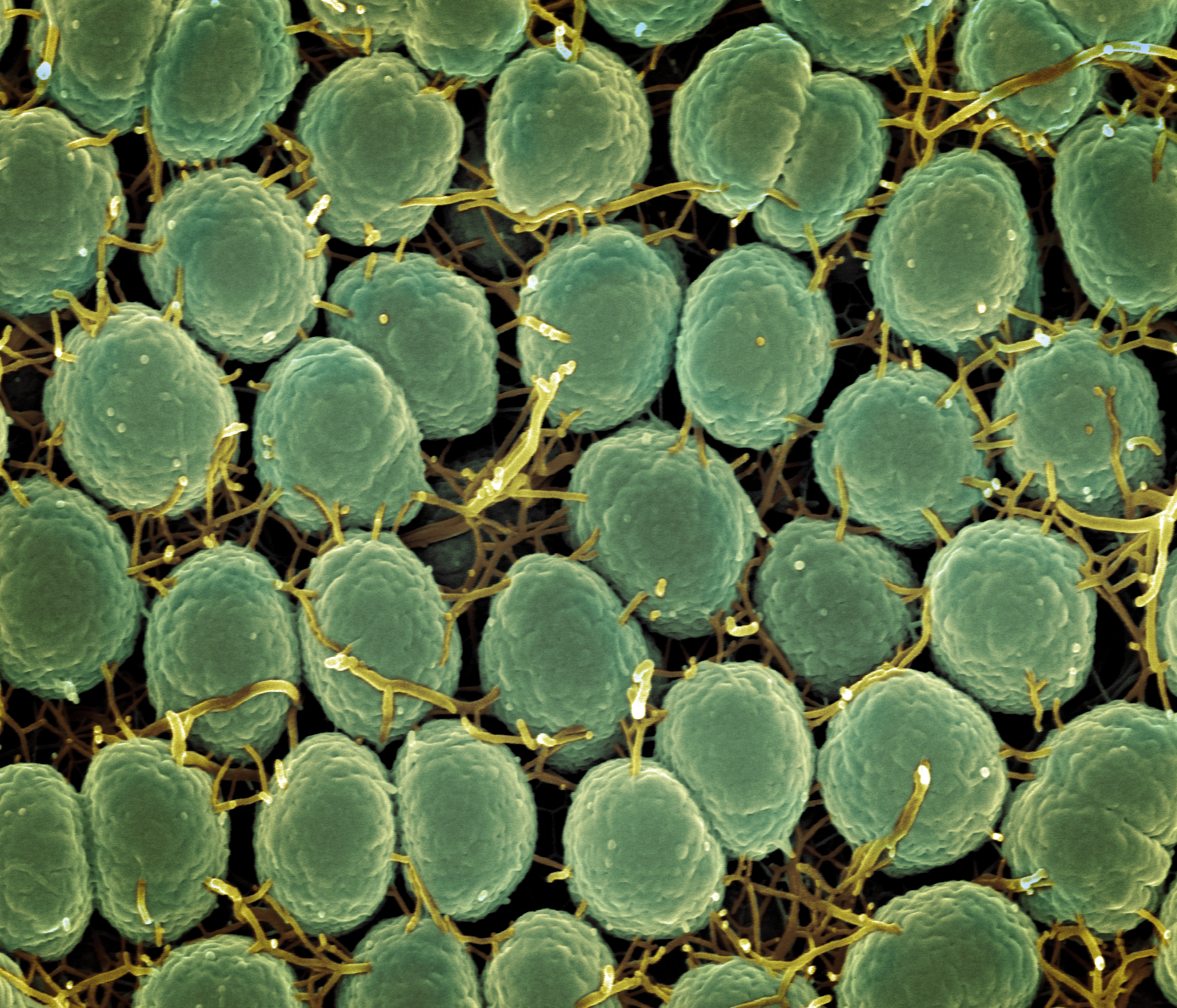
| Shape | Cocci |
| Mobility | No |
| Flagellar presence | Yes |
| Number of membranes | 2 |

Image source: Wikipedia/Wikimedia
| Ecology, Host, and Life Cycle | |
|---|---|
| Oxygen requirements | Aerobe |
| Optimal temperature | 35 |
| Temperature range | Mesophilic |
| Habitat | HostAssociated |
| Biotic relationship | Free living |
| Host(s) | Homo sapiens, Mammalia |
| Cell arrangement | Singles - Pairs |
| Sporulation | Not Available |
| Energy source | Not Available |
| Pathogenicity | Not Available |
Gene Summary
Adenine Count
495691 bp
Thymine Count
499966 bp
Guanine Count
553873 bp
Cytosine Count
551785 bp
Genome Length
2109106 bp
Protein-coding Genes
2176 genes
Non-Coding Genes
82 genes
# of Chromosomes/Plasmids
1
Genes
| Name | Locus Tag | UniProt ID | Strand Orientation | Gene Start/End | Protein Molecular Weight |
|---|---|---|---|---|---|
| Is1016c2 transposase | EPH10_08060 | Not Available | Positive | 1401728 - 1401842 | 4357.38 |
| Hypothetical protein | EPH10_08065 | Not Available | Positive | 1401897 - 1402109 | 8379.05 |
| mucin | EPH10_08070 | Not Available | Positive | 1402082 - 1402204 | 4582.58 |
| Baseplate assembly protein | EPH10_08075 | Not Available | Positive | 1402215 - 1402808 | 21592.2 |
| Baseplate wedge subunit | EPH10_08080 | Not Available | Positive | 1402805 - 1403131 | 11868.4 |
| Putative phage tail protein | EPH10_08085 | Not Available | Positive | 1403152 - 1404207 | 39225.4 |
| Gp25, tail fiber | EPH10_08090 | Not Available | Positive | 1404038 - 1404586 | 20685.6 |
| hypothetical | EPH10_08095 | Not Available | Positive | 1404626 - 1405131 | 17553.9 |
| Tail fibers | EPH10_08100 | Not Available | Positive | 1405360 - 1406813 | 51363.1 |
| hypothetical protein | EPH10_08105 | Not Available | Negative | 1406754 - 1406945 | 6486.89 |
Pathways
1087 pathways
Health Effects
| Health Condition | Relation | Reference |
|---|---|---|
| Gonorrhoea | Causes | PMC3960869 |
| Gonorrhea | Causes | PMC7744932 |
| Neonatal conjunctivitis | Causes | PMC7744932 |
| Gonorrhoea | Causes | PMC8760755 |