Kingdom
Pseudomonadati
Phylum
Pseudomonadota
Class
Gammaproteobacteria
Order
Enterobacterales
Family
Enterobacteriaceae
Genus
Shigella
Description
Taxonomy
| Kingdom | Pseudomonadati |
|---|---|
| Phylum | Pseudomonadota |
| Class | Gammaproteobacteria |
| Order | Enterobacterales |
| Family | Enterobacteriaceae |
| Genus | Shigella |
| Species | Shigella dysenteriae |
| Strain | strain 561031 |
Profile
| Physiology | |
|---|---|
| Gram staining properties | Negative |
| Shape | Rod |
| Mobility | No |
| Flagellar presence | Yes |
| Number of membranes | 2 |

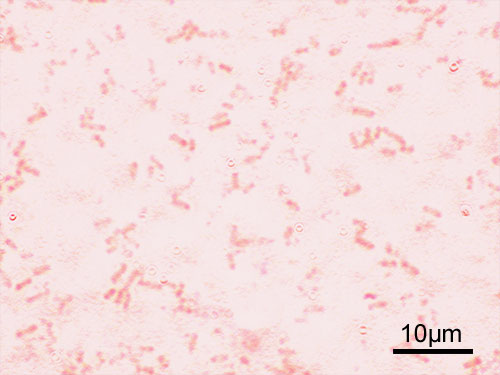
Image source: Wikipedia/Wikimedia
| Ecology, Host, and Life Cycle | |
|---|---|
| Oxygen requirements | Facultative anaerobe |
| Optimal temperature | 37 |
| Temperature range | Mesophilic |
| Habitat | HostAssociated |
| Biotic relationship | Free living |
| Host(s) | Homo sapiens, Metazoa, Primates |
| Cell arrangement | Pairs - Singles |
| Sporulation | Not Available |
| Energy source | Chemoorganotroph |
| Pathogenicity | Not Available |
Gene Summary
Adenine Count
1235726 bp
Thymine Count
1219989 bp
Guanine Count
1230748 bp
Cytosine Count
1255519 bp
Genome Length
4954914 bp
Protein-coding Genes
4468 genes
Non-Coding Genes
382 genes
# of Chromosomes/Plasmids
1
Genes
| Name | Locus Tag | UniProt ID | Strand Orientation | Gene Start/End | Protein Molecular Weight |
|---|---|---|---|---|---|
| Trna-val | Not Available | Not Available | Positive | 3099943 - 3100019 | Not Available |
| Trna-val | Not Available | Not Available | Positive | 3100024 - 3100100 | Not Available |
| hypothetical protein | DRW31_16135 | Not Available | Positive | 3100408 - 3101664 | 42794.6 |
| multidrug resistance protein mdtk | DRW31_16140 | Not Available | Negative | 3101705 - 3103078 | 49450.2 |
| riboflavin synthase | DRW31_16145 | Not Available | Positive | 3103293 - 3103934 | 23446.3 |
| cyclopropane-fatty-acyl-phospholipid synthase | DRW31_16150 | Not Available | Negative | 3103974 - 3105122 | 43911.3 |
| bcr/cfla family multidrug efflux mfs transporter | DRW31_16155 | Not Available | Negative | 3105413 - 3106624 | 43426.9 |
| lysr family transcriptional regulator | DRW31_16160 | Not Available | Positive | 3106737 - 3107669 | 35251.9 |
| hth-type transcriptional repressor purr | DRW31_16165 | Not Available | Negative | 3107666 - 3108691 | 38191.1 |
| hypothetical protein | DRW31_16170 | Not Available | Negative | 3108679 - 3108903 | 8699.68 |
Pathways
0 pathways
No pathways found
No metabolic pathways have been associated with this bacterium yet.
Health Effects
| Health Condition | Relation | Reference |
|---|---|---|
| Shigellosis | Causes | PMC5177732 |
| Hus | Causes | PMC7320338 |
| Shigellosis | Causes | PMC8742002 |
| Bacillary dysentery | Causes | PMC8742002 |
| Bacillary dysentery | Causes | PMC11098424 |
| Bacillary dysentery | Causes | PMC11143797 |
| Shigellosis | Causes | PMC11143797 |
| Epidemic shigella dysentery | Causes | PMC4445032 |