Kingdom
Pseudomonadati
Phylum
Pseudomonadota
Class
Gammaproteobacteria
Order
Enterobacterales
Family
Enterobacteriaceae
Genus
Shigella
Description
Taxonomy
| Kingdom | Pseudomonadati |
|---|---|
| Phylum | Pseudomonadota |
| Class | Gammaproteobacteria |
| Order | Enterobacterales |
| Family | Enterobacteriaceae |
| Genus | Shigella |
| Species | Shigella dysenteriae |
| Strain | strain 561031 |
Profile
| Physiology | |
|---|---|
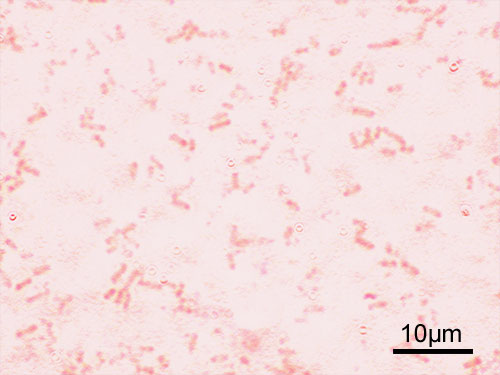
| Gram staining properties | Negative |
| Shape | Rod |
| Mobility | No |
| Flagellar presence | Yes |
| Number of membranes | 2 |

Image source: Wikipedia/Wikimedia
| Ecology, Host, and Life Cycle | |
|---|---|
| Oxygen requirements | Facultative anaerobe |
| Optimal temperature | 37 |
| Temperature range | Mesophilic |
| Habitat | HostAssociated |
| Biotic relationship | Free living |
| Host(s) | Homo sapiens, Metazoa, Primates |
| Cell arrangement | Pairs - Singles |
| Sporulation | Not Available |
| Energy source | Chemoorganotroph |
| Pathogenicity | Not Available |
Gene Summary
Adenine Count
1235726 bp
Thymine Count
1219989 bp
Guanine Count
1230748 bp
Cytosine Count
1255519 bp
Genome Length
4954914 bp
Protein-coding Genes
4468 genes
Non-Coding Genes
382 genes
# of Chromosomes/Plasmids
1
Genes
| Name | Locus Tag | UniProt ID | Strand Orientation | Gene Start/End | Protein Molecular Weight |
|---|---|---|---|---|---|
| pyrimidine utilization protein d | DRW31_13805 | Not Available | Positive | 2641738 - 2642538 | 28930.8 |
| malonic semialdehyde reductase | DRW31_13810 | Not Available | Positive | 2642548 - 2643138 | 21662.7 |
| dna polymerase iii subunit theta | DRW31_13965 | Not Available | Positive | 2667751 - 2667981 | 8846.79 |
| carbon-nitrogen hydrolase family protein | DRW31_13970 | Not Available | Positive | 2668083 - 2668739 | 24391.4 |
| dna polymerase iii subunit epsilon | DRW31_13975 | Not Available | Positive | 2668763 - 2669425 | 25134.5 |
| oligopeptidase b | DRW31_13980 | Not Available | Negative | 2669422 - 2671482 | 79458.7 |
| hypothetical protein | DRW31_13985 | Not Available | Negative | 2671484 - 2671666 | 6761.16 |
| tellurite resistance terb family protein | DRW31_13990 | Not Available | Negative | 2671691 - 2672350 | 23832.4 |
| protein yebf | DRW31_13995 | Not Available | Negative | 2672674 - 2673030 | 12832.3 |
| damage-inducible protein yebg | DRW31_14000 | Not Available | Negative | 2673097 - 2673387 | 10749.6 |
Pathways
0 pathways
No pathways found
No metabolic pathways have been associated with this bacterium yet.
Health Effects
| Health Condition | Relation | Reference |
|---|---|---|
| Shigellosis | Causes | PMC5177732 |
| Hus | Causes | PMC7320338 |
| Shigellosis | Causes | PMC8742002 |
| Bacillary dysentery | Causes | PMC8742002 |
| Bacillary dysentery | Causes | PMC11098424 |
| Bacillary dysentery | Causes | PMC11143797 |
| Shigellosis | Causes | PMC11143797 |
| Epidemic shigella dysentery | Causes | PMC4445032 |