Kingdom
Pseudomonadati
Phylum
Pseudomonadota
Class
Gammaproteobacteria
Order
Enterobacterales
Family
Enterobacteriaceae
Genus
Shigella
Description
Taxonomy
| Kingdom | Pseudomonadati |
|---|---|
| Phylum | Pseudomonadota |
| Class | Gammaproteobacteria |
| Order | Enterobacterales |
| Family | Enterobacteriaceae |
| Genus | Shigella |
| Species | Shigella dysenteriae |
| Strain | strain 561031 |
Profile
| Physiology | |
|---|---|
| Gram staining properties | Negative |
| Shape | Rod |
| Mobility | No |
| Flagellar presence | Yes |
| Number of membranes | 2 |

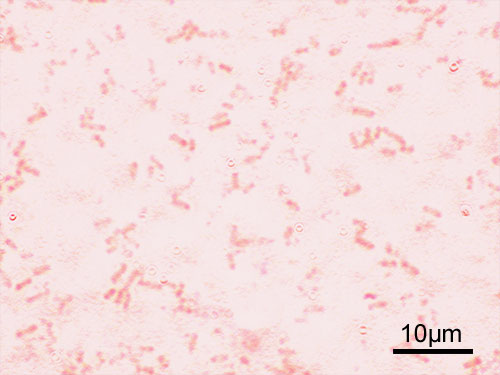
Image source: Wikipedia/Wikimedia
| Ecology, Host, and Life Cycle | |
|---|---|
| Oxygen requirements | Facultative anaerobe |
| Optimal temperature | 37 |
| Temperature range | Mesophilic |
| Habitat | HostAssociated |
| Biotic relationship | Free living |
| Host(s) | Homo sapiens, Metazoa, Primates |
| Cell arrangement | Pairs - Singles |
| Sporulation | Not Available |
| Energy source | Chemoorganotroph |
| Pathogenicity | Not Available |
Gene Summary
Adenine Count
1235726 bp
Thymine Count
1219989 bp
Guanine Count
1230748 bp
Cytosine Count
1255519 bp
Genome Length
4954914 bp
Protein-coding Genes
4468 genes
Non-Coding Genes
382 genes
# of Chromosomes/Plasmids
1
Genes
| Name | Locus Tag | UniProt ID | Strand Orientation | Gene Start/End | Protein Molecular Weight |
|---|---|---|---|---|---|
| 4-hydroxy-2-oxo-heptane-1,7-dioate aldolase | DRW31_11490 | Not Available | Negative | 2191157 - 2191945 | 28072.8 |
| 2-oxo-hepta-3-ene-1,7-dioic acid hydratase | DRW31_11495 | Not Available | Negative | 2191956 - 2192759 | 29658.5 |
| 5-carboxymethyl-2-hydroxymuconate delta-isomerase | DRW31_11500 | Not Available | Negative | 2192827 - 2193207 | 14361.3 |
| 3,4-dihydroxyphenylacetate 2,3-dioxygenase | DRW31_11505 | Not Available | Negative | 2193217 - 2194068 | 32006.2 |
| 4-hydroxyphenylacetate degradation bifunctional isomerase/decarboxylase | DRW31_11515 | Not Available | Negative | 2195533 - 2196828 | 47401.4 |
| homoprotocatechuate degradation operon regulator hpar | DRW31_11520 | Not Available | Positive | 2197040 - 2197540 | 19526.7 |
| had family hydrolase | DRW31_11525 | Not Available | Positive | 2197567 - 2198030 | 16998.6 |
| duf1479 domain-containing protein | DRW31_11530 | Not Available | Positive | 2198182 - 2199447 | 47312.9 |
| abc-f family atpase | DRW31_11535 | Not Available | Negative | 2199688 - 2201280 | 59861.4 |
| transpeptidase | DRW31_11540 | Not Available | Positive | 2201499 - 2202419 | 33327.2 |
Pathways
0 pathways
No pathways found
No metabolic pathways have been associated with this bacterium yet.
Health Effects
| Health Condition | Relation | Reference |
|---|---|---|
| Shigellosis | Causes | PMC5177732 |
| Hus | Causes | PMC7320338 |
| Shigellosis | Causes | PMC8742002 |
| Bacillary dysentery | Causes | PMC8742002 |
| Bacillary dysentery | Causes | PMC11098424 |
| Bacillary dysentery | Causes | PMC11143797 |
| Shigellosis | Causes | PMC11143797 |
| Epidemic shigella dysentery | Causes | PMC4445032 |