Kingdom
Pseudomonadati
Phylum
Pseudomonadota
Class
Gammaproteobacteria
Order
Enterobacterales
Family
Enterobacteriaceae
Genus
Escherichia
Description
Taxonomy
| Kingdom | Pseudomonadati |
|---|---|
| Phylum | Pseudomonadota |
| Class | Gammaproteobacteria |
| Order | Enterobacterales |
| Family | Enterobacteriaceae |
| Genus | Escherichia |
| Species | Escherichia coli |
| Strain | strain FWSEC0087 |
Profile
| Physiology | |
|---|---|
| Gram staining properties | Negative |
| Shape | Rod |
| Mobility | Yes |
| Flagellar presence | Yes |
| Number of membranes | 2 |

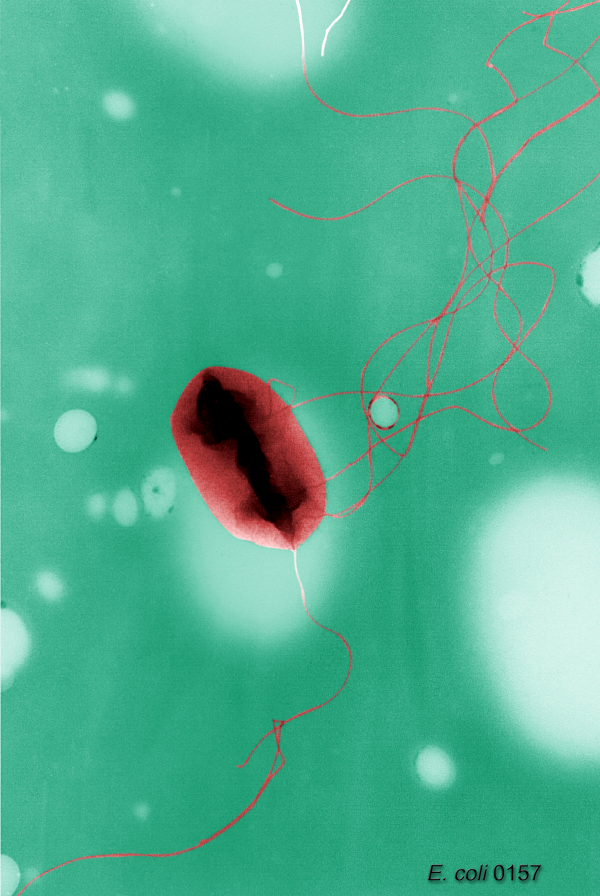
Image source: Wikipedia/Wikimedia
| Ecology, Host, and Life Cycle | |
|---|---|
| Oxygen requirements | Facultative anaerobe |
| Optimal temperature | 37 |
| Temperature range | Mesophilic |
| Habitat | HostAssociated |
| Biotic relationship | Free living |
| Host(s) | Homo sapiens, Gallus gallus, Bos taurus |
| Cell arrangement | Pairs - Singles |
| Sporulation | Not Available |
| Energy source | Not Available |
| Pathogenicity | Human |
Gene Summary
Adenine Count
1364238 bp
Thymine Count
1366477 bp
Guanine Count
1376973 bp
Cytosine Count
1362009 bp
Genome Length
5487031 bp
Protein-coding Genes
5143 genes
Non-Coding Genes
265 genes
# of Chromosomes/Plasmids
1
Genes
| Name | Locus Tag | UniProt ID | Strand Orientation | Gene Start/End | Protein Molecular Weight |
|---|---|---|---|---|---|
| hypothetical protein | C9Z37_27445 | Not Available | Negative | 5358561 - 5358896 | 12468.8 |
| pilus assembly protein pili | C9Z37_27450 | Not Available | Negative | 5359012 - 5359254 | 9157.18 |
| flotillin family protein | C9Z37_27455 | Not Available | Negative | 5359335 - 5361029 | 61838.4 |
| duf1449 family protein | C9Z37_27460 | Not Available | Negative | 5361056 - 5361676 | 22314.8 |
| conjugal transfer protein trac | C9Z37_27465 | Not Available | Negative | 5361830 - 5361979 | 5730.87 |
| trac | C9Z37_27470 | Not Available | Negative | 5361943 - 5362608 | 24860.7 |
| transcription termination factor nusg | C9Z37_27475 | Not Available | Negative | 5362749 - 5363390 | 24629.8 |
| hypothetical protein | C9Z37_27480 | Not Available | Positive | 5363660 - 5363908 | 9553.93 |
| positive regulator for repz translation | C9Z37_27485 | Not Available | Positive | 5364016 - 5364105 | 3329.98 |
| incfii family plasmid replication initiator repa | C9Z37_27490 | Not Available | Positive | 5364102 - 5364965 | 32898.7 |
Pathways
0 pathways
No pathways found
No metabolic pathways have been associated with this bacterium yet.
Health Effects
| Health Condition | Relation | Reference |
|---|---|---|
| Gi disease | Causes | PMC11149725 |
| Utis | Causes | PMC11434687 |
| Colorectal cancer | Causes | PMC12198655 |
| Pyogenic liver abscesses | Causes | PMC12392612 |
| Uti | Causes | PMC13014981 |
| Colibacillosis | Causes | PMC13255289 |
| Enteric infections | Causes | PMC13255289 |
| Foodborne infections | Causes | PMC13255289 |
| Clinical mastitis | Causes | PMC13293316 |
| Diarrhea | Causes | PMC3035056 |