Kingdom
Pseudomonadati
Phylum
Pseudomonadota
Class
Gammaproteobacteria
Order
Enterobacterales
Family
Enterobacteriaceae
Genus
Escherichia
Description
Taxonomy
| Kingdom | Pseudomonadati |
|---|---|
| Phylum | Pseudomonadota |
| Class | Gammaproteobacteria |
| Order | Enterobacterales |
| Family | Enterobacteriaceae |
| Genus | Escherichia |
| Species | Escherichia coli |
| Strain | strain FWSEC0030 |
Profile
| Physiology | |
|---|---|
| Gram staining properties | Negative |
| Shape | Rod |
| Mobility | Yes |
| Flagellar presence | Yes |
| Number of membranes | 2 |

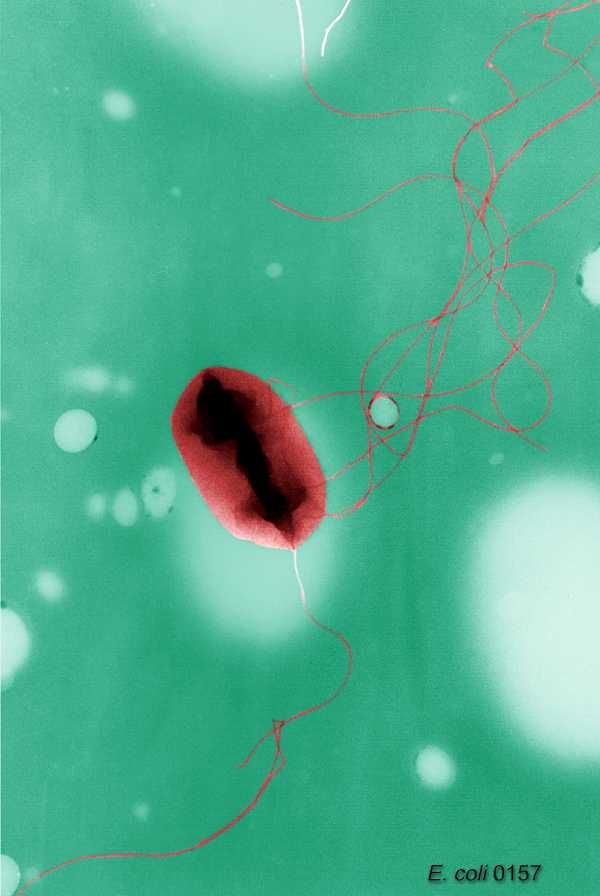
Image source: Wikipedia/Wikimedia
| Ecology, Host, and Life Cycle | |
|---|---|
| Oxygen requirements | Facultative anaerobe |
| Optimal temperature | 37 |
| Temperature range | Mesophilic |
| Habitat | HostAssociated |
| Biotic relationship | Free living |
| Host(s) | Homo sapiens, Gallus gallus, Bos taurus |
| Cell arrangement | Pairs - Singles |
| Sporulation | Not Available |
| Energy source | Not Available |
| Pathogenicity | Human |
Gene Summary
Adenine Count
1265833 bp
Thymine Count
1277245 bp
Guanine Count
1306867 bp
Cytosine Count
1287070 bp
Genome Length
5149765 bp
Protein-coding Genes
4734 genes
Non-Coding Genes
371 genes
# of Chromosomes/Plasmids
1
Genes
| Name | Locus Tag | UniProt ID | Strand Orientation | Gene Start/End | Protein Molecular Weight |
|---|---|---|---|---|---|
| flagellar type iii secretion system protein flir | C9Y83_14725 | Not Available | Negative | 2980298 - 2981083 | 28539.4 |
| flagellar biosynthetic protein fliq | C9Y83_14730 | Not Available | Negative | 2981092 - 2981361 | 9632.54 |
| flagellar biosynthetic protein flip | C9Y83_14735 | Not Available | Negative | 2981371 - 2982108 | 26930.1 |
| flagellar type iii secretion system protein flio | C9Y83_14740 | Not Available | Negative | 2982108 - 2982473 | 12694.7 |
| flagellar motor switch protein flin | C9Y83_14745 | Not Available | Negative | 2982476 - 2982889 | 14811.7 |
| flagellar motor switch protein flim | C9Y83_14750 | Not Available | Negative | 2982886 - 2983890 | 37865.5 |
| flagellar basal body-associated protein flil | C9Y83_14755 | Not Available | Negative | 2983895 - 2984359 | 17207.8 |
| flagellar hook length control protein flik | C9Y83_14760 | Not Available | Negative | 2984464 - 2985591 | 39329.1 |
| flagella biosynthesis chaperone flij | C9Y83_14765 | Not Available | Negative | 2985588 - 2986031 | 17325.6 |
| flagellum-specific atp synthase flii | C9Y83_14770 | Not Available | Negative | 2986050 - 2987423 | 49318.6 |
Pathways
1297 pathways
Health Effects
| Health Condition | Relation | Reference |
|---|---|---|
| Gi disease | Causes | PMC11149725 |
| Utis | Causes | PMC11434687 |
| Colorectal cancer | Causes | PMC12198655 |
| Pyogenic liver abscesses | Causes | PMC12392612 |
| Uti | Causes | PMC13014981 |
| Colibacillosis | Causes | PMC13255289 |
| Enteric infections | Causes | PMC13255289 |
| Foodborne infections | Causes | PMC13255289 |
| Clinical mastitis | Causes | PMC13293316 |
| Diarrhea | Causes | PMC3035056 |