Kingdom
Pseudomonadati
Phylum
Pseudomonadota
Class
Gammaproteobacteria
Order
Enterobacterales
Family
Enterobacteriaceae
Genus
Escherichia
Description
Taxonomy
| Kingdom | Pseudomonadati |
|---|---|
| Phylum | Pseudomonadota |
| Class | Gammaproteobacteria |
| Order | Enterobacterales |
| Family | Enterobacteriaceae |
| Genus | Escherichia |
| Species | Escherichia coli |
| Strain | strain CVM N17EC0248 |
Profile
| Physiology | |
|---|---|
| Gram staining properties | Negative |
| Shape | Rod |
| Mobility | Yes |
| Flagellar presence | Yes |
| Number of membranes | 2 |

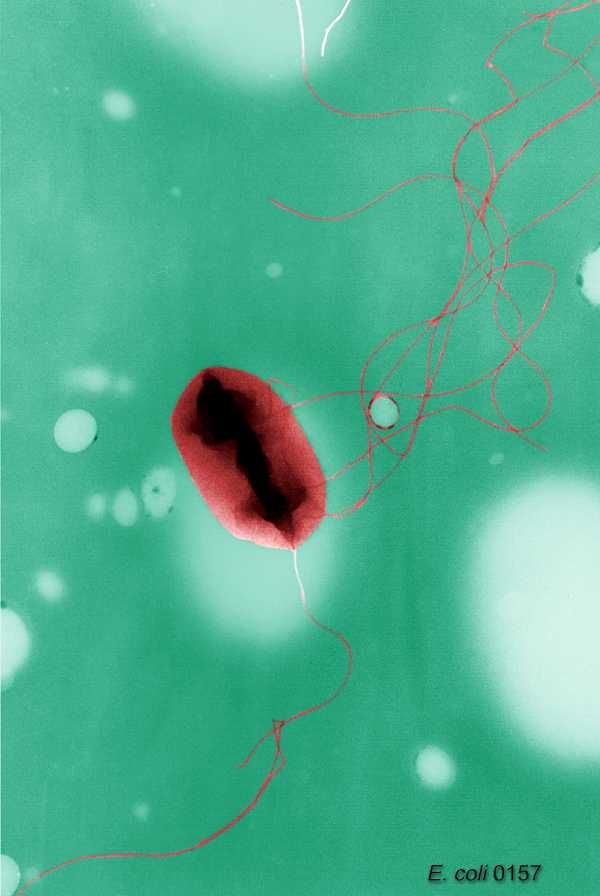
Image source: Wikipedia/Wikimedia
| Ecology, Host, and Life Cycle | |
|---|---|
| Oxygen requirements | Facultative anaerobe |
| Optimal temperature | 37 |
| Temperature range | Mesophilic |
| Habitat | HostAssociated |
| Biotic relationship | Free living |
| Host(s) | Homo sapiens, Gallus gallus, Bos taurus |
| Cell arrangement | Pairs - Singles |
| Sporulation | Not Available |
| Energy source | Not Available |
| Pathogenicity | Human |
Gene Summary
Adenine Count
1337776 bp
Thymine Count
1322231 bp
Guanine Count
1343905 bp
Cytosine Count
1380785 bp
Genome Length
5389732 bp
Protein-coding Genes
4773 genes
Non-Coding Genes
415 genes
# of Chromosomes/Plasmids
1
Genes
| Name | Locus Tag | UniProt ID | Strand Orientation | Gene Start/End | Protein Molecular Weight |
|---|---|---|---|---|---|
| adenylyl-sulfate kinase | D9E35_18785 | Not Available | Negative | 3933809 - 3934414 | 22322.7 |
| sulfate adenylyltransferase subunit cysn | D9E35_18790 | Not Available | Negative | 3934414 - 3935841 | 52649.6 |
| sulfate adenylyltransferase subunit 2 | D9E35_18795 | Not Available | Negative | 3935843 - 3936751 | 35190.3 |
| aminopeptidase | D9E35_18800 | Not Available | Positive | 3937003 - 3938040 | 37869.4 |
| type i-e crispr-associated endoribonuclease cas2 | D9E35_18805 | Not Available | Negative | 3938613 - 3938906 | 11004.4 |
| type i-e crispr-associated endonuclease cas1 | D9E35_18810 | Not Available | Negative | 3938903 - 3939826 | 33425.7 |
| type i-e crispr-associated protein cas6/cse3/case | D9E35_18815 | Not Available | Negative | 3939823 - 3940473 | 24829.8 |
| type i-e crispr-associated protein cas5/casd | D9E35_18820 | Not Available | Negative | 3940455 - 3941201 | 28630.0 |
| type i-e crispr-associated protein cas7/cse4/casc | D9E35_18825 | Not Available | Negative | 3941212 - 3942267 | 38372.6 |
| type i-e crispr-associated protein cse2/casb | D9E35_18830 | Not Available | Negative | 3942279 - 3942818 | 20602.6 |
Pathways
1297 pathways
Health Effects
| Health Condition | Relation | Reference |
|---|---|---|
| Gi disease | Causes | PMC11149725 |
| Utis | Causes | PMC11434687 |
| Colorectal cancer | Causes | PMC12198655 |
| Pyogenic liver abscesses | Causes | PMC12392612 |
| Uti | Causes | PMC13014981 |
| Colibacillosis | Causes | PMC13255289 |
| Enteric infections | Causes | PMC13255289 |
| Foodborne infections | Causes | PMC13255289 |
| Clinical mastitis | Causes | PMC13293316 |
| Diarrhea | Causes | PMC3035056 |