Kingdom
Pseudomonadati
Phylum
Pseudomonadota
Class
Gammaproteobacteria
Order
Enterobacterales
Family
Enterobacteriaceae
Genus
Escherichia
Description
Taxonomy
| Kingdom | Pseudomonadati |
|---|---|
| Phylum | Pseudomonadota |
| Class | Gammaproteobacteria |
| Order | Enterobacterales |
| Family | Enterobacteriaceae |
| Genus | Escherichia |
| Species | Escherichia coli |
| Strain | strain CVM N17EC1028 |
Profile
| Physiology | |
|---|---|
| Gram staining properties | Negative |
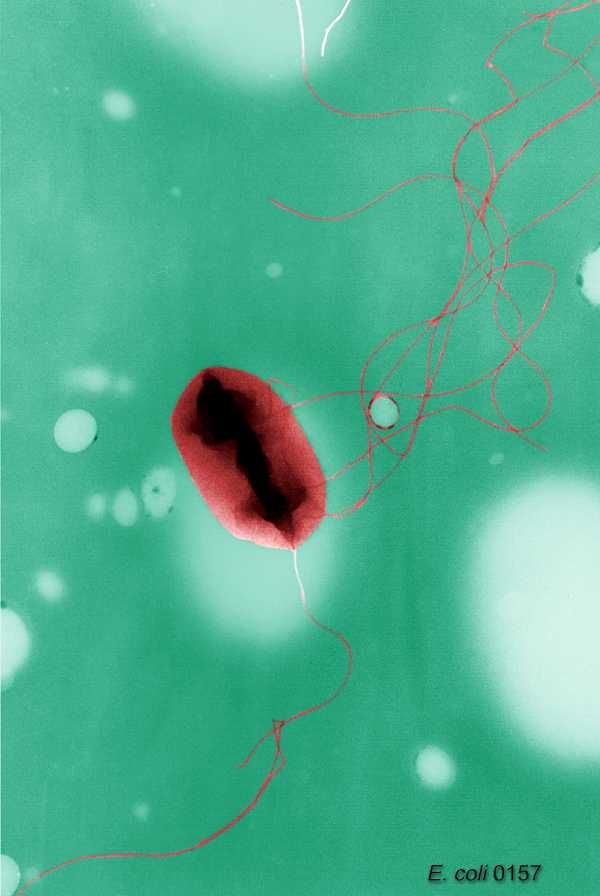
| Shape | Rod |
| Mobility | Yes |
| Flagellar presence | Yes |
| Number of membranes | 2 |

Image source: Wikipedia/Wikimedia
| Ecology, Host, and Life Cycle | |
|---|---|
| Oxygen requirements | Facultative anaerobe |
| Optimal temperature | 37 |
| Temperature range | Mesophilic |
| Habitat | HostAssociated |
| Biotic relationship | Free living |
| Host(s) | Homo sapiens, Gallus gallus, Bos taurus |
| Cell arrangement | Pairs - Singles |
| Sporulation | Not Available |
| Energy source | Not Available |
| Pathogenicity | Human |
Gene Summary
Adenine Count
1367777 bp
Thymine Count
1353527 bp
Guanine Count
1378718 bp
Cytosine Count
1392732 bp
Genome Length
5501070 bp
Protein-coding Genes
5023 genes
Non-Coding Genes
398 genes
# of Chromosomes/Plasmids
1
Genes
| Name | Locus Tag | UniProt ID | Strand Orientation | Gene Start/End | Protein Molecular Weight |
|---|---|---|---|---|---|
| thymidylate kinase | D9I11_17570 | Not Available | Negative | 3599666 - 3600358 | 25442.2 |
| thymidylate kinase | D9I11_17575 | Not Available | Positive | 3600532 - 3601245 | 26304.2 |
| hypothetical protein | D9I11_17580 | Not Available | Positive | 3601277 - 3602035 | 28126.1 |
| lipopolysaccharide biosynthesis protein | D9I11_17585 | Not Available | Positive | 3602081 - 3603430 | 48686.0 |
| hypothetical protein | D9I11_17590 | Not Available | Positive | 3603430 - 3604254 | 32094.8 |
| ytfj family protein | D9I11_17595 | Not Available | Positive | 3604266 - 3604826 | 20686.1 |
| lps export abc transporter permease lptf | D9I11_17600 | Not Available | Positive | 3604857 - 3605927 | 39896.1 |
| lps export abc transporter permease lptg | D9I11_17605 | Not Available | Positive | 3605924 - 3607003 | 39668.5 |
| aminotransferase class i/ii-fold pyridoxal phosphate-dependent enzyme | D9I11_17610 | Not Available | Negative | 3607038 - 3608210 | 41743.1 |
| acyl carrier protein | D9I11_17615 | Not Available | Negative | 3608210 - 3608458 | 9417.69 |
Pathways
1297 pathways
Health Effects
| Health Condition | Relation | Reference |
|---|---|---|
| Gi disease | Causes | PMC11149725 |
| Utis | Causes | PMC11434687 |
| Colorectal cancer | Causes | PMC12198655 |
| Pyogenic liver abscesses | Causes | PMC12392612 |
| Uti | Causes | PMC13014981 |
| Colibacillosis | Causes | PMC13255289 |
| Enteric infections | Causes | PMC13255289 |
| Foodborne infections | Causes | PMC13255289 |
| Clinical mastitis | Causes | PMC13293316 |
| Diarrhea | Causes | PMC3035056 |