Kingdom
Pseudomonadati
Phylum
Pseudomonadota
Class
Gammaproteobacteria
Order
Enterobacterales
Family
Enterobacteriaceae
Genus
Escherichia
Description
Taxonomy
| Kingdom | Pseudomonadati |
|---|---|
| Phylum | Pseudomonadota |
| Class | Gammaproteobacteria |
| Order | Enterobacterales |
| Family | Enterobacteriaceae |
| Genus | Escherichia |
| Species | Escherichia coli |
| Strain | strain CVM N17EC1228 |
Profile
| Physiology | |
|---|---|
| Gram staining properties | Negative |
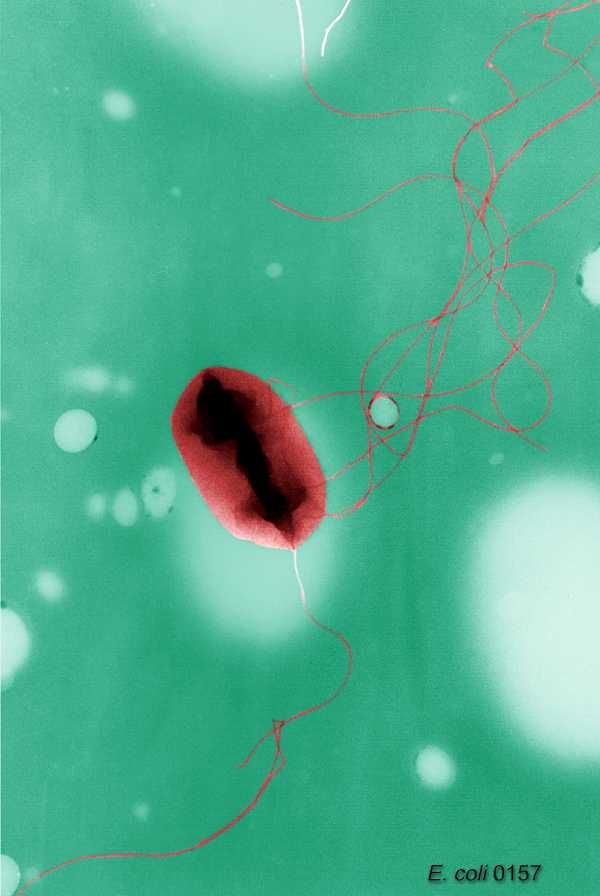
| Shape | Rod |
| Mobility | Yes |
| Flagellar presence | Yes |
| Number of membranes | 2 |

Image source: Wikipedia/Wikimedia
| Ecology, Host, and Life Cycle | |
|---|---|
| Oxygen requirements | Facultative anaerobe |
| Optimal temperature | 37 |
| Temperature range | Mesophilic |
| Habitat | HostAssociated |
| Biotic relationship | Free living |
| Host(s) | Homo sapiens, Gallus gallus, Bos taurus |
| Cell arrangement | Pairs - Singles |
| Sporulation | Not Available |
| Energy source | Not Available |
| Pathogenicity | Human |
Gene Summary
Adenine Count
1328414 bp
Thymine Count
1313561 bp
Guanine Count
1338976 bp
Cytosine Count
1354881 bp
Genome Length
5346416 bp
Protein-coding Genes
4828 genes
Non-Coding Genes
457 genes
# of Chromosomes/Plasmids
1
Genes
| Name | Locus Tag | UniProt ID | Strand Orientation | Gene Start/End | Protein Molecular Weight |
|---|---|---|---|---|---|
| hypothetical protein | D9J11_19990 | Not Available | Negative | 4075860 - 4075985 | 4757.28 |
| uric acid transporter uact | D9J11_19995 | Not Available | Negative | 4075987 - 4077435 | 51761.4 |
| small toxic protein ibsb | D9J11_20000 | Not Available | Negative | 4077771 - 4077827 | 2063.86 |
| multidrug efflux rnd transporter subunit mdta | D9J11_20005 | Not Available | Positive | 4078106 - 4079353 | 44466.8 |
| multidrug efflux rnd transporter permease subunit mdtb | D9J11_20010 | Not Available | Positive | 4079353 - 4082475 | 112114.0 |
| multidrug resistance protein mdtc | D9J11_20015 | Not Available | Positive | 4082476 - 4085553 | 111035.0 |
| mfs transporter | D9J11_20020 | Not Available | Positive | 4085554 - 4086969 | 50904.2 |
| two-component sensor histidine kinase | D9J11_20025 | Not Available | Positive | 4086966 - 4088369 | 51994.4 |
| two-component system response regulator baer | D9J11_20030 | Not Available | Positive | 4088366 - 4089088 | 27688.6 |
| duf1508 domain-containing protein | D9J11_20035 | Not Available | Positive | 4089279 - 4089611 | 11994.9 |
Pathways
1297 pathways
Health Effects
| Health Condition | Relation | Reference |
|---|---|---|
| Gi disease | Causes | PMC11149725 |
| Utis | Causes | PMC11434687 |
| Colorectal cancer | Causes | PMC12198655 |
| Pyogenic liver abscesses | Causes | PMC12392612 |
| Uti | Causes | PMC13014981 |
| Colibacillosis | Causes | PMC13255289 |
| Enteric infections | Causes | PMC13255289 |
| Foodborne infections | Causes | PMC13255289 |
| Clinical mastitis | Causes | PMC13293316 |
| Diarrhea | Causes | PMC3035056 |