Kingdom
Pseudomonadati
Phylum
Pseudomonadota
Class
Gammaproteobacteria
Order
Enterobacterales
Family
Enterobacteriaceae
Genus
Escherichia
Description
Taxonomy
| Kingdom | Pseudomonadati |
|---|---|
| Phylum | Pseudomonadota |
| Class | Gammaproteobacteria |
| Order | Enterobacterales |
| Family | Enterobacteriaceae |
| Genus | Escherichia |
| Species | Escherichia coli |
| Strain | strain L889 |
Profile
| Physiology | |
|---|---|
| Gram staining properties | Negative |
| Shape | Rod |
| Mobility | Yes |
| Flagellar presence | Yes |
| Number of membranes | 2 |

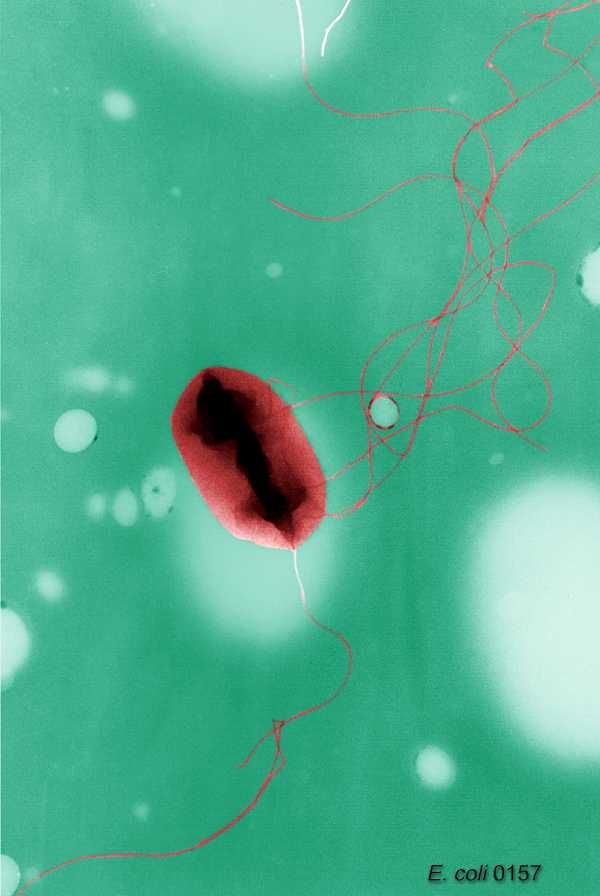
Image source: Wikipedia/Wikimedia
| Ecology, Host, and Life Cycle | |
|---|---|
| Oxygen requirements | Facultative anaerobe |
| Optimal temperature | 37 |
| Temperature range | Mesophilic |
| Habitat | HostAssociated |
| Biotic relationship | Free living |
| Host(s) | Homo sapiens, Gallus gallus, Bos taurus |
| Cell arrangement | Pairs - Singles |
| Sporulation | Not Available |
| Energy source | Not Available |
| Pathogenicity | Human |
Gene Summary
Adenine Count
1386626 bp
Thymine Count
1382639 bp
Guanine Count
1409391 bp
Cytosine Count
1412408 bp
Genome Length
5605530 bp
Protein-coding Genes
5216 genes
Non-Coding Genes
253 genes
# of Chromosomes/Plasmids
1
Genes
| Name | Locus Tag | UniProt ID | Strand Orientation | Gene Start/End | Protein Molecular Weight |
|---|---|---|---|---|---|
| guanosine monophosphate reductase | D9K54_16430 | Not Available | Positive | 3294578 - 3295621 | 37385.8 |
| type iv pilin biogenesis protein | D9K54_16435 | Not Available | Negative | 3295656 - 3296858 | 44418.2 |
| type ii secretion system protein gspe | D9K54_16440 | Not Available | Negative | 3296848 - 3298233 | 50582.5 |
| prepilin peptidase-dependent pilin | D9K54_16445 | Not Available | Negative | 3298243 - 3298683 | 15649.7 |
| carboxylating nicotinate-nucleotide diphosphorylase | D9K54_16450 | Not Available | Negative | 3298886 - 3299779 | 32774.0 |
| 1,6-anhydro-n-acetylmuramyl-l-alanine amidase ampd | D9K54_16455 | Not Available | Positive | 3299867 - 3300418 | 20509.2 |
| protein ampe | D9K54_16460 | Not Available | Positive | 3300415 - 3301269 | 32123.9 |
| aromatic amino acid transporter arop | D9K54_16465 | Not Available | Negative | 3301312 - 3302682 | 49547.9 |
| pyruvate dehydrogenase complex repressor | D9K54_16470 | Not Available | Positive | 3303226 - 3303990 | 29427.2 |
| pyruvate dehydrogenase (acetyl-transferring), homodimeric type | D9K54_16475 | Not Available | Positive | 3304151 - 3306814 | 99674.1 |
Pathways
1332 pathways
Health Effects
| Health Condition | Relation | Reference |
|---|---|---|
| Gi disease | Causes | PMC11149725 |
| Utis | Causes | PMC11434687 |
| Colorectal cancer | Causes | PMC12198655 |
| Pyogenic liver abscesses | Causes | PMC12392612 |
| Uti | Causes | PMC13014981 |
| Colibacillosis | Causes | PMC13255289 |
| Enteric infections | Causes | PMC13255289 |
| Foodborne infections | Causes | PMC13255289 |
| Clinical mastitis | Causes | PMC13293316 |
| Diarrhea | Causes | PMC3035056 |