
Kingdom
Bacillati
Phylum
Bacillota
Class
Clostridia
Order
Eubacteriales
Family
Clostridiaceae
Genus
Clostridium
Description
Taxonomy
| Kingdom | Bacillati |
|---|---|
| Phylum | Bacillota |
| Class | Clostridia |
| Order | Eubacteriales |
| Family | Clostridiaceae |
| Genus | Clostridium |
| Species | Clostridium botulinum |
| Strain | strain CDC66008 |
Profile
| Physiology | |
|---|---|
| Gram staining properties | Positive |
| Shape | Rod |
| Mobility | Yes |
| Flagellar presence | Yes |
| Number of membranes | 1 |
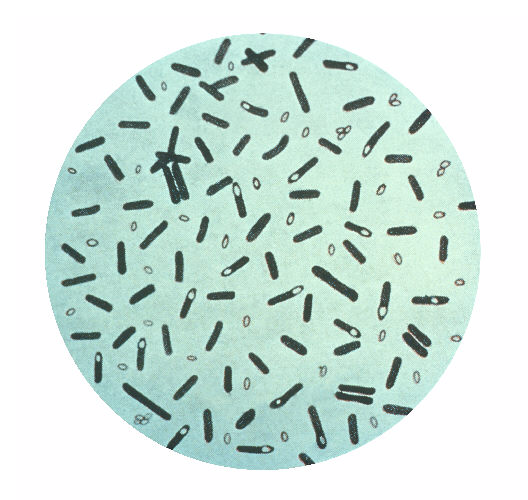
Image source: Wikipedia/Wikimedia
| Ecology, Host, and Life Cycle | |
|---|---|
| Oxygen requirements | Anaerobe |
| Optimal temperature | 37 |
| Temperature range | Mesophilic |
| Habitat | Multiple |
| Biotic relationship | Free living |
| Host(s) | Homo sapiens, Bos, Metazoa |
| Cell arrangement | Pairs - Singles - Chains |
| Sporulation | Not Available |
| Energy source | Chemoorganotroph |
| Pathogenicity | Not Available |
Gene Summary
Adenine Count
1501389 bp
Thymine Count
1498305 bp
Guanine Count
579555 bp
Cytosine Count
583054 bp
Genome Length
4162303 bp
Protein-coding Genes
3160 genes
Non-Coding Genes
120 genes
# of Chromosomes/Plasmids
1
Genes
| Name | Locus Tag | UniProt ID | Strand Orientation | Gene Start/End | Protein Molecular Weight |
|---|---|---|---|---|---|
| Trna-leu | Not Available | Not Available | Positive | 1124995 - 1125083 | Not Available |
| Trna-met | Not Available | Not Available | Positive | 1125088 - 1125163 | Not Available |
| Trna-met | Not Available | Not Available | Positive | 1125217 - 1125292 | Not Available |
| Trna-met | Not Available | Not Available | Positive | 1125303 - 1125379 | Not Available |
| hypoxanthine phosphoribosyltransferase | DZC34_05935 | Not Available | Positive | 1129632 - 1130177 | 20562.1 |
| atp-dependent metallopeptidase ftsh/yme1/tma family protein | DZC34_05940 | Not Available | Positive | 1130259 - 1132064 | 66441.6 |
| formate--tetrahydrofolate ligase | DZC34_05945 | Not Available | Positive | 1132268 - 1133941 | 60772.3 |
| type iii pantothenate kinase | DZC34_05950 | Not Available | Positive | 1134096 - 1134872 | 28310.6 |
| trna dihydrouridine synthase dusb | DZC34_05955 | Not Available | Positive | 1134882 - 1135853 | 36542.4 |
| hypothetical protein | DZC34_05960 | Not Available | Positive | 1135903 - 1136730 | 32252.6 |
Pathways
0 pathways
No pathways found
No metabolic pathways have been associated with this bacterium yet.
Health Effects
| Health Condition | Relation | Reference |
|---|---|---|
| Wound botulism | Causes | PMC8283217 |
| Botulism | Causes | PMC2693436 |
| Botulism | Causes | PMC13317340 |
| Botulism | Causes | PMC3232984 |
| Botulism | Causes | PMC5113727 |
| Botulism | Causes | PMC7904509 |


