
Kingdom
Bacillati
Phylum
Bacillota
Class
Clostridia
Order
Eubacteriales
Family
Clostridiaceae
Genus
Clostridium
Description
Taxonomy
| Kingdom | Bacillati |
|---|---|
| Phylum | Bacillota |
| Class | Clostridia |
| Order | Eubacteriales |
| Family | Clostridiaceae |
| Genus | Clostridium |
| Species | Clostridium botulinum |
| Strain | strain CDC66008 |
Profile
| Physiology | |
|---|---|
| Gram staining properties | Positive |
| Shape | Rod |
| Mobility | Yes |
| Flagellar presence | Yes |
| Number of membranes | 1 |
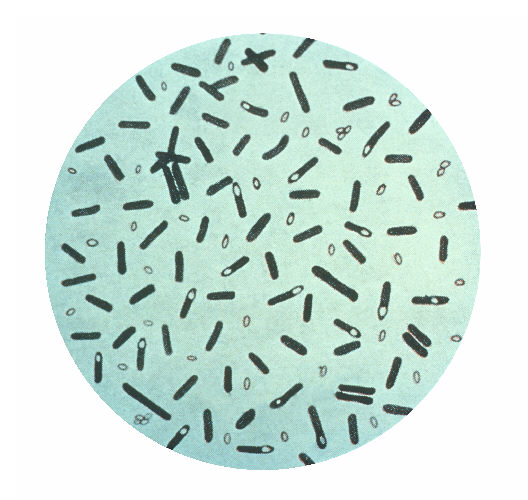
Image source: Wikipedia/Wikimedia
| Ecology, Host, and Life Cycle | |
|---|---|
| Oxygen requirements | Anaerobe |
| Optimal temperature | 37 |
| Temperature range | Mesophilic |
| Habitat | Multiple |
| Biotic relationship | Free living |
| Host(s) | Homo sapiens, Bos, Metazoa |
| Cell arrangement | Pairs - Singles - Chains |
| Sporulation | Not Available |
| Energy source | Chemoorganotroph |
| Pathogenicity | Not Available |
Gene Summary
Adenine Count
1501389 bp
Thymine Count
1498305 bp
Guanine Count
579555 bp
Cytosine Count
583054 bp
Genome Length
4162303 bp
Protein-coding Genes
3160 genes
Non-Coding Genes
120 genes
# of Chromosomes/Plasmids
1
Genes
| Name | Locus Tag | UniProt ID | Strand Orientation | Gene Start/End | Protein Molecular Weight |
|---|---|---|---|---|---|
| ctsr family transcriptional regulator | DZC34_10280 | Not Available | Negative | 1917380 - 1917844 | 17691.5 |
| hypothetical protein | DZC34_10285 | Not Available | Negative | 1918240 - 1918470 | 9033.78 |
| Trna-asn | Not Available | Not Available | Positive | 1921023 - 1921097 | Not Available |
| trna (adenosine(37)-n6)-dimethylallyltransferase miaa | DZC34_10300 | Not Available | Negative | 1921220 - 1922155 | 36232.8 |
| penicillin-binding protein 2 | DZC34_10310 | Not Available | Negative | 1924292 - 1924789 | 20112.2 |
| uridine kinase | DZC34_10315 | Not Available | Negative | 1924859 - 1925479 | 23846.9 |
| endolytic transglycosylase mltg | DZC34_10330 | Not Available | Negative | 1927616 - 1928647 | 39487.2 |
| translational gtpase typa | DZC34_10335 | Not Available | Negative | 1928725 - 1930551 | 68179.1 |
| ribonuclease j | DZC34_10340 | Not Available | Negative | 1931197 - 1932906 | 63201.6 |
| duf1292 domain-containing protein | DZC34_10350 | Not Available | Negative | 1933527 - 1933781 | 9654.95 |
Pathways
1096 pathways
Health Effects
| Health Condition | Relation | Reference |
|---|---|---|
| Wound botulism | Causes | PMC8283217 |
| Botulism | Causes | PMC2693436 |
| Botulism | Causes | PMC13317340 |
| Botulism | Causes | PMC3232984 |
| Botulism | Causes | PMC5113727 |
| Botulism | Causes | PMC7904509 |


