
Kingdom
Bacillati
Phylum
Bacillota
Class
Clostridia
Order
Eubacteriales
Family
Clostridiaceae
Genus
Clostridium
Description
Taxonomy
| Kingdom | Bacillati |
|---|---|
| Phylum | Bacillota |
| Class | Clostridia |
| Order | Eubacteriales |
| Family | Clostridiaceae |
| Genus | Clostridium |
| Species | Clostridium botulinum |
| Strain | strain CDC66008 |
Profile
| Physiology | |
|---|---|
| Gram staining properties | Positive |
| Shape | Rod |
| Mobility | Yes |
| Flagellar presence | Yes |
| Number of membranes | 1 |
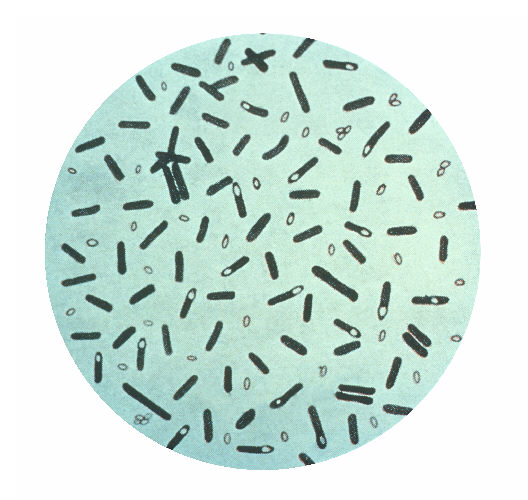
Image source: Wikipedia/Wikimedia
| Ecology, Host, and Life Cycle | |
|---|---|
| Oxygen requirements | Anaerobe |
| Optimal temperature | 37 |
| Temperature range | Mesophilic |
| Habitat | Multiple |
| Biotic relationship | Free living |
| Host(s) | Homo sapiens, Bos, Metazoa |
| Cell arrangement | Pairs - Singles - Chains |
| Sporulation | Not Available |
| Energy source | Chemoorganotroph |
| Pathogenicity | Not Available |
Gene Summary
Adenine Count
1501389 bp
Thymine Count
1498305 bp
Guanine Count
579555 bp
Cytosine Count
583054 bp
Genome Length
4162303 bp
Protein-coding Genes
3160 genes
Non-Coding Genes
120 genes
# of Chromosomes/Plasmids
1
Genes
| Name | Locus Tag | UniProt ID | Strand Orientation | Gene Start/End | Protein Molecular Weight |
|---|---|---|---|---|---|
| nicotinate-nicotinamide nucleotide adenylyltransferase | DZC34_07025 | Not Available | Positive | 1343416 - 1344021 | 23933.1 |
| rida family protein | DZC34_07040 | Not Available | Positive | 1345974 - 1346354 | 13705.7 |
| rlua family pseudouridine synthase | DZC34_07045 | Not Available | Positive | 1346679 - 1347581 | 34881.1 |
| mfs transporter | DZC34_07050 | Not Available | Negative | 1347925 - 1349277 | 50073.4 |
| mfs transporter | DZC34_07055 | Not Available | Negative | 1349586 - 1350932 | 49133.7 |
| aminopeptidase p family protein | DZC34_07060 | Not Available | Positive | 1351441 - 1352529 | 40769.9 |
| proline iminopeptidase | DZC34_07065 | Not Available | Positive | 1352611 - 1353492 | 33418.8 |
| mets family nss transporter small subunit | DZC34_07070 | Not Available | Negative | 1353640 - 1353765 | 4543.55 |
| sodium-dependent transporter | DZC34_07075 | Not Available | Negative | 1353782 - 1355275 | 54999.4 |
| duf2974 domain-containing protein | DZC34_07085 | Not Available | Negative | 1356558 - 1358952 | 89808.8 |
Pathways
1096 pathways
Health Effects
| Health Condition | Relation | Reference |
|---|---|---|
| Wound botulism | Causes | PMC8283217 |
| Botulism | Causes | PMC2693436 |
| Botulism | Causes | PMC13317340 |
| Botulism | Causes | PMC3232984 |
| Botulism | Causes | PMC5113727 |
| Botulism | Causes | PMC7904509 |


