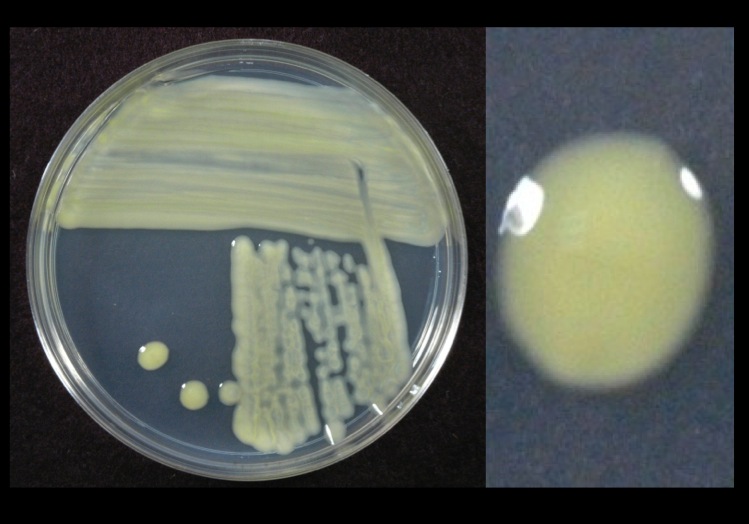
Kingdom
Pseudomonadati
Phylum
Pseudomonadota
Class
Gammaproteobacteria
Order
Lysobacterales
Family
Lysobacteraceae
Genus
Xanthomonas
Description
Taxonomy
| Kingdom | Pseudomonadati |
|---|---|
| Phylum | Pseudomonadota |
| Class | Gammaproteobacteria |
| Order | Lysobacterales |
| Family | Lysobacteraceae |
| Genus | Xanthomonas |
| Species | Xanthomonas campestris |
| Strain | pv. campestris strain WHRI8960 |
Profile
| Physiology | |
|---|---|
| Gram staining properties | Negative |
| Shape | Rod |
| Mobility | Yes |
| Flagellar presence | Yes |
| Number of membranes | 2 |

Image source: Wikipedia/Wikimedia
| Ecology, Host, and Life Cycle | |
|---|---|
| Oxygen requirements | Aerobe |
| Optimal temperature | 25 |
| Temperature range | Mesophilic |
| Habitat | HostAssociated |
| Biotic relationship | Free living |
| Host(s) | Viridiplantae, Brassica oleracea var. capitata, Arabidopsis |
| Cell arrangement | Not Available |
| Sporulation | Not Available |
| Energy source | Not Available |
| Pathogenicity | Not Available |
Gene Summary
Adenine Count
863808 bp
Thymine Count
855945 bp
Guanine Count
1607689 bp
Cytosine Count
1615702 bp
Genome Length
4943363 bp
Protein-coding Genes
4114 genes
Non-Coding Genes
182 genes
# of Chromosomes/Plasmids
1
Genes
| Name | Locus Tag | UniProt ID | Strand Orientation | Gene Start/End | Protein Molecular Weight |
|---|---|---|---|---|---|
| ubih/ubif family hydroxylase | D0A42_18070 | Not Available | Positive | 4041234 - 4042415 | 42315.5 |
| alpha/beta fold hydrolase | D0A42_18075 | Not Available | Positive | 4042518 - 4043234 | 25690.0 |
| nuclear transport factor 2 family protein | D0A42_18080 | Not Available | Positive | 4043349 - 4043780 | 15764.7 |
| phenol degradation protein meta | D0A42_18085 | Not Available | Positive | 4043829 - 4044923 | 40237.0 |
| gntr family transcriptional regulator | D0A42_18090 | Not Available | Negative | 4045098 - 4045772 | 24610.7 |
| gallate dioxygenase | D0A42_18095 | Not Available | Positive | 4046009 - 4046908 | 33286.6 |
| protocatechuate 4,5-dioxygenase subunit alpha | D0A42_18100 | Not Available | Positive | 4046918 - 4047277 | 14194.2 |
| lysr family transcriptional regulator | D0A42_18105 | Not Available | Positive | 4047350 - 4048351 | 36789.9 |
| acyl-coa synthetase | D0A42_18110 | Not Available | Negative | 4048683 - 4050161 | 53319.1 |
| p-hydroxycinnamoyl coa hydratase/lyase | D0A42_18120 | Not Available | Negative | 4051936 - 4052763 | 31117.1 |
Pathways
0 pathways
No pathways found
No metabolic pathways have been associated with this bacterium yet.
Health Effects
| Health Condition | Relation | Reference |
|---|---|---|
| Black rot of cabbage | Causes | PMC8042644 |
| Black rot | Causes | PMC8042644 |
| Black rot | Causes | PMC13117714 |
| Bacterial spot disease | Causes | PMC8465007 |
| Black rot | Causes | PMC10335992 |
| Black-rot disease of cruciferous crops | Causes | PMC5488342 |
| Black-rot disease | Causes | PMC5488342 |