Kingdom
Bacillati
Phylum
Bacillota
Class
Clostridia
Order
Lachnospirales
Family
Lachnospiraceae
Genus
Faecalicatena
Description
Taxonomy
| Kingdom | Bacillati |
|---|---|
| Phylum | Bacillota |
| Class | Clostridia |
| Order | Lachnospirales |
| Family | Lachnospiraceae |
| Genus | Faecalicatena |
| Species | Faecalicatena orotica |
| Strain | strain NLAE-zl-C242 |
Profile
| Physiology | |
|---|---|
| Gram staining properties | Gram-positive |
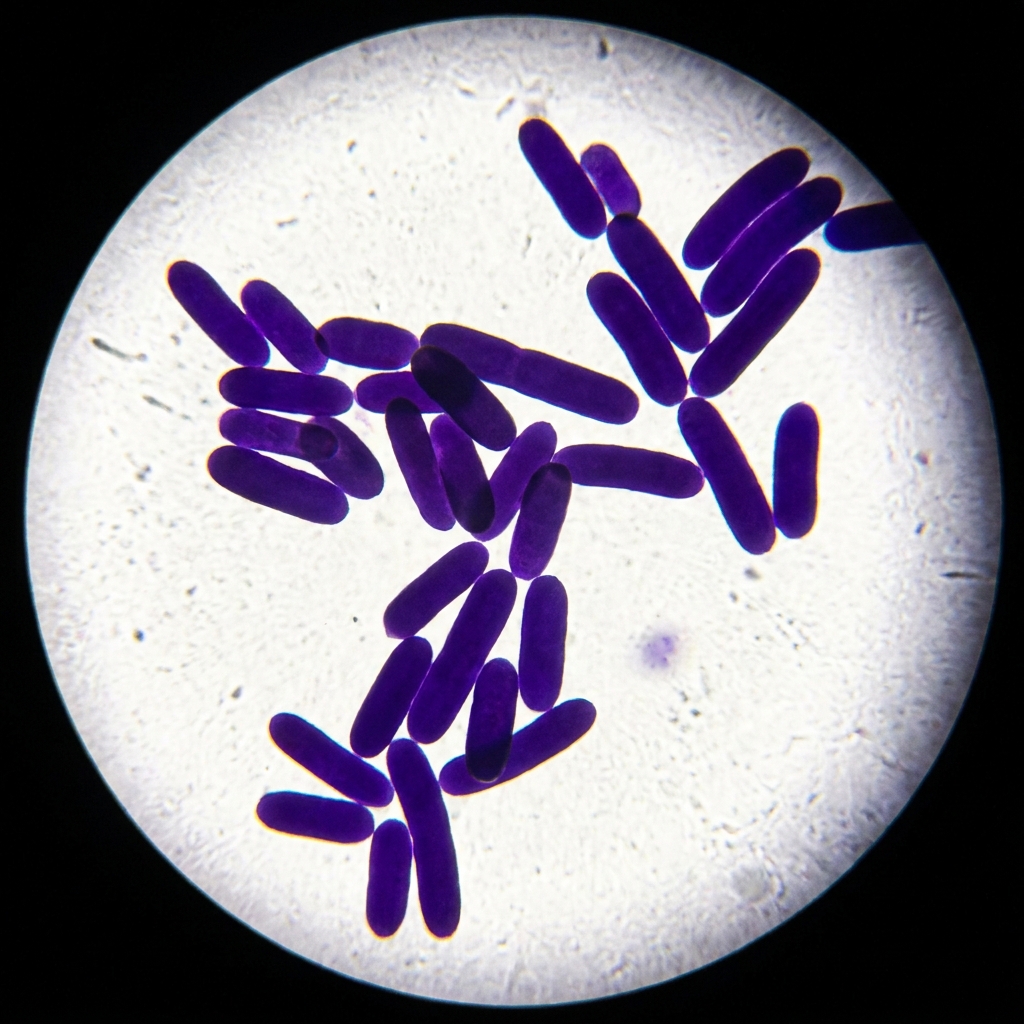
| Shape | rod |
| Mobility | No |
| Flagellar presence | Yes |
| Number of membranes | Not Available |

AI-generated image based on bacteria physiology
| Ecology, Host, and Life Cycle | |
|---|---|
| Oxygen requirements | Not Available |
| Optimal temperature | 37 |
| Temperature range | mesophilic |
| Habitat | Not Available |
| Biotic relationship | Not Available |
| Host(s) | Not Available |
| Cell arrangement | Not Available |
| Sporulation | spore-forming |
| Energy source | Chemoheterotroph |
| Pathogenicity | Not Available |
Gene Summary
Adenine Count
1594429 bp
Thymine Count
1565140 bp
Guanine Count
1310910 bp
Cytosine Count
1246888 bp
Genome Length
5717637 bp
Protein-coding Genes
5079 genes
Non-Coding Genes
131 genes
# of Chromosomes/Plasmids
1
Genes
| Name | Locus Tag | UniProt ID | Strand Orientation | Gene Start/End | Protein Molecular Weight |
|---|---|---|---|---|---|
| putative membrane protein yfho | A8806_101265 | Not Available | Negative | 292180 - 294711 | 95214.7 |
| protein of unknown function (duf3048) | A8806_101266 | Not Available | Negative | 294817 - 295923 | 41058.0 |
| glycosyltransferase involved in cell wall biosynthesis | A8806_101267 | Not Available | Negative | 296014 - 296967 | 36412.4 |
| o-antigen/teichoic acid export membrane protein | A8806_101268 | Not Available | Negative | 297022 - 298476 | 53148.2 |
| glycosyl transferase family 2 | A8806_101269 | Not Available | Negative | 298479 - 299486 | 39327.9 |
| glycosyltransferase involved in cell wall biosynthesis | A8806_101270 | Not Available | Negative | 299537 - 300541 | 38981.7 |
| glycosyltransferase involved in cell wall biosynthesis | A8806_101271 | Not Available | Negative | 300552 - 301658 | 42232.0 |
| o-antigen ligase | A8806_101272 | Not Available | Negative | 301658 - 303094 | 54135.3 |
| o-antigen/teichoic acid export membrane protein | A8806_101273 | Not Available | Negative | 303514 - 304938 | 53405.8 |
| diamine n-acetyltransferase | A8806_101274 | Not Available | Negative | 304931 - 305473 | 20873.0 |
Pathways
0 pathways
No pathways found
No metabolic pathways have been associated with this bacterium yet.
Health Effects
No health effects information available for this bacterium.