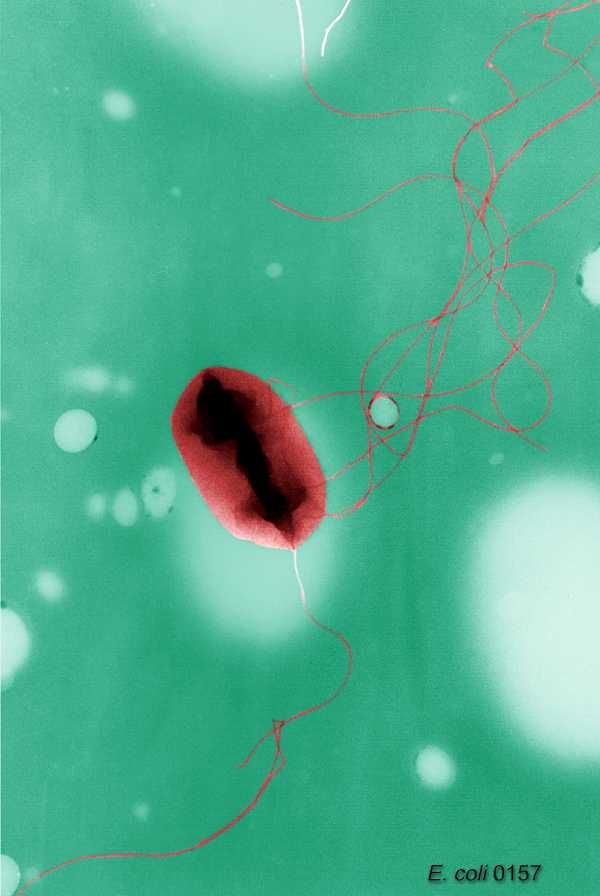
Escherichia coli strain E-9

Gram-negativeRodMotileFacultative anaerobe

Kingdom

Pseudomonadati

Phylum

Pseudomonadota

Class

Gammaproteobacteria

Order

Enterobacterales

Family

Enterobacteriaceae

Genus

Escherichia

Description

Escherichia coli strain E-9 is a Gram-negative, rod-shaped bacterium that demonstrates mobility due to the presence of flagella. It is a facultative anaerobe, thriving optimally at 37°C and fitting within the mesophilic temperature range. E-9 exhibits a cell arrangement characterized by singles and pairs, and it possesses a double membrane structure typical of Gram-negative bacteria. This strain is host-associated, living freely in various environments, and interacts with a wide range of hosts, including Homo sapiens, various livestock species such as Bos taurus and Sus scrofa, as well as numerous other vertebrates and invertebrates. The diverse host range underscores its ecological versatility and adaptability. E-9 is associated with a significant number of health effects in humans and animals, being implicated in conditions such as urinary tract infections (UTIs), gastrointestinal infections, and neonatal meningitis. Other notable health issues include severe complications like hemolytic uremic syndrome (HUS), food poisoning, and various forms of colitis. The pathogenicity of E-9 in humans highlights its role as a significant contributor to clinical diseases, particularly in immunocompromised individuals and infants. Understanding the interactions between E-9 and its various hosts could provide insights into its epidemiology and the mechanisms underlying its pathogenic effects. Furthermore, the strain's presence in both human and agricultural contexts emphasizes the importance of monitoring its spread to mitigate health risks associated with its infections.

Taxonomy

KingdomPseudomonadati
PhylumPseudomonadota
ClassGammaproteobacteria
OrderEnterobacterales
FamilyEnterobacteriaceae
GenusEscherichia
SpeciesEscherichia coli
Strainstrain E-9

Profile

Physiology
Gram staining propertiesNegative
ShapeRod
MobilityYes
Flagellar presenceYes
Number of membranes2
Image of Escherichia coli strain E-9
Image source: Wikipedia/Wikimedia
Ecology, Host, and Life Cycle
Oxygen requirementsFacultative anaerobe
Optimal temperature37
Temperature rangeMesophilic
HabitatHostAssociated
Biotic relationshipFree living
Host(s)Homo sapiens, Gallus gallus, Bos taurus
Cell arrangementPairs - Singles
SporulationNot Available
Energy sourceNot Available
PathogenicityHuman

Genome Summary

Escherichia coli strain E-9 NODE_205_length_207_cov_7.3875, whole

Gene Summary

Adenine Count

1050001 bp

Thymine Count

1052755 bp

Guanine Count

1075150 bp

Cytosine Count

1076456 bp

Genome Length

4254362 bp

Protein-coding Genes

4037 genes

Non-Coding Genes

203 genes

# of Chromosomes/Plasmids

1

Genes

NameLocus TagUniProt IDStrand OrientationGene Start/EndProtein Molecular Weight
dtw domain-containing proteinDIZ28_16040Not AvailablePositive3197315 - 319801325982.4
protein lysine acetyltransferaseDIZ28_16045Not AvailablePositive3198045 - 320070597893.1
phosphatidylserine synthaseDIZ28_16050Not AvailablePositive3200819 - 320217452776.8
lipoproteinDIZ28_16055Not AvailablePositive3202220 - 320254311805.9
alpha-ketoglutarate permeaseDIZ28_16060Not AvailableNegative3202540 - 320383847055.3
alpha-ketoglutarate permeaseDIZ28_16065Not AvailableNegative3203820 - 32039334337.44
a/g-specific adenine glycosylaseDIZ28_16080Not AvailableNegative3204486 - 320545936549.0
adenine glycosylaseDIZ28_16085Not AvailableNegative3205413 - 32055504915.0
trna (guanosine(46)-n7)-methyltransferase trmbDIZ28_16090Not AvailablePositive3205620 - 320633927308.9
duf469 domain-containing proteinDIZ28_16095Not AvailablePositive3206339 - 320666512881.2

Displaying genes 3131 – 3140 of 4240 in total

Metabolites

4785 records
Metabolite IDMetabolite nameStructureCAS number
BASm0000173(R)-3-Hydroxybutyric acidC4H8O3Chemical structure of (R)-3-Hydroxybutyric acid625-72-3
Average104.0473Da
Monoisotopic104.047344122Da
BASm0000217alpha-ribazoleC14H18N2O4Chemical structure of alpha-ribazoleNot available
Average278.3037Da
Monoisotopic278.126657074Da
BASm0000237(R)-4'-phosphopantothenateC9H18NO8PChemical structure of (R)-4'-phosphopantothenateNot available
Average299.2149Da
Monoisotopic299.0770031Da
BASm0000238(R)-3-phenyllactateC9H9O3Chemical structure of (R)-3-phenyllactateNot available
Average165.169Da
Monoisotopic165.05571773Da
BASm00002482,3-dihydroxy-3-methylbutanoateC5H10O4Chemical structure of 2,3-dihydroxy-3-methylbutanoate1756-18-9
Average134.1305Da
Monoisotopic134.0579088Da
BASm00002502,5-didehydro-D-gluconateC6H7O7Chemical structure of 2,5-didehydro-D-gluconate53736-12-2
Average191.1156Da
Monoisotopic191.019177578Da
BASm00002512-dehydropantoateC6H9O4Chemical structure of 2-dehydropantoateNot available
Average145.1333Da
Monoisotopic145.050083776Da
BASm00002532-oxopent-4-enoateC5H5O3Chemical structure of 2-oxopent-4-enoateNot available
Average113.093Da
Monoisotopic113.024417601Da
BASm00002593alpha,12alpha-dihydroxy-7-oxo-5beta-cholanateC24H37O5Chemical structure of 3alpha,12alpha-dihydroxy-7-oxo-5beta-cholanateNot available
Average405.556Da
Monoisotopic405.264647871Da
BASm00002603alpha,7alpha-dihydroxy-12-oxo-5beta-cholanateC24H37O5Chemical structure of 3alpha,7alpha-dihydroxy-12-oxo-5beta-cholanateNot available
Average405.556Da
Monoisotopic405.264647871Da

Displaying 1–10 of 4785 metabolites

Health Effects

Health ConditionRelationReference
Gi diseaseCausesPMC11149725
UtisCausesPMC11434687
Colorectal cancerCausesPMC12198655
Pyogenic liver abscessesCausesPMC12392612
UtiCausesPMC13014981
ColibacillosisCausesPMC13255289
Enteric infectionsCausesPMC13255289
Foodborne infectionsCausesPMC13255289
Clinical mastitisCausesPMC13293316
DiarrheaCausesPMC3035056

Displaying health effects 1 – 10 of 103 in total