Kingdom
Pseudomonadati
Phylum
Pseudomonadota
Class
Gammaproteobacteria
Order
Legionellales
Family
Legionellaceae
Genus
Legionella
Description
Taxonomy
| Kingdom | Pseudomonadati |
|---|---|
| Phylum | Pseudomonadota |
| Class | Gammaproteobacteria |
| Order | Legionellales |
| Family | Legionellaceae |
| Genus | Legionella |
| Species | Legionella pneumophila |
| Strain | strain HH13 |
Profile
| Physiology | |
|---|---|
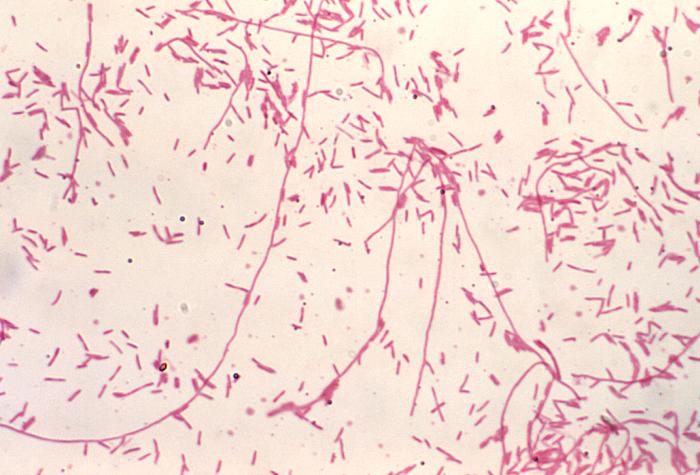
| Gram staining properties | Negative |
| Shape | Rod |
| Mobility | Yes |
| Flagellar presence | Yes |
| Number of membranes | 2 |

Image source: Wikipedia/Wikimedia
| Ecology, Host, and Life Cycle | |
|---|---|
| Oxygen requirements | Aerobic |
| Optimal temperature | Not Available |
| Temperature range | Mesophilic |
| Habitat | HostAssociated |
| Biotic relationship | Free living |
| Host(s) | Homo sapiens, Viridiplantae, Acanthamoeba castellanii |
| Cell arrangement | Singles |
| Sporulation | Nonsporulating |
| Energy source | Chemoorganotroph |
| Pathogenicity | Animal; Human |
Gene Summary
Adenine Count
1055603 bp
Thymine Count
1038174 bp
Guanine Count
631030 bp
Cytosine Count
665456 bp
Genome Length
3390263 bp
Protein-coding Genes
3007 genes
Non-Coding Genes
50 genes
# of Chromosomes/Plasmids
1
Genes
| Name | Locus Tag | UniProt ID | Strand Orientation | Gene Start/End | Protein Molecular Weight |
|---|---|---|---|---|---|
| hypothetical protein | DI056_15170 | Not Available | Negative | 3294339 - 3295787 | 55017.4 |
| atpase | DI056_15175 | Not Available | Positive | 3296201 - 3298651 | 92957.4 |
| response regulator | DI056_15180 | Not Available | Positive | 3298641 - 3299060 | 15848.4 |
| f-box/ankyrin repeat-containing t4ss effector ankb | DI056_15185 | Not Available | Negative | 3299091 - 3299609 | 19996.2 |
| dehydrogenase | DI056_15190 | Not Available | Positive | 3299842 - 3300783 | 35643.3 |
| hypothetical protein | DI056_15195 | Not Available | Negative | 3300878 - 3301138 | 10167.3 |
| sdr family nad(p)-dependent oxidoreductase | DI056_15200 | Not Available | Negative | 3301161 - 3301997 | 30925.1 |
| transcriptional regulator | DI056_15205 | Not Available | Positive | 3302020 - 3302400 | 14702.9 |
| pyridoxamine 5'-phosphate oxidase | DI056_15210 | Not Available | Positive | 3302531 - 3303121 | 22816.3 |
| lysr family transcriptional regulator | DI056_15215 | Not Available | Negative | 3303133 - 3304047 | 35205.9 |
Pathways
0 pathways
No pathways found
No metabolic pathways have been associated with this bacterium yet.
Health Effects
| Health Condition | Relation | Reference |
|---|---|---|
| Community-acquired pneumonia (cap) | Causes | PMC12584241 |
| Pneumonia | Causes | PMC12584241 |
| Legionnaires' disease | Causes | PMC2653234 |
| Legionnaires' disease | Causes | PMC3014939 |
| Legionnaires disease | Causes | PMC4379102 |
| Mild diseases | Causes | PMC5615607 |
| Cap | Causes | PMC7609860 |
| Legionnaires disease | Causes | PMC8394066 |
| Ld | Causes | PMC8394066 |
| Pneumonia | Causes | PMC8431511 |