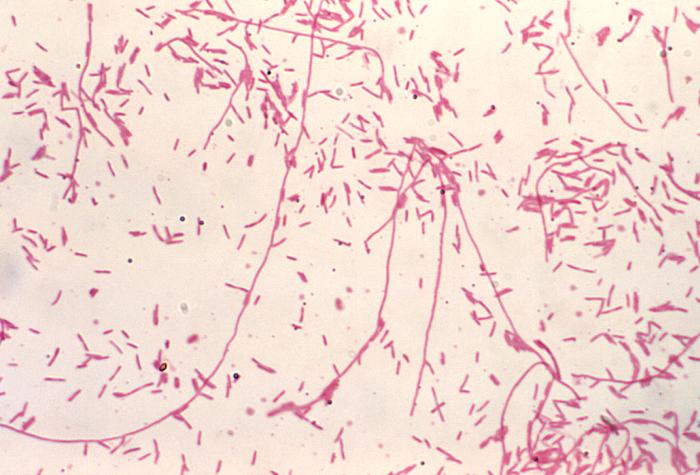
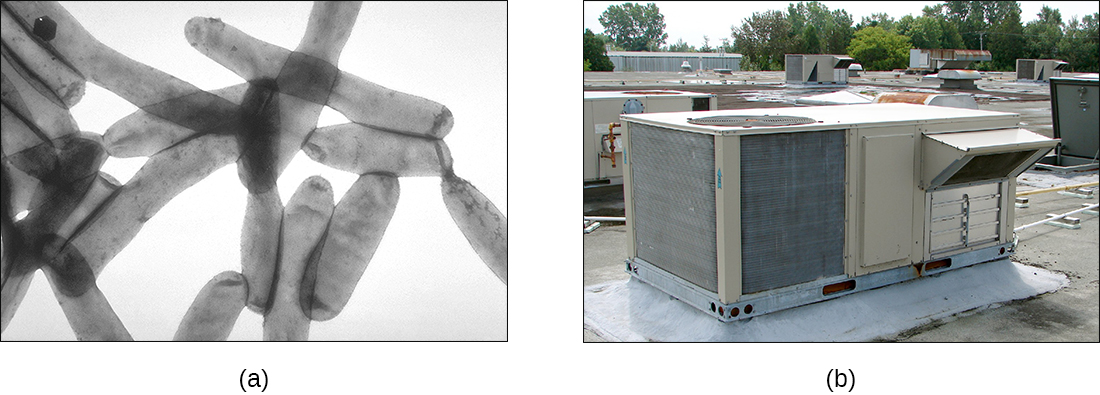
Kingdom
Pseudomonadati
Phylum
Pseudomonadota
Class
Gammaproteobacteria
Order
Legionellales
Family
Legionellaceae
Genus
Legionella
Description
Taxonomy
| Kingdom | Pseudomonadati |
|---|---|
| Phylum | Pseudomonadota |
| Class | Gammaproteobacteria |
| Order | Legionellales |
| Family | Legionellaceae |
| Genus | Legionella |
| Species | Legionella pneumophila |
| Strain | strain HH36 |
Profile
| Physiology | |
|---|---|
| Gram staining properties | Negative |
| Shape | Rod |
| Mobility | Yes |
| Flagellar presence | Yes |
| Number of membranes | 2 |
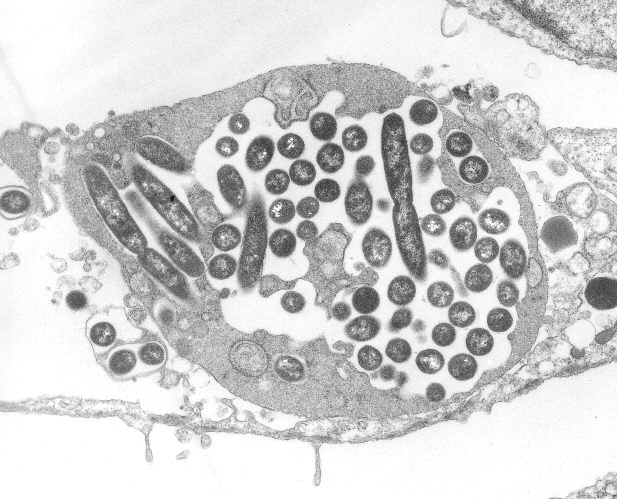
Image source: Wikipedia/Wikimedia
| Ecology, Host, and Life Cycle | |
|---|---|
| Oxygen requirements | Aerobic |
| Optimal temperature | Not Available |
| Temperature range | Mesophilic |
| Habitat | HostAssociated |
| Biotic relationship | Free living |
| Host(s) | Homo sapiens, Viridiplantae, Acanthamoeba castellanii |
| Cell arrangement | Singles |
| Sporulation | Nonsporulating |
| Energy source | Chemoorganotroph |
| Pathogenicity | Animal; Human |
Gene Summary
Adenine Count
1058438 bp
Thymine Count
1043291 bp
Guanine Count
635307 bp
Cytosine Count
668152 bp
Genome Length
3405188 bp
Protein-coding Genes
3022 genes
Non-Coding Genes
50 genes
# of Chromosomes/Plasmids
1
Genes
| Name | Locus Tag | UniProt ID | Strand Orientation | Gene Start/End | Protein Molecular Weight |
|---|---|---|---|---|---|
| potassium transporter | DI018_09060 | Not Available | Positive | 2016812 - 2018617 | 66416.1 |
| moxr family atpase | DI018_09065 | Not Available | Positive | 2018659 - 2019573 | 34015.4 |
| hypothetical protein | DI018_09070 | Not Available | Positive | 2019597 - 2020520 | 35639.7 |
| duf3488 domain-containing protein | DI018_09075 | Not Available | Positive | 2020520 - 2022508 | 77851.6 |
| cupin domain-containing protein | DI018_09080 | Not Available | Positive | 2022590 - 2023777 | 46474.9 |
| hypothetical protein | DI018_09085 | Not Available | Positive | 2023885 - 2024211 | 11701.0 |
| alpha/beta hydrolase | DI018_09090 | Not Available | Positive | 2024658 - 2025560 | 34227.2 |
| eama/rhat family transporter | DI018_09095 | Not Available | Negative | 2025590 - 2026492 | 33467.9 |
| multidrug dmt transporter permease | DI018_09100 | Not Available | Positive | 2026708 - 2027889 | 44533.7 |
| diaminobutyrate-2-oxoglutarate aminotransferase | DI018_09105 | Not Available | Negative | 2027894 - 2028427 | 20803.5 |
Pathways
1264 pathways
Health Effects
| Health Condition | Relation | Reference |
|---|---|---|
| Community-acquired pneumonia (cap) | Causes | PMC12584241 |
| Pneumonia | Causes | PMC12584241 |
| Legionnaires' disease | Causes | PMC2653234 |
| Legionnaires' disease | Causes | PMC3014939 |
| Legionnaires disease | Causes | PMC4379102 |
| Mild diseases | Causes | PMC5615607 |
| Cap | Causes | PMC7609860 |
| Legionnaires disease | Causes | PMC8394066 |
| Ld | Causes | PMC8394066 |
| Pneumonia | Causes | PMC8431511 |