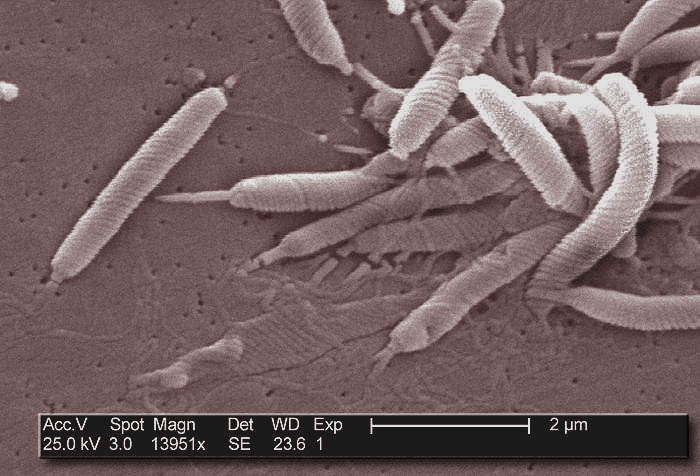
Kingdom
Pseudomonadati
Phylum
Campylobacterota
Class
Epsilonproteobacteria
Order
Campylobacterales
Family
Helicobacteraceae
Genus
Helicobacter
Description
Taxonomy
| Kingdom | Pseudomonadati |
|---|---|
| Phylum | Campylobacterota |
| Class | Epsilonproteobacteria |
| Order | Campylobacterales |
| Family | Helicobacteraceae |
| Genus | Helicobacter |
| Species | Helicobacter pylori |
| Strain | strain B368 |
Profile
| Physiology | |
|---|---|
| Gram staining properties | Negative |
| Shape | Spirilla |
| Mobility | No |
| Flagellar presence | Yes |
| Number of membranes | 2 |

Image source: Wikipedia/Wikimedia
| Ecology, Host, and Life Cycle | |
|---|---|
| Oxygen requirements | Microaerophilic |
| Optimal temperature | 37 |
| Temperature range | Mesophilic |
| Habitat | HostAssociated |
| Biotic relationship | Free living |
| Host(s) | Homo sapiens, Gallus gallus, Aves |
| Cell arrangement | Singles |
| Sporulation | Not Available |
| Energy source | Not Available |
| Pathogenicity | Human |
Gene Summary
Adenine Count
506163 bp
Thymine Count
511110 bp
Guanine Count
319309 bp
Cytosine Count
326921 bp
Genome Length
1663557 bp
Protein-coding Genes
1537 genes
Non-Coding Genes
61 genes
# of Chromosomes/Plasmids
1
Genes
| Name | Locus Tag | UniProt ID | Strand Orientation | Gene Start/End | Protein Molecular Weight |
|---|---|---|---|---|---|
| metal-dependent hydrolase | DD767_07625 | Not Available | Positive | 1533763 - 1534902 | 44004.5 |
| metal-dependent hydrolase | DD767_07630 | Not Available | Positive | 1534899 - 1535435 | 21045.8 |
| cell division protein fsti | DD767_07635 | Not Available | Negative | 1535829 - 1537676 | 69343.4 |
| transcriptional regulator | DD767_07640 | Not Available | Negative | 1537683 - 1537808 | 4950.29 |
| flagellar hook-basal body complex protein flie | DD767_07645 | Not Available | Negative | 1537832 - 1538161 | 12193.5 |
| flagellar basal body rod protein flgc | DD767_07650 | Not Available | Negative | 1538288 - 1538773 | 17690.7 |
| flagellar basal body rod protein flgb | DD767_07655 | Not Available | Negative | 1538786 - 1539208 | 15731.5 |
| cell division protein ftsw | DD767_07660 | Not Available | Positive | 1539414 - 1540580 | 42380.0 |
| abc transporter substrate-binding protein | DD767_07665 | Not Available | Negative | 1540604 - 1541611 | 37403.8 |
| abc transporter substrate-binding protein | DD767_07670 | Not Available | Negative | 1541809 - 1542810 | 37164.5 |
Pathways
1083 pathways
Health Effects
| Health Condition | Relation | Reference |
|---|---|---|
| Chronic gastric inflammation | Causes | PMC10226649 |
| Gastric cancer | Causes | PMC10226649 |
| Gastric ulcers | Causes | PMC10420633 |
| Stomach carcinoma | Causes | PMC10420633 |
| Ulcers | Causes | PMC10420633 |
| Adenocarcinoma | Causes | PMC10420633 |
| Mucosa-associated lymphoid tissue lymphoma | Causes | PMC10420633 |
| Gerd | Causes | PMC10712878 |
| Gastritis | Causes | PMC10712878 |
| Gastric cancer | Causes | PMC10732068 |