Kingdom
Pseudomonadati
Phylum
Pseudomonadota
Class
Gammaproteobacteria
Order
Enterobacterales
Family
Enterobacteriaceae
Genus
Salmonella
Description
Taxonomy
| Kingdom | Pseudomonadati |
|---|---|
| Phylum | Pseudomonadota |
| Class | Gammaproteobacteria |
| Order | Enterobacterales |
| Family | Enterobacteriaceae |
| Genus | Salmonella |
| Species | Salmonella enterica |
| Strain | subsp. enterica serovar Saintpaul strain |
Profile
| Physiology | |
|---|---|
| Gram staining properties | Negative |
| Shape | Spirilla |
| Mobility | No |
| Flagellar presence | Yes |
| Number of membranes | 2 |

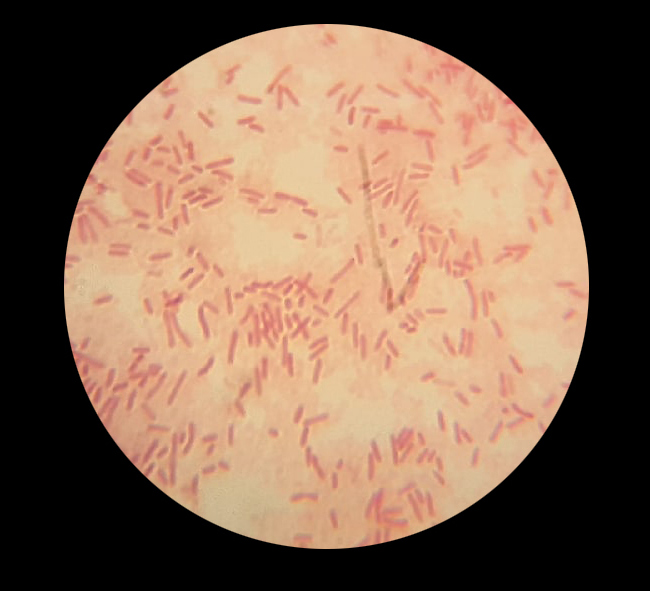
Image source: Wikipedia/Wikimedia
| Ecology, Host, and Life Cycle | |
|---|---|
| Oxygen requirements | Microaerophilic |
| Optimal temperature | 37 |
| Temperature range | Mesophilic |
| Habitat | HostAssociated |
| Biotic relationship | Free living |
| Host(s) | Not Available |
| Cell arrangement | Chains - Singles |
| Sporulation | Not Available |
| Energy source | Chemoorganotroph |
| Pathogenicity | Not Available |
Gene Summary
Adenine Count
1203357 bp
Thymine Count
1207600 bp
Guanine Count
1300883 bp
Cytosine Count
1303714 bp
Genome Length
5015554 bp
Protein-coding Genes
4773 genes
Non-Coding Genes
243 genes
# of Chromosomes/Plasmids
1
Genes
| Name | Locus Tag | UniProt ID | Strand Orientation | Gene Start/End | Protein Molecular Weight |
|---|---|---|---|---|---|
| gdp-mannose pyrophosphatase nudk | DB006_13385 | Not Available | Positive | 2579689 - 2580264 | 21811.1 |
| duf1176 domain-containing protein | DB006_13390 | Not Available | Positive | 2580389 - 2581432 | 38697.5 |
| hypothetical protein | DB006_13395 | Not Available | Positive | 2581560 - 2581790 | 8308.0 |
| transketolase | DB006_13400 | Not Available | Negative | 2581853 - 2583853 | 73063.7 |
| transaldolase a | DB006_13405 | Not Available | Negative | 2583873 - 2584823 | 35593.6 |
| hypothetical protein | DB006_13410 | Not Available | Negative | 2584893 - 2585093 | 7583.47 |
| nadp-dependent malic enzyme | DB006_13415 | Not Available | Positive | 2585095 - 2587374 | 82327.1 |
| ethanolamine utilization protein euts | DB006_13420 | Not Available | Positive | 2587792 - 2588127 | 11673.4 |
| ethanolamine utilization protein eutp | DB006_13425 | Not Available | Positive | 2588140 - 2588619 | 17726.9 |
| ethanolamine utilization acetate kinase eutq | DB006_13430 | Not Available | Positive | 2588597 - 2589286 | 24993.8 |
Pathways
0 pathways
No pathways found
No metabolic pathways have been associated with this bacterium yet.
Health Effects
No health effects information available for this bacterium.