Kingdom
Pseudomonadati
Phylum
Pseudomonadota
Class
Gammaproteobacteria
Order
Enterobacterales
Family
Enterobacteriaceae
Genus
Salmonella
Description
Taxonomy
| Kingdom | Pseudomonadati |
|---|---|
| Phylum | Pseudomonadota |
| Class | Gammaproteobacteria |
| Order | Enterobacterales |
| Family | Enterobacteriaceae |
| Genus | Salmonella |
| Species | Salmonella enterica |
| Strain | subsp. enterica serovar Saintpaul strain |
Profile
| Physiology | |
|---|---|
| Gram staining properties | Negative |
| Shape | Spirilla |
| Mobility | No |
| Flagellar presence | Yes |
| Number of membranes | 2 |

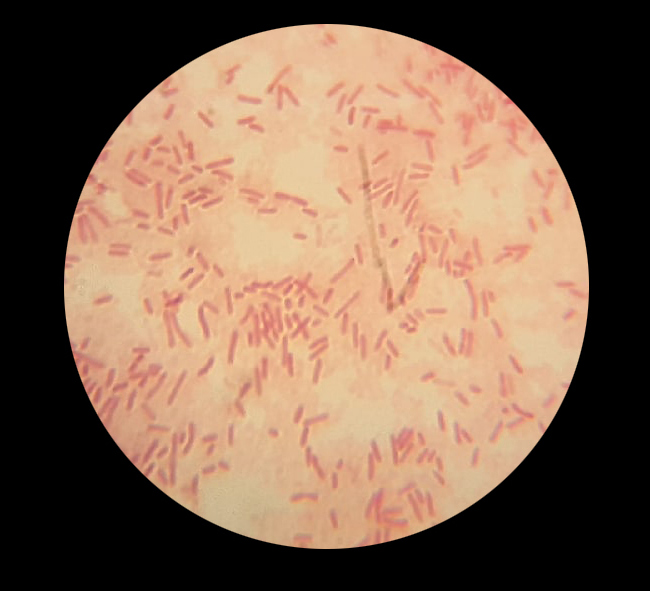
Image source: Wikipedia/Wikimedia
| Ecology, Host, and Life Cycle | |
|---|---|
| Oxygen requirements | Microaerophilic |
| Optimal temperature | 37 |
| Temperature range | Mesophilic |
| Habitat | HostAssociated |
| Biotic relationship | Free living |
| Host(s) | Not Available |
| Cell arrangement | Chains - Singles |
| Sporulation | Not Available |
| Energy source | Chemoorganotroph |
| Pathogenicity | Not Available |
Gene Summary
Adenine Count
1203357 bp
Thymine Count
1207600 bp
Guanine Count
1300883 bp
Cytosine Count
1303714 bp
Genome Length
5015554 bp
Protein-coding Genes
4773 genes
Non-Coding Genes
243 genes
# of Chromosomes/Plasmids
1
Genes
| Name | Locus Tag | UniProt ID | Strand Orientation | Gene Start/End | Protein Molecular Weight |
|---|---|---|---|---|---|
| hypothetical protein | DB006_13060 | Not Available | Negative | 2492545 - 2492754 | 7884.66 |
| duf5066 domain-containing protein | DB006_13065 | Not Available | Negative | 2492878 - 2493546 | 25635.2 |
| hypothetical protein | DB006_13070 | Not Available | Positive | 2493589 - 2493813 | 8695.74 |
| 3-mercaptopyruvate sulfurtransferase | DB006_13075 | Not Available | Negative | 2493793 - 2494635 | 30835.5 |
| alpha-2-macroglobulin family protein | DB006_13080 | Not Available | Positive | 2494844 - 2499778 | 179646.0 |
| penicillin-binding protein 1c | DB006_13085 | Not Available | Positive | 2499779 - 2502094 | 85109.6 |
| dimethyl sulfoxide reductase subunit a | DB006_13090 | Not Available | Positive | 2502223 - 2504628 | 88761.6 |
| dimethylsulfoxide reductase, chain b | DB006_13095 | Not Available | Positive | 2504625 - 2505254 | 22535.0 |
| dimethyl sulfoxide reductase | DB006_13100 | Not Available | Positive | 2505247 - 2506056 | 28661.1 |
| ferredoxin | DB006_13105 | Not Available | Positive | 2506056 - 2506919 | 31740.4 |
Pathways
0 pathways
No pathways found
No metabolic pathways have been associated with this bacterium yet.
Health Effects
No health effects information available for this bacterium.