
Kingdom
Pseudomonadati
Phylum
Pseudomonadota
Class
Gammaproteobacteria
Order
Vibrionales
Family
Vibrionaceae
Genus
Photobacterium
Description
Taxonomy
| Kingdom | Pseudomonadati |
|---|---|
| Phylum | Pseudomonadota |
| Class | Gammaproteobacteria |
| Order | Vibrionales |
| Family | Vibrionaceae |
| Genus | Photobacterium |
| Species | Photobacterium damselae |
| Strain | strain BT-6 CFSAN065500_43 |
Profile
| Physiology | |
|---|---|
| Gram staining properties | Negative |
| Shape | Coccus |
| Mobility | Yes |
| Flagellar presence | Yes |
| Number of membranes | Not Available |
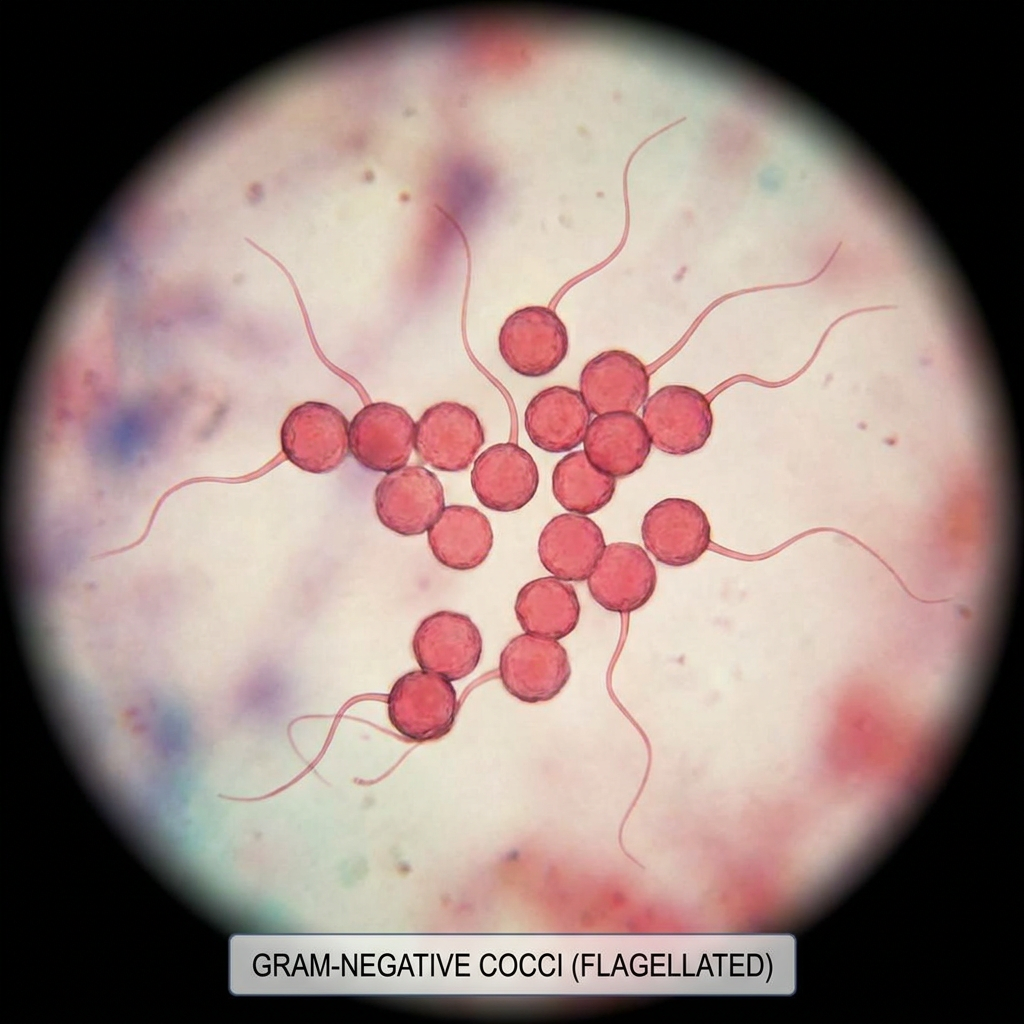
AI-generated image based on bacteria physiology
| Ecology, Host, and Life Cycle | |
|---|---|
| Oxygen requirements | Not Available |
| Optimal temperature | Not Available |
| Temperature range | mesophilic |
| Habitat | Italian aquaculture; Marine |
| Biotic relationship | Not Available |
| Host(s) | Homo sapiens, Alca torda |
| Cell arrangement | Not Available |
| Sporulation | Not Available |
| Energy source | Not Available |
| Pathogenicity | Not Available |
Gene Summary
Adenine Count
1317805 bp
Thymine Count
1343305 bp
Guanine Count
924455 bp
Cytosine Count
882234 bp
Genome Length
4467799 bp
Protein-coding Genes
3795 genes
Non-Coding Genes
159 genes
# of Chromosomes/Plasmids
1
Genes
| Name | Locus Tag | UniProt ID | Strand Orientation | Gene Start/End | Protein Molecular Weight |
|---|---|---|---|---|---|
| o-antigen ligase family protein | CTM90_12370 | Not Available | Negative | 2796532 - 2797728 | 44646.9 |
| lauroyl-kdo(2)-lipid iv(a) myristoyltransferase | CTM90_12375 | Not Available | Negative | 2797728 - 2798678 | 36434.0 |
| tetr family transcriptional regulator | CTM90_12380 | Not Available | Positive | 2798850 - 2799491 | 25050.9 |
| peptidase m23 | CTM90_12385 | Not Available | Negative | 2799555 - 2800742 | 43755.7 |
| 2,3-bisphosphoglycerate-independent phosphoglycerate mutase | CTM90_12390 | Not Available | Negative | 2800760 - 2802301 | 55741.0 |
| rhodanese-like domain-containing protein | CTM90_12395 | Not Available | Positive | 2802710 - 2803150 | 16121.6 |
| protein-export chaperone secb | CTM90_12400 | Not Available | Positive | 2803243 - 2803710 | 17163.2 |
| nad(p)h-dependent glycerol-3-phosphate dehydrogenase | CTM90_12405 | Not Available | Positive | 2803734 - 2804750 | 35971.2 |
| serine o-acetyltransferase | CTM90_12410 | Not Available | Positive | 2804882 - 2805703 | 29299.3 |
| trna (uridine(34)/cytosine(34)/5- carboxymethylaminomethyluridine(34)-2'-o)- methyltransferase trml | CTM90_12415 | Not Available | Negative | 2805762 - 2806226 | 17438.9 |
Pathways
0 pathways
No pathways found
No metabolic pathways have been associated with this bacterium yet.
