
Kingdom
Pseudomonadati
Phylum
Pseudomonadota
Class
Betaproteobacteria
Order
Burkholderiales
Family
Burkholderiaceae
Genus
Burkholderia
Description
Taxonomy
| Kingdom | Pseudomonadati |
|---|---|
| Phylum | Pseudomonadota |
| Class | Betaproteobacteria |
| Order | Burkholderiales |
| Family | Burkholderiaceae |
| Genus | Burkholderia |
| Species | Burkholderia cepacia |
| Strain | strain Y14-15 |
Profile
| Physiology | |
|---|---|
| Gram staining properties | Negative |
| Shape | Not Available |
| Mobility | Not Available |
| Flagellar presence | Not Available |
| Number of membranes | Not Available |
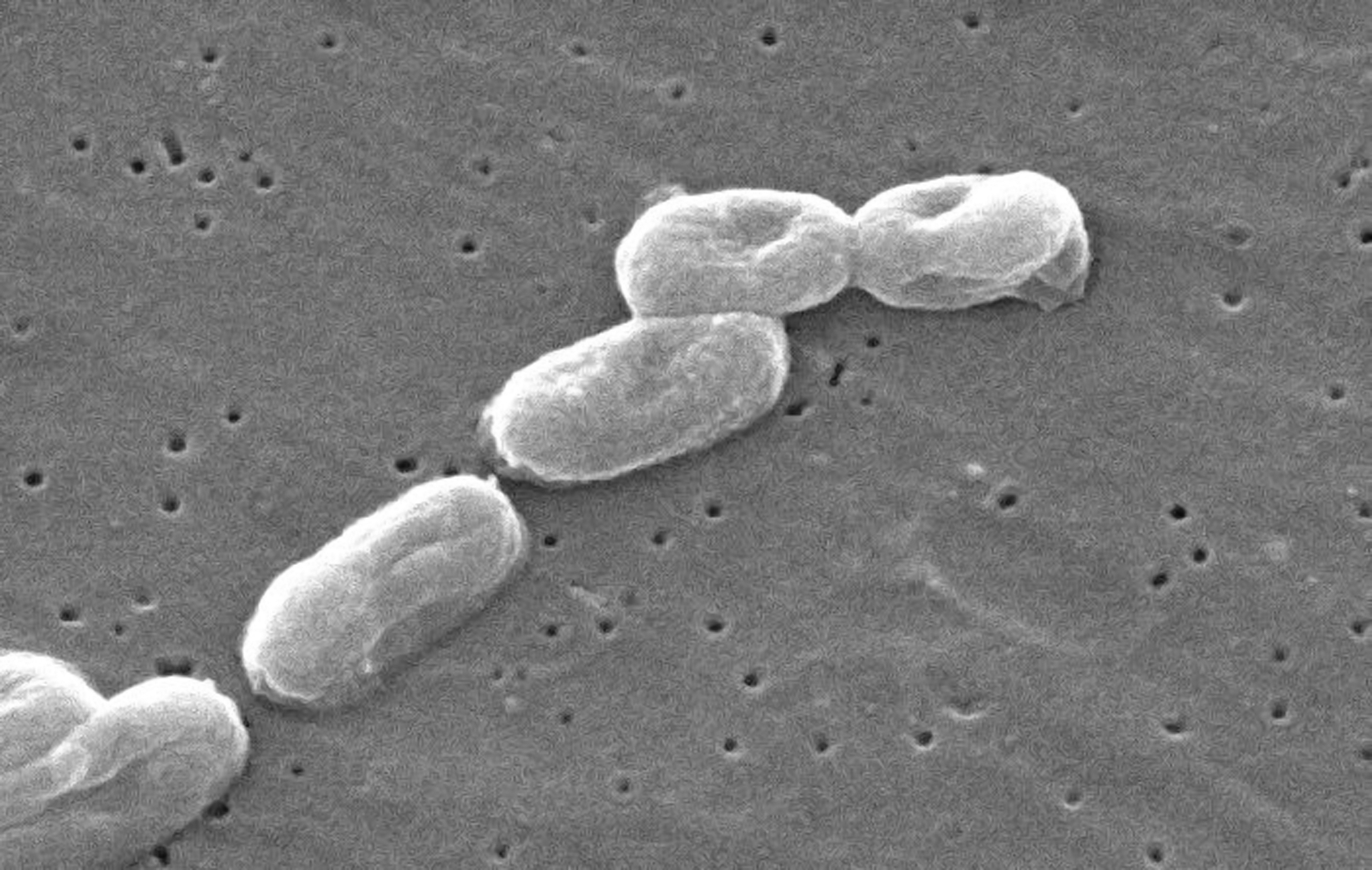
Image source: Wikipedia/Wikimedia
| Ecology, Host, and Life Cycle | |
|---|---|
| Oxygen requirements | Microaerophile |
| Optimal temperature | Not Available |
| Temperature range | Not Available |
| Habitat | rhizosphere |
| Biotic relationship | Not Available |
| Host(s) | Homo sapiens, Viridiplantae, Anura |
| Cell arrangement | Not Available |
| Sporulation | Not Available |
| Energy source | Not Available |
| Pathogenicity | Not Available |
Gene Summary
Adenine Count
1393244 bp
Thymine Count
1393984 bp
Guanine Count
2722320 bp
Cytosine Count
2723439 bp
Genome Length
8232987 bp
Protein-coding Genes
7078 genes
Non-Coding Genes
337 genes
# of Chromosomes/Plasmids
1
Genes
| Name | Locus Tag | UniProt ID | Strand Orientation | Gene Start/End | Protein Molecular Weight |
|---|---|---|---|---|---|
| cytochrome c | C5615_23590 | Not Available | Negative | 4963209 - 4964063 | 31062.3 |
| hypothetical protein | C5615_23595 | Not Available | Negative | 4964345 - 4965601 | 44935.2 |
| glutamine--fructose-6-phosphate transaminase (isomerizing) | C5615_23600 | Not Available | Negative | 4965598 - 4967421 | 65665.1 |
| biofilm pga synthesis auxiliary protein pgad | C5615_23605 | Not Available | Negative | 4967540 - 4968028 | 18029.5 |
| poly-beta-1,6 n-acetyl-d-glucosamine synthase | C5615_23610 | Not Available | Negative | 4968006 - 4969277 | 48071.1 |
| poly-beta-1,6-n-acetyl-d-glucosamine n-deacetylase pgab | C5615_23615 | Not Available | Negative | 4969274 - 4971364 | 78919.2 |
| poly-beta-1,6 n-acetyl-d-glucosamine export porin pgaa | C5615_23620 | Not Available | Negative | 4971380 - 4973707 | 83585.8 |
| hypothetical protein | C5615_23625 | Not Available | Negative | 4973811 - 4974596 | 26946.6 |
| hypothetical protein | C5615_23630 | Not Available | Negative | 4974660 - 4975070 | 14552.3 |
| gnat family n-acetyltransferase | C5615_23640 | Not Available | Negative | 4976700 - 4977125 | 15371.3 |
Pathways
1489 pathways
Health Effects
| Health Condition | Relation | Reference |
|---|---|---|
| Infective endocarditis | Causes | PMC3112426 |
| Native valve endocarditis | Causes | PMC3112426 |
| Pneumonia | Causes | PMC9294674 |



