
Kingdom
Pseudomonadati
Phylum
Pseudomonadota
Class
Betaproteobacteria
Order
Burkholderiales
Family
Burkholderiaceae
Genus
Burkholderia
Description
Taxonomy
| Kingdom | Pseudomonadati |
|---|---|
| Phylum | Pseudomonadota |
| Class | Betaproteobacteria |
| Order | Burkholderiales |
| Family | Burkholderiaceae |
| Genus | Burkholderia |
| Species | Burkholderia cepacia |
| Strain | strain Y14-15 |
Profile
| Physiology | |
|---|---|
| Gram staining properties | Negative |
| Shape | Not Available |
| Mobility | Not Available |
| Flagellar presence | Not Available |
| Number of membranes | Not Available |
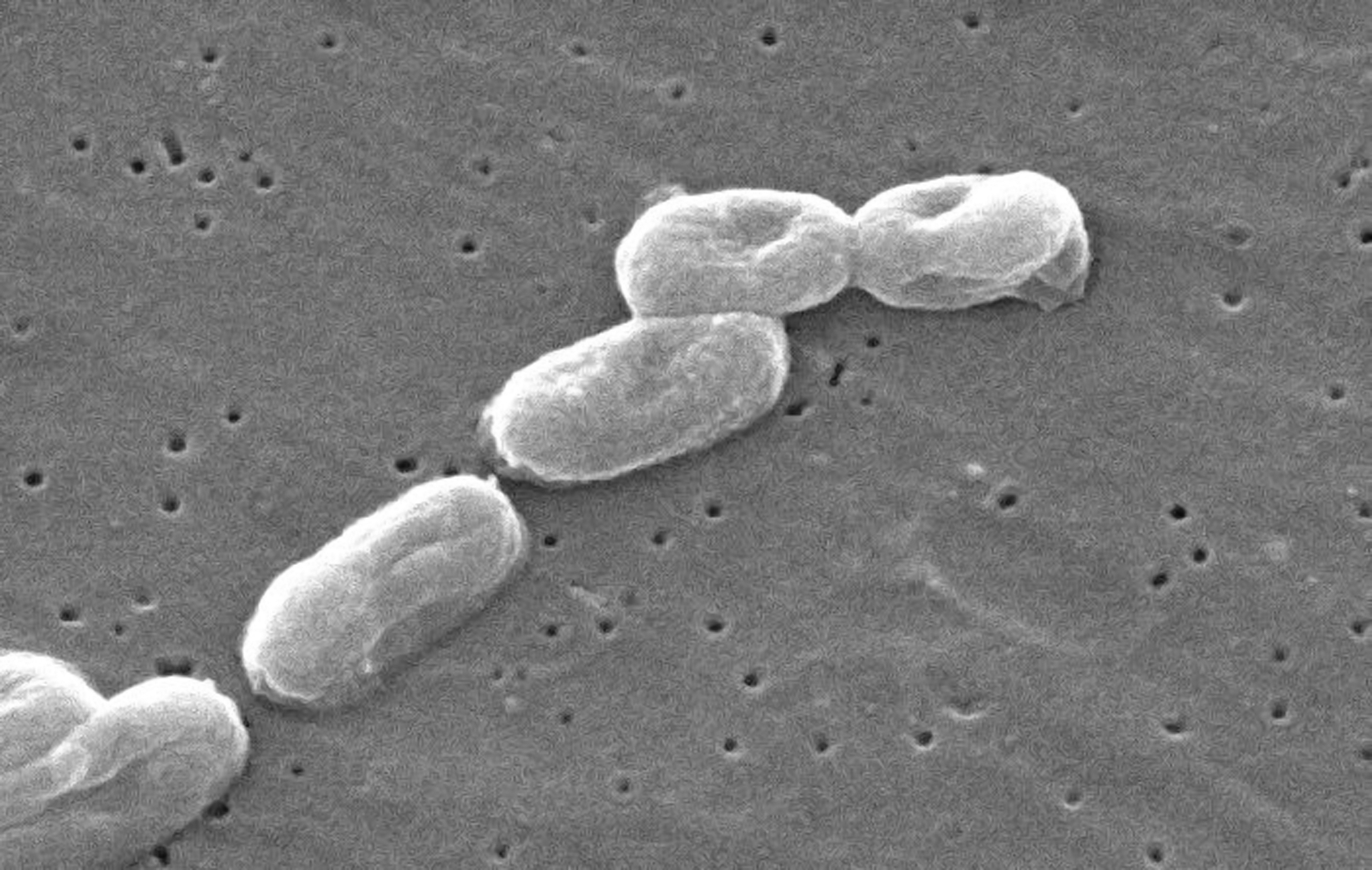
Image source: Wikipedia/Wikimedia
| Ecology, Host, and Life Cycle | |
|---|---|
| Oxygen requirements | Microaerophile |
| Optimal temperature | Not Available |
| Temperature range | Not Available |
| Habitat | rhizosphere |
| Biotic relationship | Not Available |
| Host(s) | Homo sapiens, Viridiplantae, Anura |
| Cell arrangement | Not Available |
| Sporulation | Not Available |
| Energy source | Not Available |
| Pathogenicity | Not Available |
Gene Summary
Adenine Count
1393244 bp
Thymine Count
1393984 bp
Guanine Count
2722320 bp
Cytosine Count
2723439 bp
Genome Length
8232987 bp
Protein-coding Genes
7078 genes
Non-Coding Genes
337 genes
# of Chromosomes/Plasmids
1
Genes
| Name | Locus Tag | UniProt ID | Strand Orientation | Gene Start/End | Protein Molecular Weight |
|---|---|---|---|---|---|
| mfs transporter | C5615_23220 | Not Available | Positive | 4889765 - 4891327 | 52428.8 |
| duf1090 domain-containing protein | C5615_23230 | Not Available | Negative | 4891623 - 4892054 | 15870.7 |
| lysr family transcriptional regulator | C5615_23235 | Not Available | Negative | 4892355 - 4893509 | 42710.1 |
| asp/glu/hydantoin racemase | C5615_23240 | Not Available | Negative | 4893583 - 4894311 | 25642.9 |
| nitrate reductase | C5615_23245 | Not Available | Negative | 4894334 - 4895884 | 55885.0 |
| 2-oxoglutarate dehydrogenase | C5615_23255 | Not Available | Positive | 4896557 - 4897111 | 19351.4 |
| histidine kinase | C5615_23260 | Not Available | Negative | 4897178 - 4897942 | 26251.7 |
| mfs transporter | C5615_23265 | Not Available | Negative | 4898219 - 4899526 | 46890.8 |
| marr family transcriptional regulator | C5615_23270 | Not Available | Positive | 4900059 - 4900505 | 16510.9 |
| aldehyde dehydrogenase | C5615_23275 | Not Available | Negative | 4900530 - 4902821 | 81551.3 |
Pathways
1489 pathways
Health Effects
| Health Condition | Relation | Reference |
|---|---|---|
| Infective endocarditis | Causes | PMC3112426 |
| Native valve endocarditis | Causes | PMC3112426 |
| Pneumonia | Causes | PMC9294674 |



