
Kingdom
Pseudomonadati
Phylum
Pseudomonadota
Class
Betaproteobacteria
Order
Burkholderiales
Family
Burkholderiaceae
Genus
Burkholderia
Description
Taxonomy
| Kingdom | Pseudomonadati |
|---|---|
| Phylum | Pseudomonadota |
| Class | Betaproteobacteria |
| Order | Burkholderiales |
| Family | Burkholderiaceae |
| Genus | Burkholderia |
| Species | Burkholderia cepacia |
| Strain | strain Y14-15 |
Profile
| Physiology | |
|---|---|
| Gram staining properties | Negative |
| Shape | Not Available |
| Mobility | Not Available |
| Flagellar presence | Not Available |
| Number of membranes | Not Available |
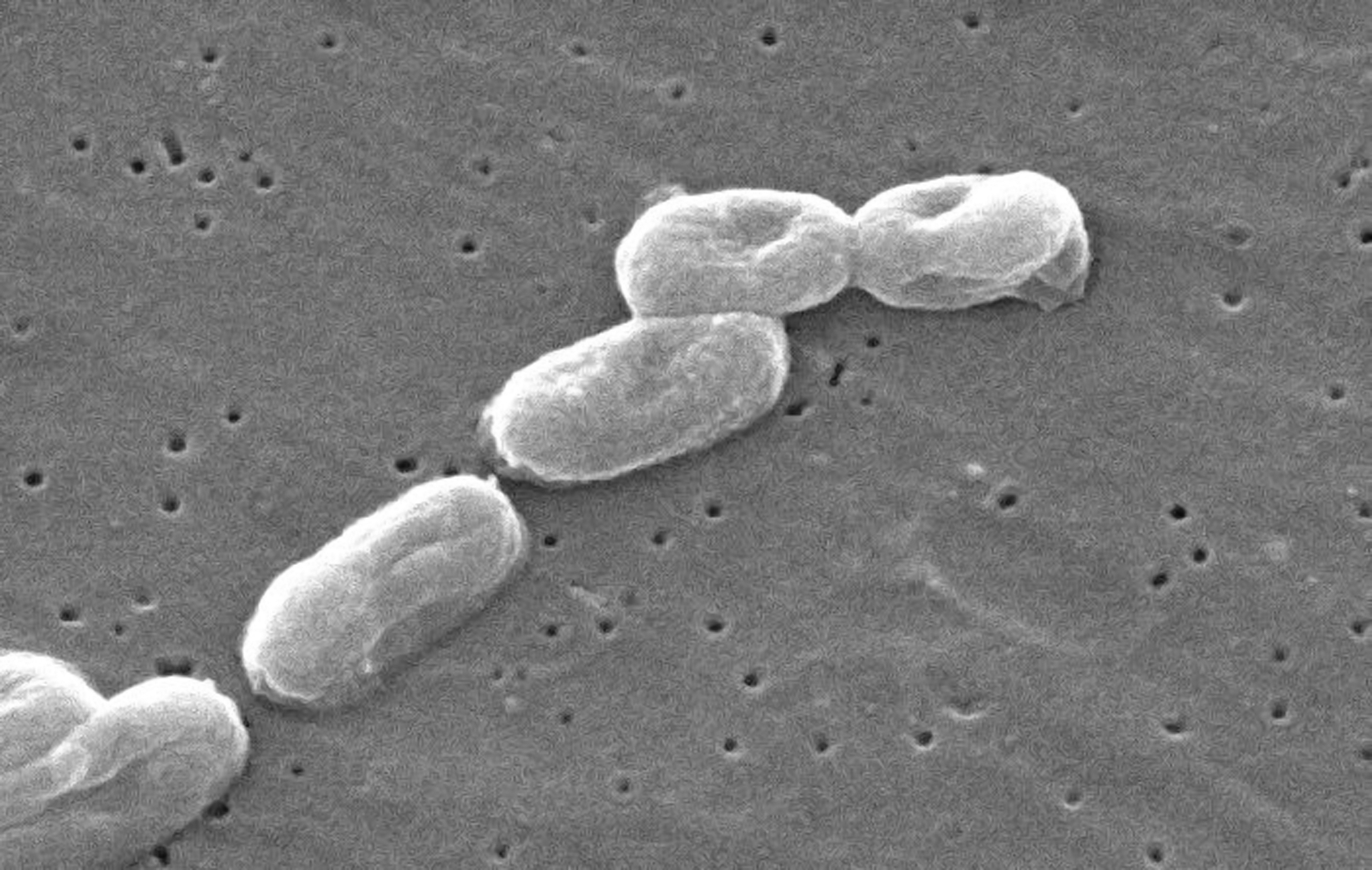
Image source: Wikipedia/Wikimedia
| Ecology, Host, and Life Cycle | |
|---|---|
| Oxygen requirements | Microaerophile |
| Optimal temperature | Not Available |
| Temperature range | Not Available |
| Habitat | rhizosphere |
| Biotic relationship | Not Available |
| Host(s) | Homo sapiens, Viridiplantae, Anura |
| Cell arrangement | Not Available |
| Sporulation | Not Available |
| Energy source | Not Available |
| Pathogenicity | Not Available |
Gene Summary
Adenine Count
1393244 bp
Thymine Count
1393984 bp
Guanine Count
2722320 bp
Cytosine Count
2723439 bp
Genome Length
8232987 bp
Protein-coding Genes
7078 genes
Non-Coding Genes
337 genes
# of Chromosomes/Plasmids
1
Genes
| Name | Locus Tag | UniProt ID | Strand Orientation | Gene Start/End | Protein Molecular Weight |
|---|---|---|---|---|---|
| alpha,alpha-trehalose-phosphate synthase (udp-forming) | C5615_21700 | Not Available | Positive | 4599389 - 4600795 | 52982.4 |
| osmc family peroxiredoxin | C5615_21705 | Not Available | Negative | 4600803 - 4601270 | 16323.5 |
| cell division protein ftsh | C5615_21710 | Not Available | Negative | 4601354 - 4603327 | 70866.0 |
| acid phosphatase | C5615_21720 | Not Available | Positive | 4603761 - 4605464 | 62037.7 |
| phosphoenolpyruvate carboxykinase (gtp) | C5615_21725 | Not Available | Negative | 4605754 - 4607619 | 68381.3 |
| polyketide cyclase | C5615_21740 | Not Available | Negative | 4609293 - 4609727 | 16035.1 |
| lysr family transcriptional regulator | C5615_21745 | Not Available | Positive | 4609773 - 4610714 | 34015.8 |
| hypothetical protein | C5615_21750 | Not Available | Negative | 4610999 - 4611187 | 6748.94 |
| hypothetical protein | C5615_21755 | Not Available | Positive | 4611434 - 4611949 | 18317.9 |
| transcriptional regulator | C5615_21760 | Not Available | Positive | 4612000 - 4612638 | 23290.6 |
Pathways
1357 pathways
Health Effects
| Health Condition | Relation | Reference |
|---|---|---|
| Infective endocarditis | Causes | PMC3112426 |
| Native valve endocarditis | Causes | PMC3112426 |
| Pneumonia | Causes | PMC9294674 |



