Kingdom
Pseudomonadati
Phylum
Pseudomonadota
Class
Gammaproteobacteria
Order
Enterobacterales
Family
Enterobacteriaceae
Genus
Escherichia
Description
Taxonomy
| Kingdom | Pseudomonadati |
|---|---|
| Phylum | Pseudomonadota |
| Class | Gammaproteobacteria |
| Order | Enterobacterales |
| Family | Enterobacteriaceae |
| Genus | Escherichia |
| Species | Escherichia coli |
| Strain | strain JL_F20_1 |
Profile
| Physiology | |
|---|---|
| Gram staining properties | Negative |
| Shape | Rod |
| Mobility | Yes |
| Flagellar presence | Yes |
| Number of membranes | 2 |

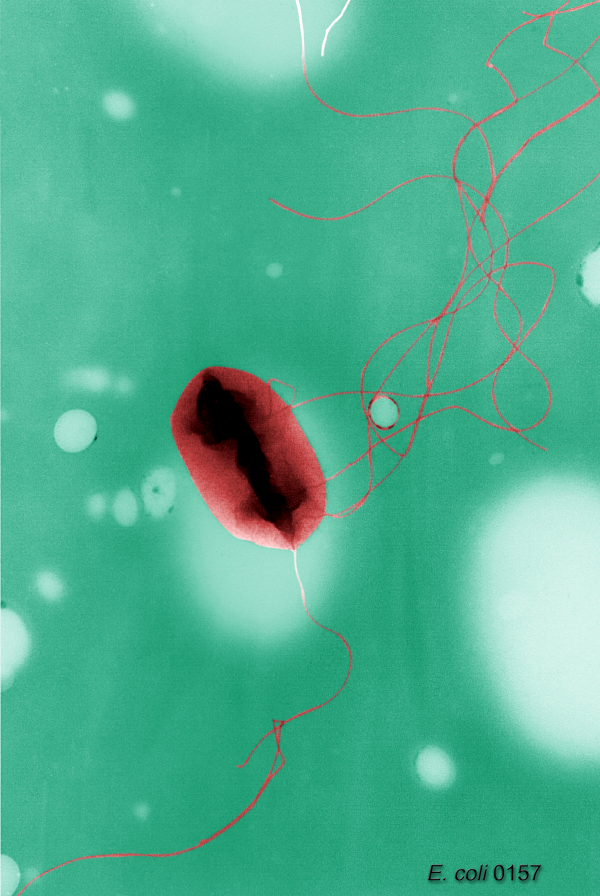
Image source: Wikipedia/Wikimedia
| Ecology, Host, and Life Cycle | |
|---|---|
| Oxygen requirements | Facultative anaerobe |
| Optimal temperature | 37 |
| Temperature range | Mesophilic |
| Habitat | HostAssociated |
| Biotic relationship | Free living |
| Host(s) | Homo sapiens, Gallus gallus, Bos taurus |
| Cell arrangement | Pairs - Singles |
| Sporulation | Not Available |
| Energy source | Not Available |
| Pathogenicity | Human |
Gene Summary
Adenine Count
1363620 bp
Thymine Count
1365332 bp
Guanine Count
1392194 bp
Cytosine Count
1395992 bp
Genome Length
5517138 bp
Protein-coding Genes
5208 genes
Non-Coding Genes
362 genes
# of Chromosomes/Plasmids
1
Genes
| Name | Locus Tag | UniProt ID | Strand Orientation | Gene Start/End | Protein Molecular Weight |
|---|---|---|---|---|---|
| Putative tail component | C5P44_27360 | Not Available | Negative | 5240747 - 5241394 | 22674.5 |
| Tail fiber component | C5P44_27365 | Not Available | Negative | 5241292 - 5242035 | 28396.4 |
| Putative minor tail protein | C5P44_27370 | Not Available | Negative | 5242041 - 5242739 | 25609.8 |
| Putative minor tail protein | C5P44_27375 | Not Available | Negative | 5242749 - 5243078 | 12530.1 |
| Putative tail protein | C5P44_27380 | Not Available | Negative | 5243078 - 5246134 | 112140.0 |
| Putative minor tail protein | C5P44_27385 | Not Available | Negative | 5246106 - 5246435 | 12350.6 |
| Minor tail protein | C5P44_27390 | Not Available | Negative | 5246444 - 5246830 | 14212.8 |
| Major tail protein | C5P44_27395 | Not Available | Negative | 5246890 - 5247633 | 25698.2 |
| Putative tail component | C5P44_27400 | Not Available | Negative | 5247644 - 5248045 | 15045.8 |
| Putative tail component | C5P44_27405 | Not Available | Negative | 5248042 - 5248620 | 21549.7 |
Pathways
0 pathways
No pathways found
No metabolic pathways have been associated with this bacterium yet.
Health Effects
| Health Condition | Relation | Reference |
|---|---|---|
| Gi disease | Causes | PMC11149725 |
| Utis | Causes | PMC11434687 |
| Colorectal cancer | Causes | PMC12198655 |
| Pyogenic liver abscesses | Causes | PMC12392612 |
| Uti | Causes | PMC13014981 |
| Colibacillosis | Causes | PMC13255289 |
| Enteric infections | Causes | PMC13255289 |
| Foodborne infections | Causes | PMC13255289 |
| Clinical mastitis | Causes | PMC13293316 |
| Diarrhea | Causes | PMC3035056 |