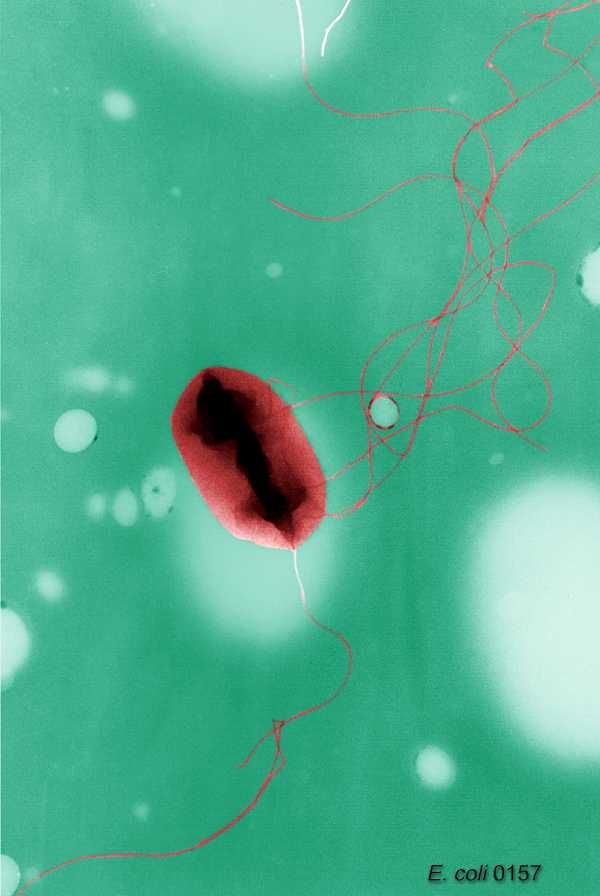
Kingdom
Pseudomonadati
Phylum
Pseudomonadota
Class
Gammaproteobacteria
Order
Enterobacterales
Family
Enterobacteriaceae
Genus
Escherichia
Description
Taxonomy
| Kingdom | Pseudomonadati |
|---|---|
| Phylum | Pseudomonadota |
| Class | Gammaproteobacteria |
| Order | Enterobacterales |
| Family | Enterobacteriaceae |
| Genus | Escherichia |
| Species | Escherichia coli |
| Strain | strain FEX725 |
Profile
| Physiology | |
|---|---|
| Gram staining properties | Negative |
| Shape | Rod |
| Mobility | Yes |
| Flagellar presence | Yes |
| Number of membranes | 2 |
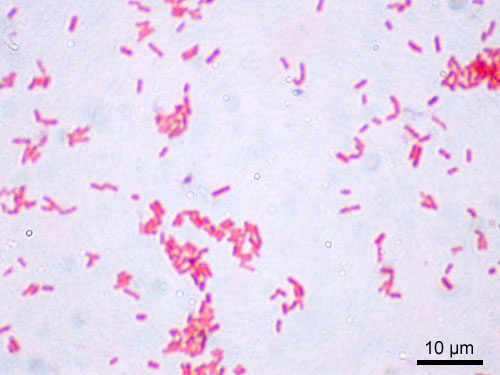
Image source: Wikipedia/Wikimedia
| Ecology, Host, and Life Cycle | |
|---|---|
| Oxygen requirements | Facultative anaerobe |
| Optimal temperature | 37 |
| Temperature range | Mesophilic |
| Habitat | HostAssociated |
| Biotic relationship | Free living |
| Host(s) | Homo sapiens, Gallus gallus, Bos taurus |
| Cell arrangement | Pairs - Singles |
| Sporulation | Not Available |
| Energy source | Not Available |
| Pathogenicity | Human |
Gene Summary
Adenine Count
1355591 bp
Thymine Count
1355096 bp
Guanine Count
1350474 bp
Cytosine Count
1376764 bp
Genome Length
5437925 bp
Protein-coding Genes
5139 genes
Non-Coding Genes
314 genes
# of Chromosomes/Plasmids
1
Genes
| Name | Locus Tag | UniProt ID | Strand Orientation | Gene Start/End | Protein Molecular Weight |
|---|---|---|---|---|---|
| n-acetyltransferase | C4M78_13775 | Not Available | Negative | 2662934 - 2663155 | 7948.48 |
| hypothetical protein | C4M78_13780 | Not Available | Negative | 2663184 - 2664122 | 34946.2 |
| duf3363 domain-containing protein | C4M78_13785 | Not Available | Negative | 2664199 - 2665431 | 46015.4 |
| is6 family transposase is15di | C4M78_13800 | Not Available | Negative | 2669575 - 2670279 | 27953.9 |
| sodium/glutamate symporter | C4M78_13805 | Not Available | Negative | 2670579 - 2671784 | 42719.9 |
| antibiotic biosynthesis monooxygenase | C4M78_13810 | Not Available | Positive | 2672228 - 2672548 | 12500.9 |
| amino acid-binding protein | C4M78_13815 | Not Available | Positive | 2672541 - 2672927 | 13818.9 |
| arsr family transcriptional regulator | C4M78_13820 | Not Available | Positive | 2672935 - 2673621 | 25297.6 |
| tetr family transcriptional regulator | C4M78_13825 | Not Available | Negative | 2673599 - 2674225 | 23514.3 |
| tetracycline efflux mfs transporter tet(b) | C4M78_13830 | Not Available | Positive | 2674304 - 2675509 | 43239.8 |
Pathways
1297 pathways
Health Effects
| Health Condition | Relation | Reference |
|---|---|---|
| Gi disease | Causes | PMC11149725 |
| Utis | Causes | PMC11434687 |
| Colorectal cancer | Causes | PMC12198655 |
| Pyogenic liver abscesses | Causes | PMC12392612 |
| Uti | Causes | PMC13014981 |
| Colibacillosis | Causes | PMC13255289 |
| Enteric infections | Causes | PMC13255289 |
| Foodborne infections | Causes | PMC13255289 |
| Clinical mastitis | Causes | PMC13293316 |
| Diarrhea | Causes | PMC3035056 |