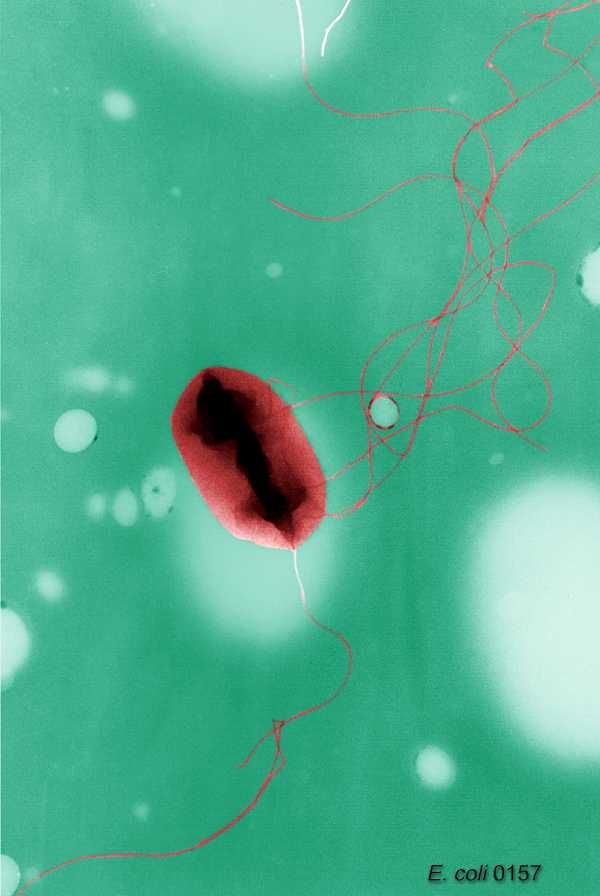
Kingdom
Pseudomonadati
Phylum
Pseudomonadota
Class
Gammaproteobacteria
Order
Enterobacterales
Family
Enterobacteriaceae
Genus
Escherichia
Description
Taxonomy
| Kingdom | Pseudomonadati |
|---|---|
| Phylum | Pseudomonadota |
| Class | Gammaproteobacteria |
| Order | Enterobacterales |
| Family | Enterobacteriaceae |
| Genus | Escherichia |
| Species | Escherichia coli |
| Strain | strain FEX725 |
Profile
| Physiology | |
|---|---|
| Gram staining properties | Negative |
| Shape | Rod |
| Mobility | Yes |
| Flagellar presence | Yes |
| Number of membranes | 2 |
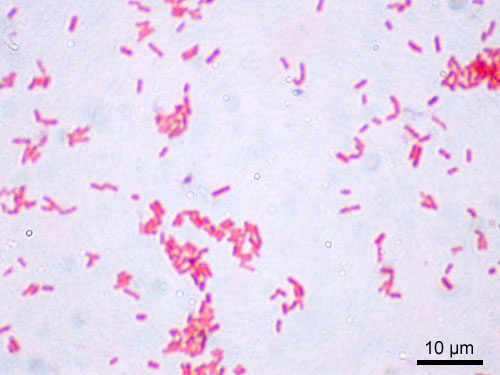
Image source: Wikipedia/Wikimedia
| Ecology, Host, and Life Cycle | |
|---|---|
| Oxygen requirements | Facultative anaerobe |
| Optimal temperature | 37 |
| Temperature range | Mesophilic |
| Habitat | HostAssociated |
| Biotic relationship | Free living |
| Host(s) | Homo sapiens, Gallus gallus, Bos taurus |
| Cell arrangement | Pairs - Singles |
| Sporulation | Not Available |
| Energy source | Not Available |
| Pathogenicity | Human |
Gene Summary
Adenine Count
1355591 bp
Thymine Count
1355096 bp
Guanine Count
1350474 bp
Cytosine Count
1376764 bp
Genome Length
5437925 bp
Protein-coding Genes
5139 genes
Non-Coding Genes
314 genes
# of Chromosomes/Plasmids
1
Genes
| Name | Locus Tag | UniProt ID | Strand Orientation | Gene Start/End | Protein Molecular Weight |
|---|---|---|---|---|---|
| tetraacyldisaccharide 4'-kinase | C4M78_08375 | Not Available | Negative | 1624859 - 1625845 | 35596.3 |
| lipid a export atp-binding/permease msba | C4M78_08380 | Not Available | Negative | 1625842 - 1627590 | 64464.6 |
| integration host factor subunit beta | C4M78_08390 | Not Available | Negative | 1630093 - 1630377 | 10651.8 |
| 30s ribosomal protein s1 | C4M78_08395 | Not Available | Negative | 1630537 - 1632210 | 61161.5 |
| cytidylate kinase | C4M78_08400 | Not Available | Negative | 1632321 - 1633004 | 24747.8 |
| metalloprotease | C4M78_08405 | Not Available | Negative | 1633177 - 1633941 | 26738.7 |
| 3-phosphoshikimate 1-carboxyvinyltransferase | C4M78_08410 | Not Available | Negative | 1634110 - 1635393 | 46216.7 |
| 3-phosphoserine/phosphohydroxythreonine transaminase | C4M78_08415 | Not Available | Negative | 1635464 - 1636552 | 39884.6 |
| duf421 domain-containing protein | C4M78_08420 | Not Available | Negative | 1636751 - 1637443 | 26251.4 |
| 30s ribosomal protein s12 methylthiotransferase accessory factor ycao | C4M78_08425 | Not Available | Positive | 1637573 - 1639333 | 65624.0 |
Pathways
1297 pathways
Health Effects
| Health Condition | Relation | Reference |
|---|---|---|
| Gi disease | Causes | PMC11149725 |
| Utis | Causes | PMC11434687 |
| Colorectal cancer | Causes | PMC12198655 |
| Pyogenic liver abscesses | Causes | PMC12392612 |
| Uti | Causes | PMC13014981 |
| Colibacillosis | Causes | PMC13255289 |
| Enteric infections | Causes | PMC13255289 |
| Foodborne infections | Causes | PMC13255289 |
| Clinical mastitis | Causes | PMC13293316 |
| Diarrhea | Causes | PMC3035056 |