Kingdom
Bacillati
Phylum
Bacillota
Class
Bacilli
Order
Lactobacillales
Family
Lactobacillaceae
Genus
Lactobacillus
Description
Taxonomy
| Kingdom | Bacillati |
|---|---|
| Phylum | Bacillota |
| Class | Bacilli |
| Order | Lactobacillales |
| Family | Lactobacillaceae |
| Genus | Lactobacillus |
| Species | Lactobacillus jensenii |
| Strain | strain UMB0077 |
Profile
| Physiology | |
|---|---|
| Gram staining properties | Not Available |
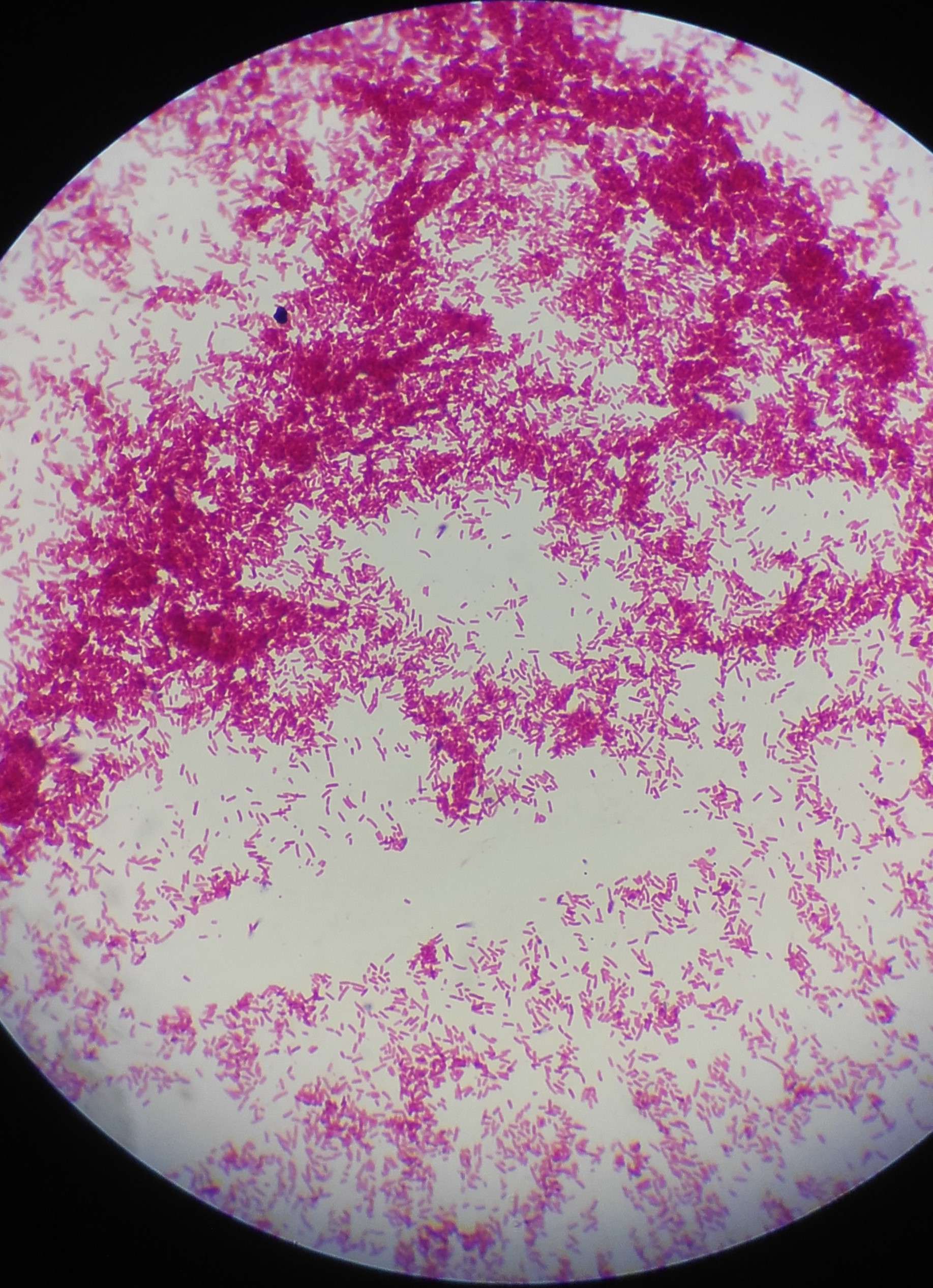
| Shape | Rod |
| Mobility | Not Available |
| Flagellar presence | Yes |
| Number of membranes | Not Available |

Image source: Wikipedia/Wikimedia
| Ecology, Host, and Life Cycle | |
|---|---|
| Oxygen requirements | Not Available |
| Optimal temperature | Not Available |
| Temperature range | Not Available |
| Habitat | vagina |
| Biotic relationship | Not Available |
| Host(s) | Homo sapiens |
| Cell arrangement | Not Available |
| Sporulation | Not Available |
| Energy source | Not Available |
| Pathogenicity | Not Available |
Gene Summary
Adenine Count
574180 bp
Thymine Count
580341 bp
Guanine Count
299231 bp
Cytosine Count
301717 bp
Genome Length
1756562 bp
Protein-coding Genes
1603 genes
Non-Coding Genes
184 genes
# of Chromosomes/Plasmids
1
Genes
| Name | Locus Tag | UniProt ID | Strand Orientation | Gene Start/End | Protein Molecular Weight |
|---|---|---|---|---|---|
| is982 family transposase | CYJ90_08315 | Not Available | Positive | 1627210 - 1627335 | 4832.77 |
| hypothetical protein | CYJ90_08395 | Not Available | Positive | 1638027 - 1638371 | 13888.3 |
| dna-binding protein | CYJ90_08400 | Not Available | Positive | 1638371 - 1638550 | 6928.33 |
| hypothetical protein | CYJ90_08405 | Not Available | Positive | 1638901 - 1639122 | 8753.41 |
| hypothetical protein | CYJ90_08410 | Not Available | Positive | 1639116 - 1639403 | 10966.2 |
| hypothetical protein | CYJ90_08415 | Not Available | Positive | 1639396 - 1639644 | 9374.24 |
| hypothetical protein | CYJ90_08420 | Not Available | Positive | 1639641 - 1639967 | 13080.7 |
| hypothetical protein | CYJ90_08425 | Not Available | Positive | 1639924 - 1640442 | 20077.4 |
| hypothetical protein | CYJ90_08430 | Not Available | Positive | 1640644 - 1640841 | 7330.23 |
| hypothetical protein | CYJ90_08435 | Not Available | Positive | 1640834 - 1641352 | 20295.4 |
Pathways
65 pathways
Health Effects
No health effects information available for this bacterium.