Kingdom
Bacillati
Phylum
Bacillota
Class
Bacilli
Order
Lactobacillales
Family
Lactobacillaceae
Genus
Lactobacillus
Description
Taxonomy
| Kingdom | Bacillati |
|---|---|
| Phylum | Bacillota |
| Class | Bacilli |
| Order | Lactobacillales |
| Family | Lactobacillaceae |
| Genus | Lactobacillus |
| Species | Lactobacillus jensenii |
| Strain | strain UMB0077 |
Profile
| Physiology | |
|---|---|
| Gram staining properties | Not Available |
| Shape | Rod |
| Mobility | Not Available |
| Flagellar presence | Yes |
| Number of membranes | Not Available |

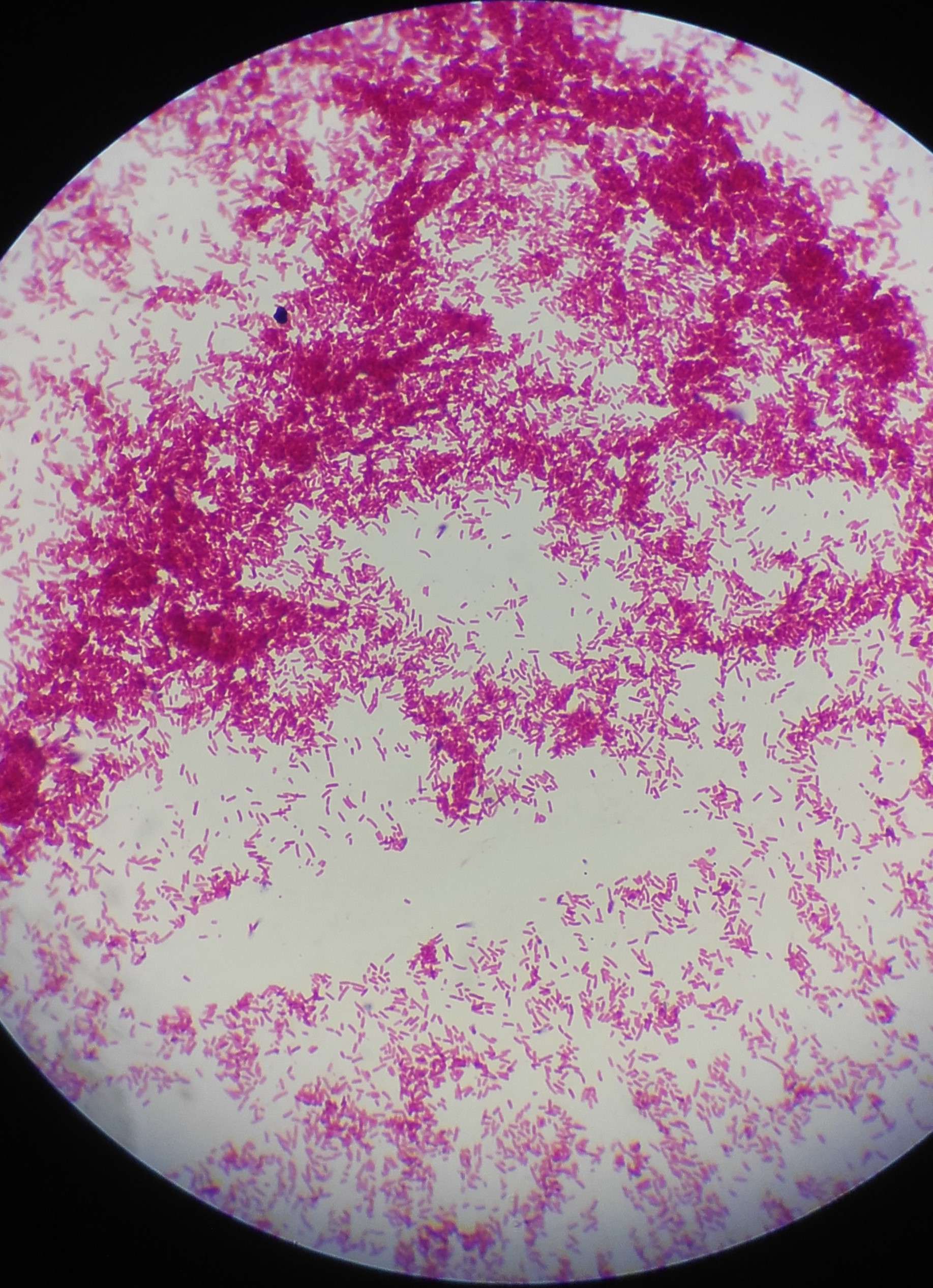
Image source: Wikipedia/Wikimedia
| Ecology, Host, and Life Cycle | |
|---|---|
| Oxygen requirements | Not Available |
| Optimal temperature | Not Available |
| Temperature range | Not Available |
| Habitat | vagina |
| Biotic relationship | Not Available |
| Host(s) | Homo sapiens |
| Cell arrangement | Not Available |
| Sporulation | Not Available |
| Energy source | Not Available |
| Pathogenicity | Not Available |
Gene Summary
Adenine Count
574180 bp
Thymine Count
580341 bp
Guanine Count
299231 bp
Cytosine Count
301717 bp
Genome Length
1756562 bp
Protein-coding Genes
1603 genes
Non-Coding Genes
184 genes
# of Chromosomes/Plasmids
1
Genes
| Name | Locus Tag | UniProt ID | Strand Orientation | Gene Start/End | Protein Molecular Weight |
|---|---|---|---|---|---|
| d-alanyl-d-alanine carboxypeptidase | CYJ90_06890 | Not Available | Negative | 1372755 - 1374023 | 46534.3 |
| nad(p)h-hydrate dehydratase | CYJ90_06895 | Not Available | Negative | 1374035 - 1374880 | 30560.1 |
| Trna-leu | Not Available | Not Available | Positive | 1374953 - 1375036 | Not Available |
| duf3862 domain-containing protein | CYJ90_06905 | Not Available | Positive | 1375195 - 1375839 | 23185.9 |
| cell division protein | CYJ90_06910 | Not Available | Negative | 1375885 - 1377597 | 65512.9 |
| peptide deformylase | CYJ90_06915 | Not Available | Negative | 1377651 - 1378061 | 15448.0 |
| phosphoenolpyruvate synthase | CYJ90_06920 | Not Available | Negative | 1378149 - 1380533 | 88378.6 |
| is982 family transposase | CYJ90_06925 | Not Available | Positive | 1380710 - 1380836 | 4832.77 |
| cation transporter | CYJ90_06930 | Not Available | Negative | 1380829 - 1381947 | 41882.5 |
| iron-sulfur cluster biosynthesis family protein | CYJ90_06935 | Not Available | Positive | 1382140 - 1382541 | 14554.3 |
Pathways
65 pathways
Health Effects
No health effects information available for this bacterium.