Kingdom
Pseudomonadati
Phylum
Pseudomonadota
Class
Gammaproteobacteria
Order
Enterobacterales
Family
Yersiniaceae
Genus
Yersinia
Description
Taxonomy
| Kingdom | Pseudomonadati |
|---|---|
| Phylum | Pseudomonadota |
| Class | Gammaproteobacteria |
| Order | Enterobacterales |
| Family | Yersiniaceae |
| Genus | Yersinia |
| Species | Yersinia bercovieri |
| Strain | strain SCPM-O-B-7607 |
Profile
| Physiology | |
|---|---|
| Gram staining properties | Negative |
| Shape | Rod |
| Mobility | Yes |
| Flagellar presence | Yes |
| Number of membranes | 2 |

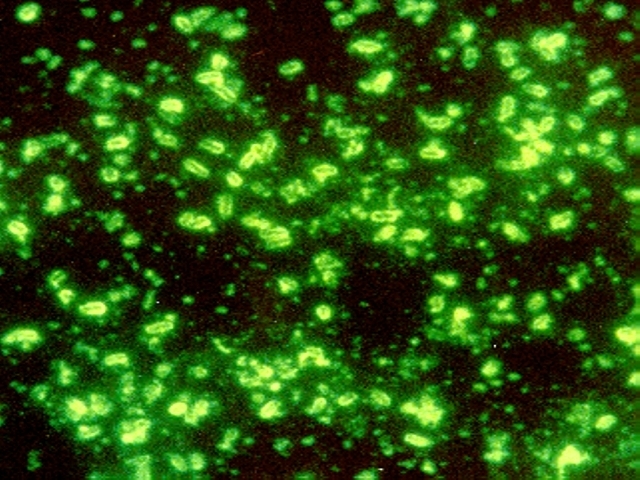
Image source: Wikipedia/Wikimedia
| Ecology, Host, and Life Cycle | |
|---|---|
| Oxygen requirements | Facultative anaerobe |
| Optimal temperature | 28 |
| Temperature range | Mesophilic |
| Habitat | Multiple |
| Biotic relationship | Free living |
| Host(s) | Homo sapiens |
| Cell arrangement | Singles |
| Sporulation | Not Available |
| Energy source | Heterotroph |
| Pathogenicity | Not Available |
Gene Summary
Adenine Count
1106748 bp
Thymine Count
1091650 bp
Guanine Count
1040798 bp
Cytosine Count
1079584 bp
Genome Length
4318780 bp
Protein-coding Genes
0 genes
Non-Coding Genes
0 genes
# of Chromosomes/Plasmids
1
Genes
| Name | Locus Tag | UniProt ID | Strand Orientation | Gene Start/End | Protein Molecular Weight |
|---|---|---|---|---|---|
| lipoprotein signal peptidase | CS533_00780 | Not Available | Negative | 185223 - 185732 | 18891.2 |
| isoleucine--trna ligase | CS533_00785 | Not Available | Negative | 185732 - 188548 | 104526.0 |
| bifunctional riboflavin kinase/fmn adenylyltransferase | CS533_00790 | Not Available | Negative | 188580 - 189518 | 34395.8 |
| 30s ribosomal protein s20 | CS533_00800 | Not Available | Positive | 189932 - 190195 | 9790.02 |
| transcriptional activator nhar | CS533_00805 | Not Available | Negative | 190358 - 191257 | 33856.1 |
| na+/h+ antiporter nhaa | CS533_00810 | Not Available | Negative | 191431 - 192606 | 41320.1 |
| molecular chaperone dnaj | CS533_00815 | Not Available | Negative | 193023 - 194156 | 41060.6 |
| molecular chaperone dnak | CS533_00820 | Not Available | Negative | 194269 - 196182 | 69070.0 |
| hypothetical protein | CS533_00825 | Not Available | Positive | 196539 - 197132 | 20951.1 |
| n-acetyltransferase | CS533_00830 | Not Available | Positive | 197746 - 199614 | 70777.2 |
Pathways
0 pathways
No pathways found
No metabolic pathways have been associated with this bacterium yet.
Health Effects
No health effects information available for this bacterium.