Kingdom
Pseudomonadati
Phylum
Pseudomonadota
Class
Gammaproteobacteria
Order
Enterobacterales
Family
Yersiniaceae
Genus
Yersinia
Description
Taxonomy
| Kingdom | Pseudomonadati |
|---|---|
| Phylum | Pseudomonadota |
| Class | Gammaproteobacteria |
| Order | Enterobacterales |
| Family | Yersiniaceae |
| Genus | Yersinia |
| Species | Yersinia bercovieri |
| Strain | strain SCPM-O-B-7607 |
Profile
| Physiology | |
|---|---|
| Gram staining properties | Negative |
| Shape | Rod |
| Mobility | Yes |
| Flagellar presence | Yes |
| Number of membranes | 2 |

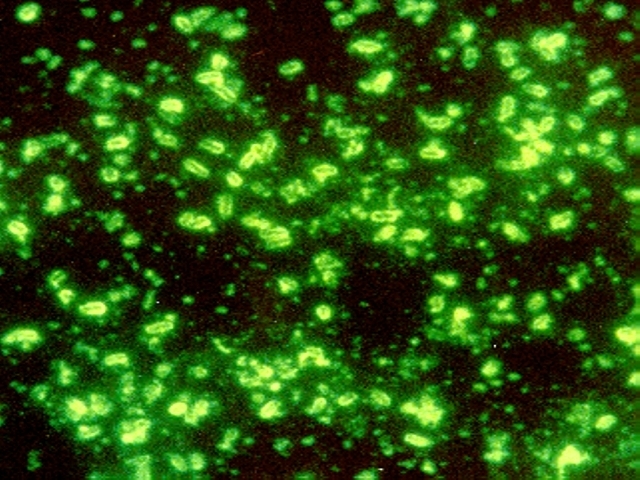
Image source: Wikipedia/Wikimedia
| Ecology, Host, and Life Cycle | |
|---|---|
| Oxygen requirements | Facultative anaerobe |
| Optimal temperature | 28 |
| Temperature range | Mesophilic |
| Habitat | Multiple |
| Biotic relationship | Free living |
| Host(s) | Homo sapiens |
| Cell arrangement | Singles |
| Sporulation | Not Available |
| Energy source | Heterotroph |
| Pathogenicity | Not Available |
Gene Summary
Adenine Count
1106748 bp
Thymine Count
1091650 bp
Guanine Count
1040798 bp
Cytosine Count
1079584 bp
Genome Length
4318780 bp
Protein-coding Genes
0 genes
Non-Coding Genes
0 genes
# of Chromosomes/Plasmids
1
Genes
| Name | Locus Tag | UniProt ID | Strand Orientation | Gene Start/End | Protein Molecular Weight |
|---|---|---|---|---|---|
| uroporphyrinogen-iii c-methyltransferase | CS533_00100 | Not Available | Negative | 17421 - 18839 | 50872.1 |
| aminopeptidase | CS533_00105 | Not Available | Positive | 19119 - 20171 | 38569.9 |
| phosphoadenylyl-sulfate reductase | CS533_00110 | Not Available | Negative | 20539 - 21273 | 27875.2 |
| nadph-dependent assimilatory sulfite reductase hemoprotein subunit | CS533_00115 | Not Available | Negative | 21270 - 23000 | 64298.1 |
| Ncrna_class:other | Not Available | Not Available | Positive | 23586 - 23704 | Not Available |
| Ncrna_class:other | Not Available | Not Available | Positive | 23745 - 23864 | Not Available |
| Ncrna_class:other | Not Available | Not Available | Positive | 23904 - 24022 | Not Available |
| nadph-dependent assimilatory sulfite reductase flavoprotein subunit | CS533_00120 | Not Available | Negative | 23000 - 24805 | 66179.4 |
| 6-carboxytetrahydropterin synthase qued | CS533_00125 | Not Available | Positive | 25175 - 25534 | 13446.1 |
| 7-carboxy-7-deazaguanine synthase quee | CS533_00130 | Not Available | Negative | 25568 - 26239 | 24962.1 |
Pathways
0 pathways
No pathways found
No metabolic pathways have been associated with this bacterium yet.
Health Effects
No health effects information available for this bacterium.