Kingdom
Pseudomonadati
Phylum
Pseudomonadota
Class
Gammaproteobacteria
Order
Enterobacterales
Family
Yersiniaceae
Genus
Yersinia
Description
Taxonomy
| Kingdom | Pseudomonadati |
|---|---|
| Phylum | Pseudomonadota |
| Class | Gammaproteobacteria |
| Order | Enterobacterales |
| Family | Yersiniaceae |
| Genus | Yersinia |
| Species | Yersinia bercovieri |
| Strain | strain SCPM-O-B-7607 |
Profile
| Physiology | |
|---|---|
| Gram staining properties | Negative |
| Shape | Rod |
| Mobility | Yes |
| Flagellar presence | Yes |
| Number of membranes | 2 |

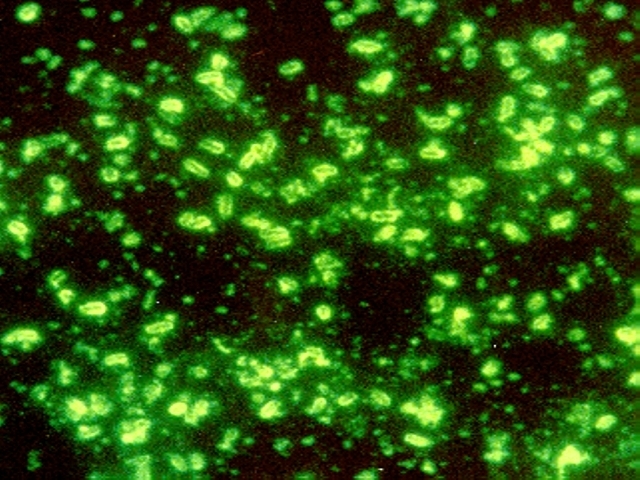
Image source: Wikipedia/Wikimedia
| Ecology, Host, and Life Cycle | |
|---|---|
| Oxygen requirements | Facultative anaerobe |
| Optimal temperature | 28 |
| Temperature range | Mesophilic |
| Habitat | Multiple |
| Biotic relationship | Free living |
| Host(s) | Homo sapiens |
| Cell arrangement | Singles |
| Sporulation | Not Available |
| Energy source | Heterotroph |
| Pathogenicity | Not Available |
Gene Summary
Adenine Count
1106748 bp
Thymine Count
1091650 bp
Guanine Count
1040798 bp
Cytosine Count
1079584 bp
Genome Length
4318780 bp
Protein-coding Genes
0 genes
Non-Coding Genes
0 genes
# of Chromosomes/Plasmids
1
Genes
| Name | Locus Tag | UniProt ID | Strand Orientation | Gene Start/End | Protein Molecular Weight |
|---|---|---|---|---|---|
| fimbrial protein | CS533_08160 | Not Available | Positive | 1766906 - 1767634 | 27064.7 |
| type 1 fimbrial protein | CS533_08165 | Not Available | Positive | 1767679 - 1768215 | 18532.2 |
| fimbrial protein | CS533_08170 | Not Available | Positive | 1768286 - 1768822 | 18542.5 |
| hypothetical protein | CS533_08175 | Not Available | Positive | 1768927 - 1770009 | 39407.4 |
| nad(p)-dependent alcohol dehydrogenase | CS533_08180 | Not Available | Negative | 1770338 - 1771348 | 36878.1 |
| lysr family transcriptional regulator | CS533_08185 | Not Available | Positive | 1771524 - 1772420 | 33364.5 |
| hypothetical protein | CS533_08190 | Not Available | Negative | 1772452 - 1772652 | 7918.34 |
| type vi secretion system contractile sheath small subunit | CS533_08195 | Not Available | Positive | 1773472 - 1773972 | 18654.4 |
| type vi secretion system contractile sheath large subunit | CS533_08200 | Not Available | Positive | 1774015 - 1775568 | 58147.9 |
| type vi secretion system baseplate subunit tssk | CS533_08205 | Not Available | Positive | 1775580 - 1776917 | 49548.4 |
Pathways
0 pathways
No pathways found
No metabolic pathways have been associated with this bacterium yet.
Health Effects
No health effects information available for this bacterium.