Kingdom
Pseudomonadati
Phylum
Pseudomonadota
Class
Gammaproteobacteria
Order
Enterobacterales
Family
Yersiniaceae
Genus
Yersinia
Description
Taxonomy
| Kingdom | Pseudomonadati |
|---|---|
| Phylum | Pseudomonadota |
| Class | Gammaproteobacteria |
| Order | Enterobacterales |
| Family | Yersiniaceae |
| Genus | Yersinia |
| Species | Yersinia bercovieri |
| Strain | strain SCPM-O-B-7607 |
Profile
| Physiology | |
|---|---|
| Gram staining properties | Negative |
| Shape | Rod |
| Mobility | Yes |
| Flagellar presence | Yes |
| Number of membranes | 2 |

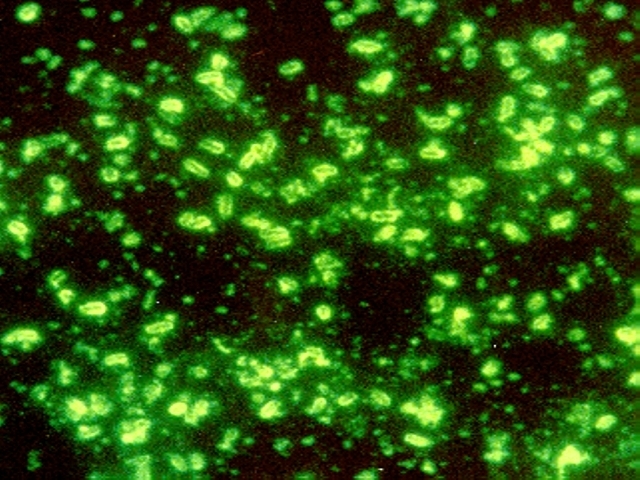
Image source: Wikipedia/Wikimedia
| Ecology, Host, and Life Cycle | |
|---|---|
| Oxygen requirements | Facultative anaerobe |
| Optimal temperature | 28 |
| Temperature range | Mesophilic |
| Habitat | Multiple |
| Biotic relationship | Free living |
| Host(s) | Homo sapiens |
| Cell arrangement | Singles |
| Sporulation | Not Available |
| Energy source | Heterotroph |
| Pathogenicity | Not Available |
Gene Summary
Adenine Count
1106748 bp
Thymine Count
1091650 bp
Guanine Count
1040798 bp
Cytosine Count
1079584 bp
Genome Length
4318780 bp
Protein-coding Genes
0 genes
Non-Coding Genes
0 genes
# of Chromosomes/Plasmids
1
Genes
| Name | Locus Tag | UniProt ID | Strand Orientation | Gene Start/End | Protein Molecular Weight |
|---|---|---|---|---|---|
| nad(p)-dependent oxidoreductase | CS533_06860 | Not Available | Negative | 1492150 - 1492977 | 29847.3 |
| atp phosphoribosyltransferase | CS533_06865 | Not Available | Positive | 1493559 - 1494458 | 33486.1 |
| histidinol dehydrogenase | CS533_06870 | Not Available | Positive | 1494462 - 1495787 | 47092.4 |
| histidinol-phosphate transaminase | CS533_06875 | Not Available | Positive | 1495784 - 1496908 | 41325.6 |
| bifunctional histidinol-phosphatase/imidazoleglycerol-phosphate dehydratase hisb | CS533_06880 | Not Available | Positive | 1496905 - 1497972 | 39918.8 |
| imidazole glycerol phosphate synthase subunit hish | CS533_06885 | Not Available | Positive | 1497972 - 1498562 | 21258.7 |
| 1-(5-phosphoribosyl)-5-[(5- phosphoribosylamino)methylideneamino]imidazole-4- carboxamide isomerase | CS533_06890 | Not Available | Positive | 1498568 - 1499305 | 26584.9 |
| imidazole glycerol phosphate synthase subunit hisf | CS533_06895 | Not Available | Positive | 1499287 - 1500063 | 28509.1 |
| bifunctional phosphoribosyl-amp cyclohydrolase/phosphoribosyl-atp diphosphatase hisie | CS533_06900 | Not Available | Positive | 1500057 - 1500671 | 22834.1 |
| phosphogluconate dehydrogenase (nadp(+)-dependent, decarboxylating) | CS533_06905 | Not Available | Negative | 1500811 - 1502220 | 51650.3 |
Pathways
0 pathways
No pathways found
No metabolic pathways have been associated with this bacterium yet.
Health Effects
No health effects information available for this bacterium.