Kingdom
Pseudomonadati
Phylum
Pseudomonadota
Class
Betaproteobacteria
Order
Burkholderiales
Family
Oxalobacteraceae
Genus
Massilia
Description
Taxonomy
| Kingdom | Pseudomonadati |
|---|---|
| Phylum | Pseudomonadota |
| Class | Betaproteobacteria |
| Order | Burkholderiales |
| Family | Oxalobacteraceae |
| Genus | Massilia |
| Species | Massilia eurypsychrophila |
| Strain | strain JCM 30074 ZB100119 |
Profile
| Physiology | |
|---|---|
| Gram staining properties | Gram-negative |
| Shape | rod |
| Mobility | Not Available |
| Flagellar presence | Not Available |
| Number of membranes | Not Available |

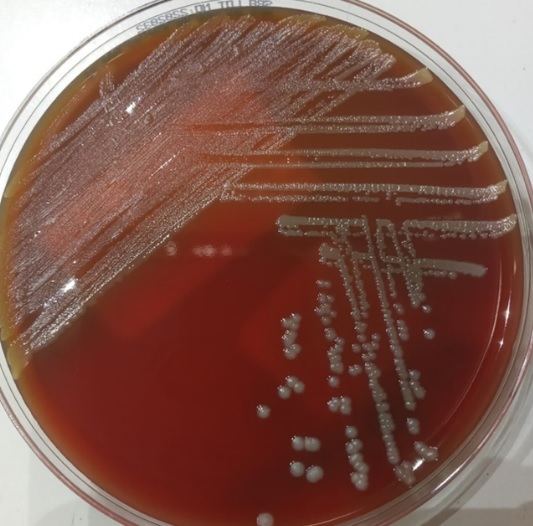
Image source: Wikipedia/Wikimedia
| Ecology, Host, and Life Cycle | |
|---|---|
| Oxygen requirements | Not Available |
| Optimal temperature | Not Available |
| Temperature range | Not Available |
| Habitat | Not Available |
| Biotic relationship | Not Available |
| Host(s) | Not Available |
| Cell arrangement | Not Available |
| Sporulation | Not Available |
| Energy source | Not Available |
| Pathogenicity | Not Available |
Gene Summary
Adenine Count
1071788 bp
Thymine Count
1072554 bp
Guanine Count
1906469 bp
Cytosine Count
1898505 bp
Genome Length
5949316 bp
Protein-coding Genes
5275 genes
Non-Coding Genes
80 genes
# of Chromosomes/Plasmids
1
Genes
| Name | Locus Tag | UniProt ID | Strand Orientation | Gene Start/End | Protein Molecular Weight |
|---|---|---|---|---|---|
| copper resistance protein copc | CR105_26260 | Not Available | Positive | 5724000 - 5724383 | 14145.2 |
| copper resistance protein copd | CR105_26265 | Not Available | Positive | 5724373 - 5725326 | 32587.2 |
| duf4440 domain-containing protein | CR105_26270 | Not Available | Positive | 5725367 - 5725810 | 15797.8 |
| copper-translocating p-type atpase | CR105_26275 | Not Available | Positive | 5725897 - 5728230 | 82507.5 |
| duf305 domain-containing protein | CR105_26280 | Not Available | Negative | 5728320 - 5728886 | 21431.5 |
| dna-binding response regulator | CR105_26285 | Not Available | Positive | 5729271 - 5729954 | 25507.1 |
| two-component sensor histidine kinase | CR105_26290 | Not Available | Positive | 5729945 - 5731342 | 49689.6 |
| duf305 domain-containing protein | CR105_26295 | Not Available | Negative | 5731393 - 5731869 | 17043.0 |
| hypothetical protein | CR105_26300 | Not Available | Negative | 5731939 - 5732292 | 12171.0 |
| hypothetical protein | CR105_26305 | Not Available | Negative | 5732354 - 5732863 | 17889.3 |
Pathways
0 pathways
No pathways found
No metabolic pathways have been associated with this bacterium yet.
Health Effects
No health effects information available for this bacterium.