
Kingdom
Pseudomonadati
Phylum
Pseudomonadota
Class
Gammaproteobacteria
Order
Lysobacterales
Family
Lysobacteraceae
Genus
Xanthomonas
Description
Taxonomy
| Kingdom | Pseudomonadati |
|---|---|
| Phylum | Pseudomonadota |
| Class | Gammaproteobacteria |
| Order | Lysobacterales |
| Family | Lysobacteraceae |
| Genus | Xanthomonas |
| Species | Xanthomonas fragariae |
| Strain | strain PD5205 |
Profile
| Physiology | |
|---|---|
| Gram staining properties | Not Available |
| Shape | Rod |
| Mobility | Not Available |
| Flagellar presence | Yes |
| Number of membranes | Not Available |
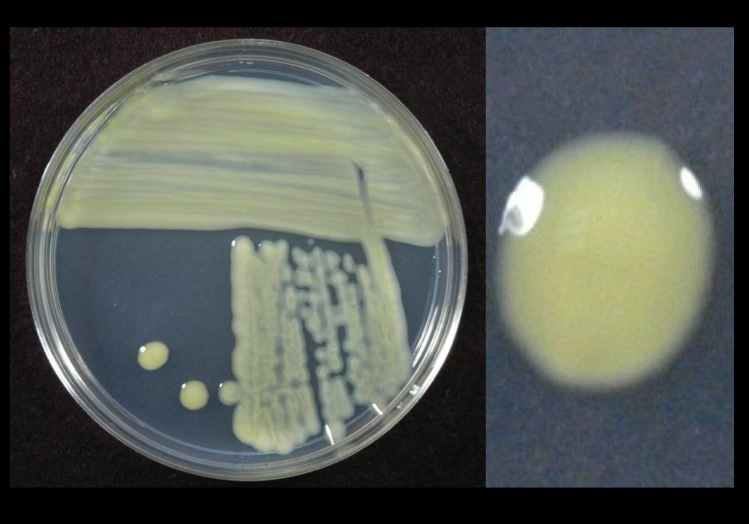
Image source: Wikipedia/Wikimedia
| Ecology, Host, and Life Cycle | |
|---|---|
| Oxygen requirements | aerobic |
| Optimal temperature | Not Available |
| Temperature range | Not Available |
| Habitat | Not Available |
| Biotic relationship | Not Available |
| Host(s) | Fragaria x ananassa |
| Cell arrangement | Not Available |
| Sporulation | Not Available |
| Energy source | Not Available |
| Pathogenicity | Not Available |
Gene Summary
Adenine Count
799566 bp
Thymine Count
796260 bp
Guanine Count
1318411 bp
Cytosine Count
1318407 bp
Genome Length
4232644 bp
Protein-coding Genes
3796 genes
Non-Coding Genes
192 genes
# of Chromosomes/Plasmids
1
Genes
| Name | Locus Tag | UniProt ID | Strand Orientation | Gene Start/End | Protein Molecular Weight |
|---|---|---|---|---|---|
| glycerophosphodiester phosphodiesterase family protein | PD5205_RS11515 | Not Available | Negative | 2475258 - 2475855 | 22607.9 |
| glycerophosphodiester phosphodiesterase family protein | PD5205_RS11520 | Not Available | Negative | 2475903 - 2476212 | 10940.8 |
| glycerophosphodiester phosphodiesterase family protein | PD5205_RS11525 | Not Available | Positive | 2476282 - 2477407 | 40939.9 |
| hypothetical protein | PD5205_RS11530 | Not Available | Negative | 2477548 - 2477829 | 10659.4 |
| glycerophosphodiester phosphodiesterase family protein | PD5205_RS11535 | Not Available | Positive | 2478204 - 2478493 | 10474.5 |
| transposase | PD5205_RS11540 | Not Available | Negative | 2478655 - 2479032 | 14301.4 |
| glycerophosphodiester phosphodiesterase family protein | PD5205_RS11545 | Not Available | Negative | 2479175 - 2480194 | 37981.0 |
| t6ss phospholipase effector tle1-like catalytic domain-containing protein | PD5205_RS11550 | Not Available | Negative | 2480436 - 2482805 | 88176.1 |
| duf3304 domain-containing protein | PD5205_RS11555 | Not Available | Negative | 2482802 - 2483377 | 21168.0 |
| hypothetical protein | PD5205_RS21975 | Not Available | Negative | 2483449 - 2483601 | 5993.19 |
Pathways
0 pathways
No pathways found
No metabolic pathways have been associated with this bacterium yet.
Health Effects
No health effects information available for this bacterium.