
Kingdom
Pseudomonadati
Phylum
Pseudomonadota
Class
Gammaproteobacteria
Order
Lysobacterales
Family
Lysobacteraceae
Genus
Xanthomonas
Description
Taxonomy
| Kingdom | Pseudomonadati |
|---|---|
| Phylum | Pseudomonadota |
| Class | Gammaproteobacteria |
| Order | Lysobacterales |
| Family | Lysobacteraceae |
| Genus | Xanthomonas |
| Species | Xanthomonas fragariae |
| Strain | strain PD5205 |
Profile
| Physiology | |
|---|---|
| Gram staining properties | Not Available |
| Shape | Rod |
| Mobility | Not Available |
| Flagellar presence | Yes |
| Number of membranes | Not Available |
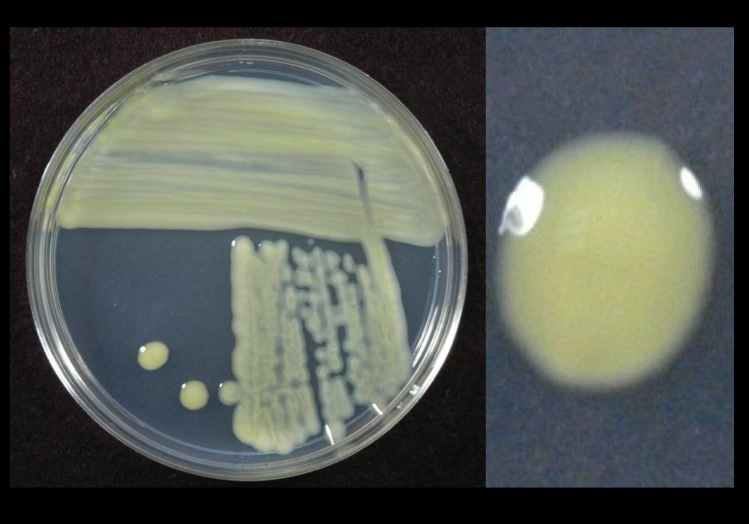
Image source: Wikipedia/Wikimedia
| Ecology, Host, and Life Cycle | |
|---|---|
| Oxygen requirements | aerobic |
| Optimal temperature | Not Available |
| Temperature range | Not Available |
| Habitat | Not Available |
| Biotic relationship | Not Available |
| Host(s) | Fragaria x ananassa |
| Cell arrangement | Not Available |
| Sporulation | Not Available |
| Energy source | Not Available |
| Pathogenicity | Not Available |
Gene Summary
Adenine Count
799566 bp
Thymine Count
796260 bp
Guanine Count
1318411 bp
Cytosine Count
1318407 bp
Genome Length
4232644 bp
Protein-coding Genes
3796 genes
Non-Coding Genes
192 genes
# of Chromosomes/Plasmids
1
Genes
| Name | Locus Tag | UniProt ID | Strand Orientation | Gene Start/End | Protein Molecular Weight |
|---|---|---|---|---|---|
| 2-c-methyl-d-erythritol 2,4-cyclodiphosphate synthase | PD5205_RS09045 | Not Available | Positive | 1926980 - 1927471 | 17343.8 |
| trna pseudouridine(13) synthase trud | PD5205_RS09050 | Not Available | Positive | 1927580 - 1928689 | 40729.3 |
| smr/muts family protein | PD5205_RS09055 | Not Available | Negative | 1928902 - 1929441 | 19660.6 |
| 5'/3'-nucleotidase sure | PD5205_RS09060 | Not Available | Positive | 1929541 - 1930320 | 27406.3 |
| protein-l-isoaspartate(d-aspartate) o-methyltransferase | PD5205_RS09065 | Not Available | Positive | 1930317 - 1930994 | 24284.5 |
| yqaa family protein | PD5205_RS09070 | Not Available | Positive | 1931013 - 1931627 | 22302.0 |
| peptidoglycan dd-metalloendopeptidase family protein | PD5205_RS09075 | Not Available | Positive | 1931624 - 1932403 | 26662.0 |
| glycerophosphodiester phosphodiesterase family protein | PD5205_RS20555 | Not Available | Negative | 1932501 - 1932809 | 10514.6 |
| glycerophosphodiester phosphodiesterase family protein | PD5205_RS09085 | Not Available | Negative | 1932960 - 1933578 | 23143.3 |
| glycerophosphodiester phosphodiesterase family protein | PD5205_RS09090 | Not Available | Negative | 1933623 - 1934752 | 38892.8 |
Pathways
0 pathways
No pathways found
No metabolic pathways have been associated with this bacterium yet.
Health Effects
No health effects information available for this bacterium.