
Kingdom
Pseudomonadati
Phylum
Pseudomonadota
Class
Betaproteobacteria
Order
Burkholderiales
Family
Alcaligenaceae
Genus
Achromobacter
Description
Taxonomy
| Kingdom | Pseudomonadati |
|---|---|
| Phylum | Pseudomonadota |
| Class | Betaproteobacteria |
| Order | Burkholderiales |
| Family | Alcaligenaceae |
| Genus | Achromobacter |
| Species | Achromobacter insolitus |
| Strain | strain NCTC13520 |
Profile
| Physiology | |
|---|---|
| Gram staining properties | Gram-negative |
| Shape | sphere |
| Mobility | Not Available |
| Flagellar presence | Yes |
| Number of membranes | Not Available |
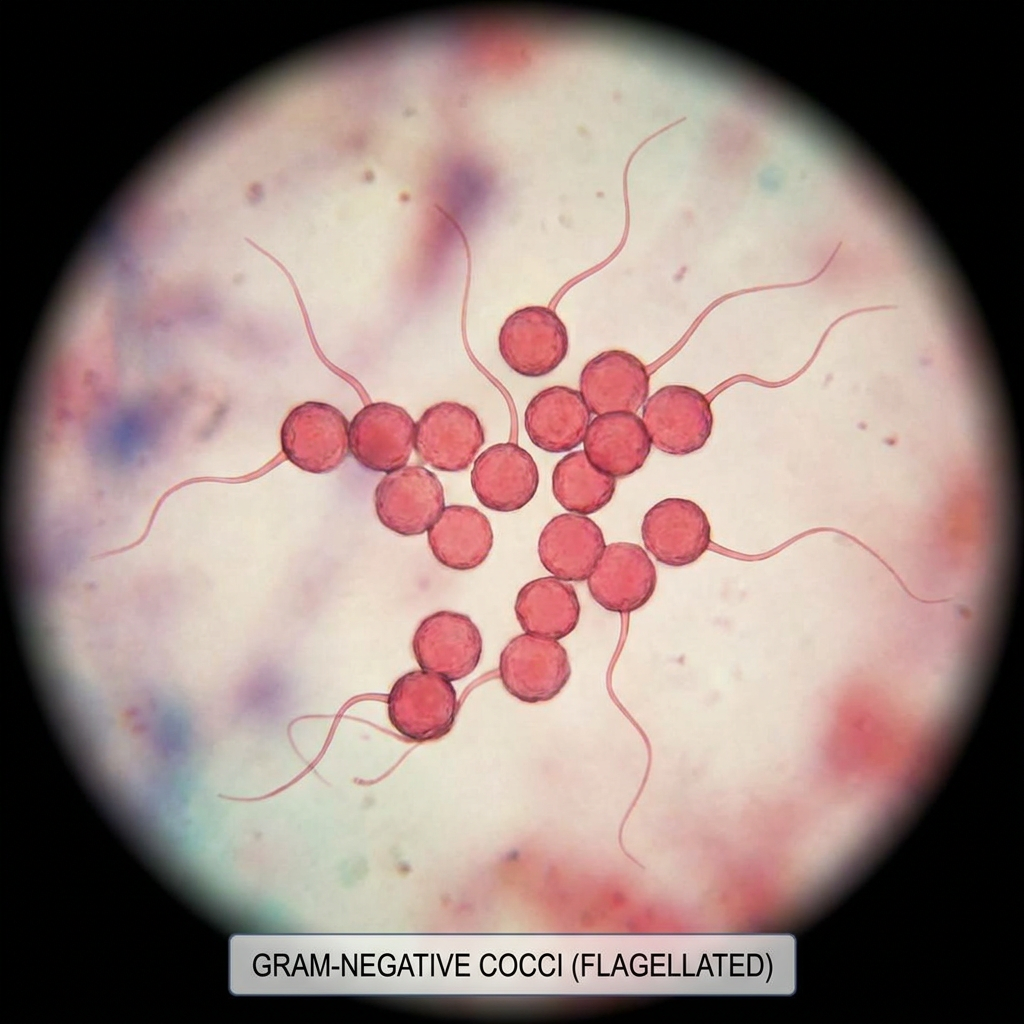
AI-generated image based on bacteria physiology
| Ecology, Host, and Life Cycle | |
|---|---|
| Oxygen requirements | aerobic |
| Optimal temperature | Not Available |
| Temperature range | Not Available |
| Habitat | electronic waste contaminated soil; permafrost |
| Biotic relationship | Not Available |
| Host(s) | Not Available |
| Cell arrangement | Not Available |
| Sporulation | Not Available |
| Energy source | Not Available |
| Pathogenicity | Not Available |
Gene Summary
Adenine Count
1130953 bp
Thymine Count
1127856 bp
Guanine Count
2108641 bp
Cytosine Count
2105026 bp
Genome Length
6472476 bp
Protein-coding Genes
5848 genes
Non-Coding Genes
109 genes
# of Chromosomes/Plasmids
1
Genes
| Name | Locus Tag | UniProt ID | Strand Orientation | Gene Start/End | Protein Molecular Weight |
|---|---|---|---|---|---|
| sdr family nad(p)-dependent oxidoreductase | EL339_RS29310 | Not Available | Negative | 6361625 - 6362392 | 26060.5 |
| fad-dependent oxidoreductase | EL339_RS29315 | Not Available | Negative | 6362389 - 6364080 | 59682.3 |
| iclr family transcriptional regulator | EL339_RS29320 | Not Available | Positive | 6364293 - 6365141 | 30028.5 |
| protein-disulfide reductase dsbd | EL339_RS29325 | Not Available | Negative | 6365247 - 6367145 | 66066.4 |
| divalent-cation tolerance protein cuta | EL339_RS29330 | Not Available | Negative | 6367145 - 6367492 | 12607.3 |
| hit family protein | EL339_RS29335 | Not Available | Positive | 6367615 - 6368052 | 16392.7 |
| 50s ribosomal protein l17 | EL339_RS29340 | Not Available | Negative | 6368125 - 6368517 | 14674.9 |
| dna-directed rna polymerase subunit alpha | EL339_RS29345 | Not Available | Negative | 6368704 - 6369690 | 36167.7 |
| 30s ribosomal protein s4 | EL339_RS29350 | Not Available | Negative | 6369906 - 6370529 | 23399.2 |
| 30s ribosomal protein s11 | EL339_RS29355 | Not Available | Negative | 6370541 - 6370942 | 13973.9 |
Pathways
0 pathways
No pathways found
No metabolic pathways have been associated with this bacterium yet.
Health Effects
No health effects information available for this bacterium.

