
Kingdom
Pseudomonadati
Phylum
Pseudomonadota
Class
Betaproteobacteria
Order
Burkholderiales
Family
Alcaligenaceae
Genus
Achromobacter
Description
Taxonomy
| Kingdom | Pseudomonadati |
|---|---|
| Phylum | Pseudomonadota |
| Class | Betaproteobacteria |
| Order | Burkholderiales |
| Family | Alcaligenaceae |
| Genus | Achromobacter |
| Species | Achromobacter insolitus |
| Strain | strain NCTC13520 |
Profile
| Physiology | |
|---|---|
| Gram staining properties | Gram-negative |
| Shape | sphere |
| Mobility | Not Available |
| Flagellar presence | Yes |
| Number of membranes | Not Available |
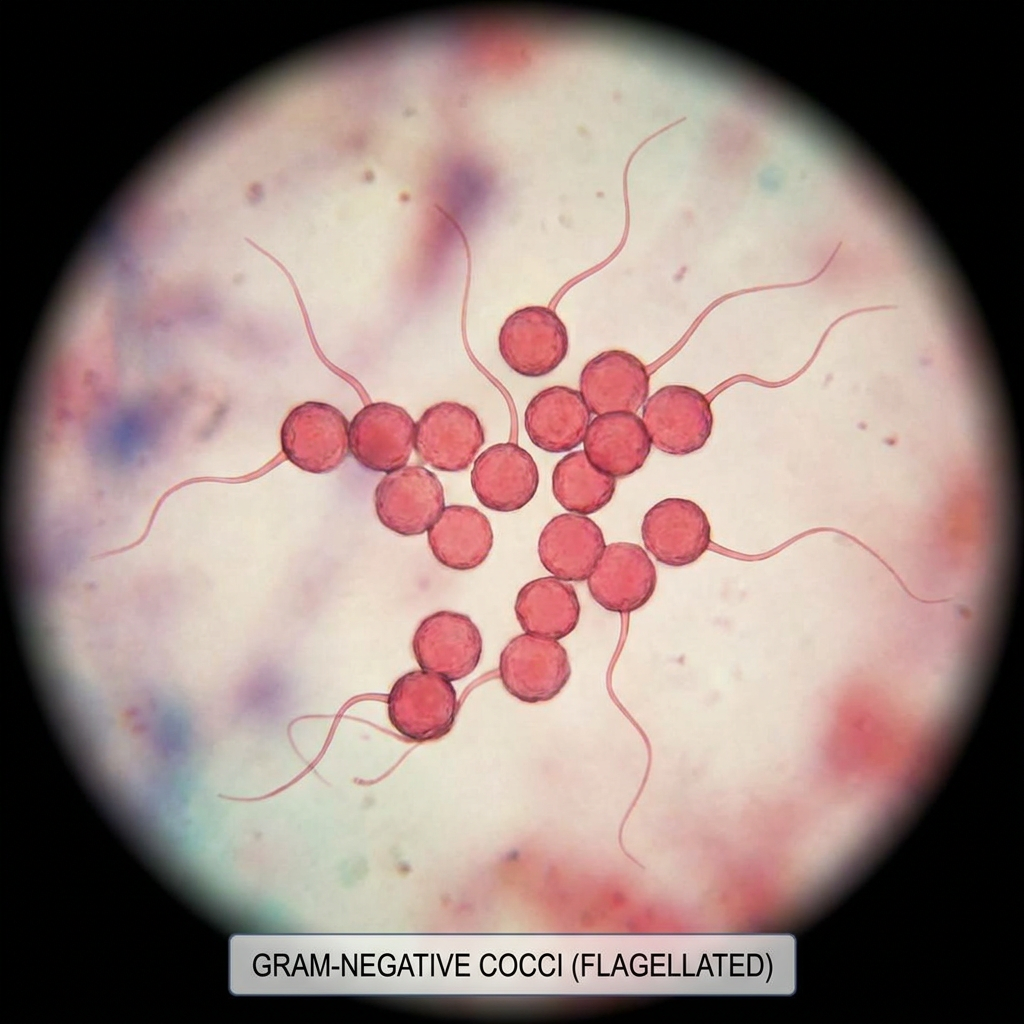
AI-generated image based on bacteria physiology
| Ecology, Host, and Life Cycle | |
|---|---|
| Oxygen requirements | aerobic |
| Optimal temperature | Not Available |
| Temperature range | Not Available |
| Habitat | electronic waste contaminated soil; permafrost |
| Biotic relationship | Not Available |
| Host(s) | Not Available |
| Cell arrangement | Not Available |
| Sporulation | Not Available |
| Energy source | Not Available |
| Pathogenicity | Not Available |
Gene Summary
Adenine Count
1130953 bp
Thymine Count
1127856 bp
Guanine Count
2108641 bp
Cytosine Count
2105026 bp
Genome Length
6472476 bp
Protein-coding Genes
5848 genes
Non-Coding Genes
109 genes
# of Chromosomes/Plasmids
1
Genes
| Name | Locus Tag | UniProt ID | Strand Orientation | Gene Start/End | Protein Molecular Weight |
|---|---|---|---|---|---|
| carboxylating nicotinate-nucleotide diphosphorylase | EL339_RS26260 | Not Available | Negative | 5716019 - 5716903 | 30717.4 |
| nudix hydrolase | EL339_RS26265 | Not Available | Negative | 5716986 - 5717915 | 34546.5 |
| hypothetical protein | EL339_RS26270 | Not Available | Positive | 5718115 - 5718342 | 8072.47 |
| lysr substrate-binding domain-containing protein | EL339_RS26275 | Not Available | Negative | 5718402 - 5719307 | 32501.3 |
| bug family tripartite tricarboxylate transporter substrate binding protein | EL339_RS26280 | Not Available | Positive | 5719450 - 5720439 | 34967.1 |
| hypothetical protein | EL339_RS26285 | Not Available | Positive | 5720521 - 5721801 | 48708.1 |
| phox family protein | EL339_RS26290 | Not Available | Positive | 5722009 - 5723886 | 66537.1 |
| Trna-ser | Not Available | Not Available | Positive | 5757136 - 5757226 | Not Available |
| spovr family protein | EL339_RS26500 | Not Available | Negative | 5757358 - 5758911 | 59836.6 |
| yeah/yhbh family protein | EL339_RS26505 | Not Available | Negative | 5758908 - 5760167 | 47669.4 |
Pathways
0 pathways
No pathways found
No metabolic pathways have been associated with this bacterium yet.
Health Effects
No health effects information available for this bacterium.

