
Kingdom
Pseudomonadati
Phylum
Pseudomonadota
Class
Gammaproteobacteria
Order
Moraxellales
Family
Moraxellaceae
Genus
Acinetobacter
Description
Taxonomy
| Kingdom | Pseudomonadati |
|---|---|
| Phylum | Pseudomonadota |
| Class | Gammaproteobacteria |
| Order | Moraxellales |
| Family | Moraxellaceae |
| Genus | Acinetobacter |
| Species | Acinetobacter baumannii |
| Strain | strain MRSN15313 |
Profile
| Physiology | |
|---|---|
| Gram staining properties | Negative |
| Shape | Rod |
| Mobility | No |
| Flagellar presence | Yes |
| Number of membranes | 2 |
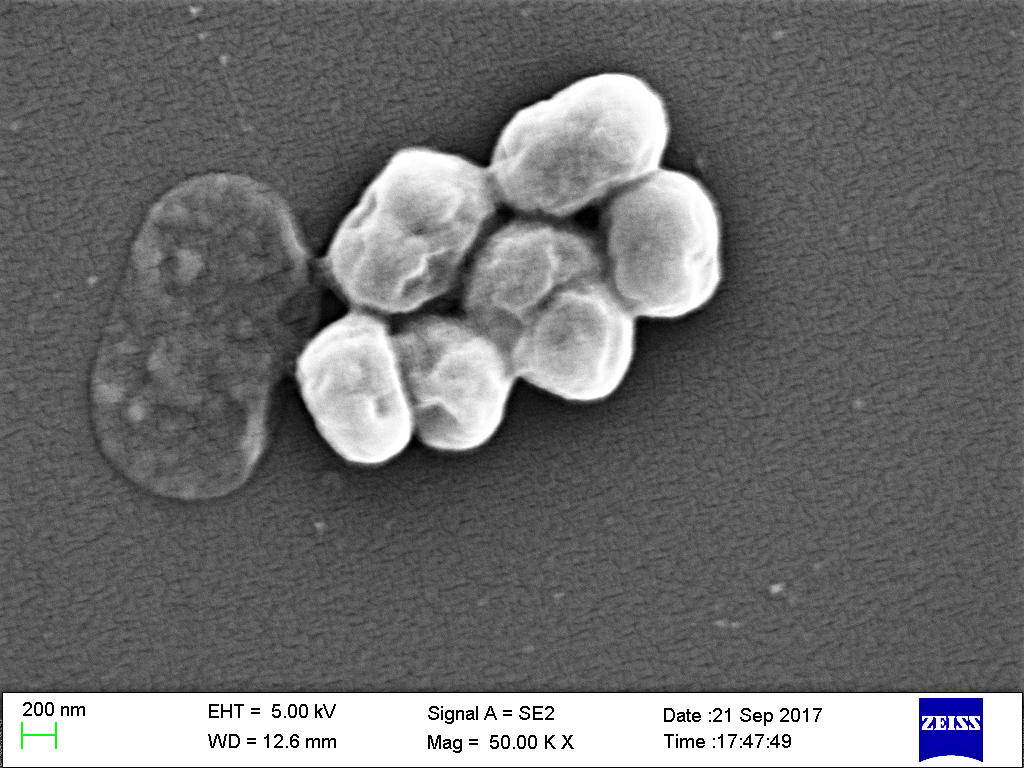
Image source: Wikipedia/Wikimedia
| Ecology, Host, and Life Cycle | |
|---|---|
| Oxygen requirements | Aerobe |
| Optimal temperature | 37 |
| Temperature range | Mesophilic |
| Habitat | Multiple |
| Biotic relationship | Free living |
| Host(s) | Homo sapiens, Gallus gallus, Bos taurus |
| Cell arrangement | Singles |
| Sporulation | Not Available |
| Energy source | Heterotroph - Chemoheterotroph |
| Pathogenicity | Human |
Genome Summary
Acinetobacter baumannii strain MRSN15313 plasmid pAb-MCR4.3,
Gene Summary
Adenine Count
Not Available
Thymine Count
Not Available
Guanine Count
Not Available
Cytosine Count
Not Available
Genome Length
Not Available
Protein-coding Genes
38 genes
Non-Coding Genes
0 genes
# of Chromosomes/Plasmids
4
Genes
| Name | Locus Tag | UniProt ID | Strand Orientation | Gene Start/End | Protein Molecular Weight |
|---|---|---|---|---|---|
| imidazole glycerol phosphate synthase subunit hish | EGM95_RS01465 | Not Available | Negative | 310425 - 311042 | 22811.4 |
| imidazoleglycerol-phosphate dehydratase hisb | EGM95_RS01470 | Not Available | Negative | 311042 - 311635 | 22032.3 |
| gnat family n-acetyltransferase | EGM95_RS01475 | Not Available | Positive | 311738 - 312121 | 14185.7 |
| Trna-phe | Not Available | Not Available | Positive | 312227 - 312302 | Not Available |
| Trna-phe | Not Available | Not Available | Positive | 312429 - 312504 | Not Available |
| gnat family acetyltransferase | EGM95_RS01490 | Not Available | Negative | 312676 - 313107 | 16465.8 |
| acetyl-coa hydrolase/transferase family protein | EGM95_RS01495 | Not Available | Negative | 313238 - 314752 | 54717.5 |
| hypothetical protein | EGM95_RS01500 | Not Available | Negative | 314788 - 314916 | 5132.23 |
| atp-binding protein | EGM95_RS01505 | Not Available | Negative | 314944 - 316401 | 56171.0 |
| two-component system response regulator ompr | EGM95_RS01510 | Not Available | Negative | 316419 - 317183 | 28816.8 |
Pathways
0 pathways
No pathways found
No metabolic pathways have been associated with this bacterium yet.
Health Effects
| Health Condition | Relation | Reference |
|---|---|---|
| Hospital-acquired pneumonia | Causes | PMC11264759 |
| Bacteremia | Causes | PMC11264759 |
| Urinary tract infections | Causes | PMC11264759 |
| Traumatic injuries | Causes | PMC11264759 |
| Respiratory tract infection | Causes | PMC11514839 |
| Healthcare-associated infections | Causes | PMC13168211 |
| Bacteremia | Causes | PMC10561989 |
| Hospital-acquired pneumonia | Causes | PMC11925754 |
| Bloodstream infections | Causes | PMC11925754 |
| Wound contaminations | Causes | PMC11925754 |

