
Kingdom
Pseudomonadati
Phylum
Pseudomonadota
Class
Gammaproteobacteria
Order
Enterobacterales
Family
Yersiniaceae
Genus
Yersinia
Description
Taxonomy
| Kingdom | Pseudomonadati |
|---|---|
| Phylum | Pseudomonadota |
| Class | Gammaproteobacteria |
| Order | Enterobacterales |
| Family | Yersiniaceae |
| Genus | Yersinia |
| Species | Yersinia pseudotuberculosis |
| Strain | strain FDAARGOS_581 |
Profile
| Physiology | |
|---|---|
| Gram staining properties | Negative |
| Shape | Rod |
| Mobility | Yes |
| Flagellar presence | Yes |
| Number of membranes | 2 |
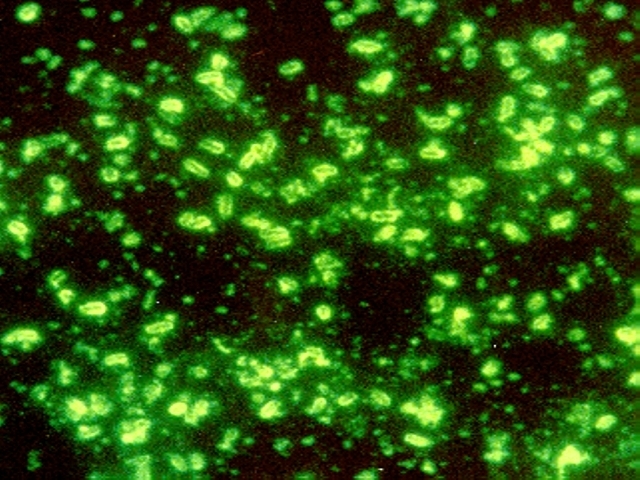
Image source: Wikipedia/Wikimedia
| Ecology, Host, and Life Cycle | |
|---|---|
| Oxygen requirements | Facultative anaerobe |
| Optimal temperature | 28 |
| Temperature range | Mesophilic |
| Habitat | Multiple |
| Biotic relationship | Free living |
| Host(s) | Homo sapiens, Metazoa, Sus scrofa |
| Cell arrangement | Singles |
| Sporulation | Not Available |
| Energy source | Heterotroph |
| Pathogenicity | Human |
Gene Summary
Adenine Count
19472 bp
Thymine Count
19175 bp
Guanine Count
15285 bp
Cytosine Count
16103 bp
Genome Length
70035 bp
Protein-coding Genes
93 genes
Non-Coding Genes
0 genes
# of Chromosomes/Plasmids
1
Genes
| Name | Locus Tag | UniProt ID | Strand Orientation | Gene Start/End | Protein Molecular Weight |
|---|---|---|---|---|---|
| type iii secretion chaperone sycn | EGX47_RS00260 | Not Available | Positive | 35618 - 35989 | 13609.6 |
| type iii secretion system protein yscx | EGX47_RS00265 | Not Available | Positive | 35986 - 36354 | 13756.5 |
| type iii secretion system chaperone yscy | EGX47_RS00270 | Not Available | Positive | 36351 - 36695 | 13117.7 |
| sctv family type iii secretion system export apparatus subunit lcrd | EGX47_RS00275 | Not Available | Positive | 36682 - 38796 | 77806.7 |
| type iii secretion system chaperone lcrr | EGX47_RS00280 | Not Available | Positive | 38793 - 39233 | 16481.2 |
| type iii secretion system chaperone lcrg | EGX47_RS00285 | Not Available | Positive | 39275 - 39562 | 11020.3 |
| type iii secretion system needle tip protein lcrv | EGX47_RS00290 | Not Available | Positive | 39564 - 40547 | 37390.3 |
| type iii secretion system chaperone sycd/lcrh | EGX47_RS00295 | Not Available | Positive | 40608 - 41114 | 19011.6 |
| type iii secretion system translocon subunit yopb | EGX47_RS00300 | Not Available | Positive | 41092 - 42297 | 41797.7 |
| type iii secretion system translocon subunit yopd | EGX47_RS00305 | Not Available | Positive | 42316 - 43236 | 33389.1 |
Pathways
0 pathways
No pathways found
No metabolic pathways have been associated with this bacterium yet.
Health Effects
| Health Condition | Relation | Reference |
|---|---|---|
| Gastroenteritis | Causes | PMC11654157 |
| Pseudoappendicitis | Causes | PMC11654157 |
| Multiple organ dysfunction syndrome | Causes | PMC11654157 |
| Mods | Causes | PMC11654157 |
| Liver abscess | Causes | PMC11654157 |
| Splenic infarction | Causes | PMC11654157 |
| Sepsis | Causes | PMC11654157 |
| Septic shock | Causes | PMC11654157 |
| Acute kidney injury | Causes | PMC11654157 |
| Acute liver injury | Causes | PMC11654157 |


