
Kingdom
Pseudomonadati
Phylum
Spirochaetota
Class
Leptospiria
Order
Leptospirales
Family
Leptospiraceae
Genus
Leptospira
Description
Taxonomy
| Kingdom | Pseudomonadati |
|---|---|
| Phylum | Spirochaetota |
| Class | Leptospiria |
| Order | Leptospirales |
| Family | Leptospiraceae |
| Genus | Leptospira |
| Species | Leptospira santarosai |
| Strain | strain U160 |
Profile
| Physiology | |
|---|---|
| Gram staining properties | Not Available |
| Shape | Not Available |
| Mobility | Not Available |
| Flagellar presence | Yes |
| Number of membranes | Not Available |
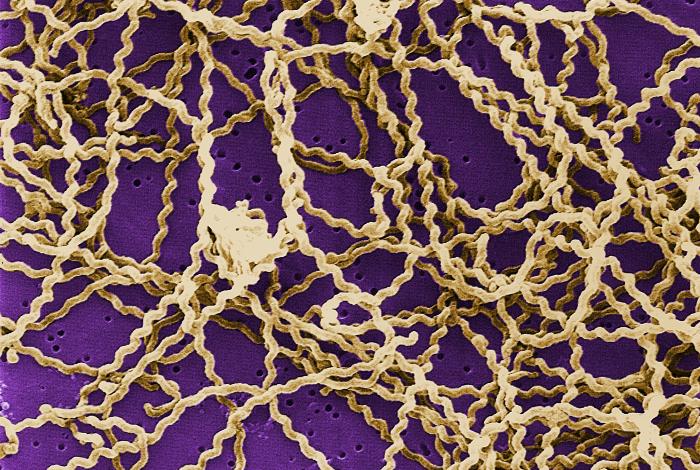
Image source: Wikipedia/Wikimedia
| Ecology, Host, and Life Cycle | |
|---|---|
| Oxygen requirements | Not Available |
| Optimal temperature | Not Available |
| Temperature range | Not Available |
| Habitat | environmental water |
| Biotic relationship | Not Available |
| Host(s) | Homo sapiens, Bos, Metazoa |
| Cell arrangement | Not Available |
| Sporulation | Not Available |
| Energy source | Not Available |
| Pathogenicity | Not Available |
Gene Summary
Adenine Count
Not Available
Thymine Count
Not Available
Guanine Count
Not Available
Cytosine Count
Not Available
Genome Length
Not Available
Protein-coding Genes
3525 genes
Non-Coding Genes
55 genes
# of Chromosomes/Plasmids
2
Genes
| Name | Locus Tag | UniProt ID | Strand Orientation | Gene Start/End | Protein Molecular Weight |
|---|---|---|---|---|---|
| 2-oxoglutarate dehydrogenase e1 component | XB16_RS02430 | Not Available | Negative | 428287 - 431055 | 104241.0 |
| dihydrolipoyl dehydrogenase | XB16_RS02435 | Not Available | Negative | 431080 - 432483 | 49953.7 |
| 2-oxoglutarate dehydrogenase complex dihydrolipoyllysine-residue succinyltransferase | XB16_RS02440 | Not Available | Negative | 432497 - 433738 | 44310.6 |
| penicillin-binding protein 1a | XB16_RS02445 | Not Available | Negative | 433840 - 436278 | 89475.1 |
| mbl fold metallo-hydrolase | XB16_RS02450 | Not Available | Negative | 436275 - 437231 | 35766.8 |
| rhomboid family intramembrane serine protease | XB16_RS02455 | Not Available | Positive | 437338 - 438156 | 31275.8 |
| gnat family n-acetyltransferase | XB16_RS02460 | Not Available | Positive | 438302 - 438910 | 23144.1 |
| serine hydroxymethyltransferase | XB16_RS02465 | Not Available | Negative | 438986 - 440233 | 45161.2 |
| lipoate--protein ligase family protein | XB16_RS02470 | Not Available | Negative | 440271 - 441263 | 37666.0 |
| efflux rnd transporter periplasmic adaptor subunit | XB16_RS02475 | Not Available | Negative | 441298 - 442482 | 43757.0 |
Pathways
0 pathways
No pathways found
No metabolic pathways have been associated with this bacterium yet.


