
Kingdom
Pseudomonadati
Phylum
Spirochaetota
Class
Leptospiria
Order
Leptospirales
Family
Leptospiraceae
Genus
Leptospira
Description
Taxonomy
| Kingdom | Pseudomonadati |
|---|---|
| Phylum | Spirochaetota |
| Class | Leptospiria |
| Order | Leptospirales |
| Family | Leptospiraceae |
| Genus | Leptospira |
| Species | Leptospira santarosai |
| Strain | strain U160 |
Profile
| Physiology | |
|---|---|
| Gram staining properties | Not Available |
| Shape | Not Available |
| Mobility | Not Available |
| Flagellar presence | Yes |
| Number of membranes | Not Available |
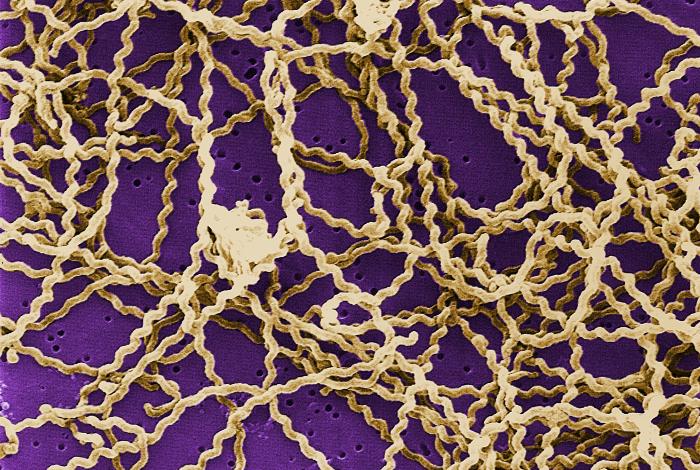
Image source: Wikipedia/Wikimedia
| Ecology, Host, and Life Cycle | |
|---|---|
| Oxygen requirements | Not Available |
| Optimal temperature | Not Available |
| Temperature range | Not Available |
| Habitat | environmental water |
| Biotic relationship | Not Available |
| Host(s) | Homo sapiens, Bos, Metazoa |
| Cell arrangement | Not Available |
| Sporulation | Not Available |
| Energy source | Not Available |
| Pathogenicity | Not Available |
Gene Summary
Adenine Count
Not Available
Thymine Count
Not Available
Guanine Count
Not Available
Cytosine Count
Not Available
Genome Length
Not Available
Protein-coding Genes
3525 genes
Non-Coding Genes
55 genes
# of Chromosomes/Plasmids
2
Genes
| Name | Locus Tag | UniProt ID | Strand Orientation | Gene Start/End | Protein Molecular Weight |
|---|---|---|---|---|---|
| transposase | XB16_RS17210 | Not Available | Negative | 3350505 - 3350717 | 7920.29 |
| transporter | XB16_RS17220 | Not Available | Negative | 3351176 - 3351565 | 14081.9 |
| periplasmic-type flagellar collar protein flbb | XB16_RS17225 | Not Available | Negative | 3351579 - 3352226 | 24310.4 |
| flagellar export protein flij | XB16_RS17230 | Not Available | Negative | 3352385 - 3352945 | 22193.3 |
| flagellar protein export atpase flii | XB16_RS17235 | Not Available | Negative | 3352949 - 3354313 | 50188.6 |
| transposase | XB16_RS17240 | Not Available | Negative | 3354368 - 3354747 | 14908.1 |
| flagellar assembly protein flih | XB16_RS17245 | Not Available | Negative | 3354731 - 3355654 | 35775.9 |
| flig c-terminal domain-containing protein | XB16_RS17250 | Not Available | Negative | 3355658 - 3356626 | 36709.3 |
| flagellar basal-body ms-ring/collar protein flif | XB16_RS17255 | Not Available | Negative | 3356626 - 3358326 | 64589.2 |
| transposase | XB16_RS17260 | Not Available | Negative | 3358879 - 3359435 | 21249.2 |
Pathways
0 pathways
No pathways found
No metabolic pathways have been associated with this bacterium yet.


