
Kingdom
Pseudomonadati
Phylum
Spirochaetota
Class
Leptospiria
Order
Leptospirales
Family
Leptospiraceae
Genus
Leptospira
Description
Taxonomy
| Kingdom | Pseudomonadati |
|---|---|
| Phylum | Spirochaetota |
| Class | Leptospiria |
| Order | Leptospirales |
| Family | Leptospiraceae |
| Genus | Leptospira |
| Species | Leptospira santarosai |
| Strain | strain U160 |
Profile
| Physiology | |
|---|---|
| Gram staining properties | Not Available |
| Shape | Not Available |
| Mobility | Not Available |
| Flagellar presence | Yes |
| Number of membranes | Not Available |
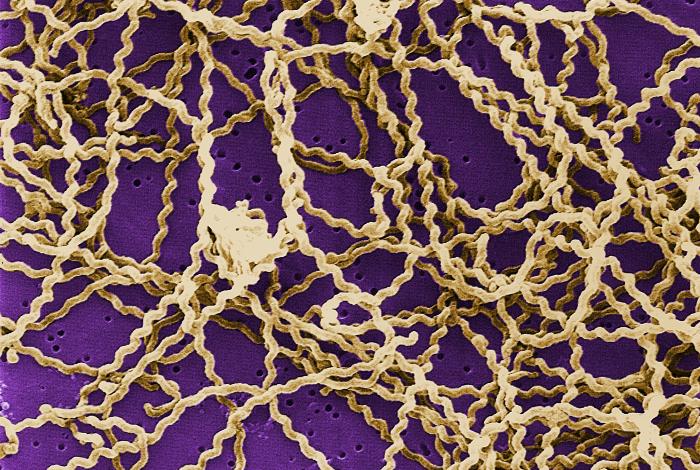
Image source: Wikipedia/Wikimedia
| Ecology, Host, and Life Cycle | |
|---|---|
| Oxygen requirements | Not Available |
| Optimal temperature | Not Available |
| Temperature range | Not Available |
| Habitat | environmental water |
| Biotic relationship | Not Available |
| Host(s) | Homo sapiens, Bos, Metazoa |
| Cell arrangement | Not Available |
| Sporulation | Not Available |
| Energy source | Not Available |
| Pathogenicity | Not Available |
Gene Summary
Adenine Count
Not Available
Thymine Count
Not Available
Guanine Count
Not Available
Cytosine Count
Not Available
Genome Length
Not Available
Protein-coding Genes
3525 genes
Non-Coding Genes
55 genes
# of Chromosomes/Plasmids
2
Genes
| Name | Locus Tag | UniProt ID | Strand Orientation | Gene Start/End | Protein Molecular Weight |
|---|---|---|---|---|---|
| ispd/tari family cytidylyltransferase | XB16_RS14430 | Not Available | Negative | 2758295 - 2759002 | 26643.3 |
| diaminopimelate decarboxylase | XB16_RS14435 | Not Available | Negative | 2758980 - 2760248 | 46817.1 |
| zinc dependent phospholipase c family protein | XB16_RS14440 | Not Available | Positive | 2760326 - 2761402 | 41827.4 |
| penicillin-binding protein 1a | XB16_RS14445 | Not Available | Positive | 2761409 - 2763883 | 93199.9 |
| bactofilin family protein | XB16_RS14450 | Not Available | Positive | 2763986 - 2764396 | 14439.3 |
| peptidoglycan dd-metalloendopeptidase family protein | XB16_RS14455 | Not Available | Positive | 2764448 - 2765566 | 42037.1 |
| hypothetical protein | XB16_RS22265 | Not Available | Positive | 2765987 - 2766109 | 4584.56 |
| hypothetical protein | XB16_RS14460 | Not Available | Negative | 2766637 - 2767308 | 25015.1 |
| marr family transcriptional regulator | XB16_RS14465 | Not Available | Negative | 2767329 - 2767790 | 17570.5 |
| histidine kinase dimerization/phosphoacceptor domain -containing protein | XB16_RS14470 | Not Available | Positive | 2769285 - 2770664 | 51495.8 |
Pathways
0 pathways
No pathways found
No metabolic pathways have been associated with this bacterium yet.


