Kingdom
Bacillati
Phylum
Bacillota
Class
Clostridia
Order
Eubacteriales
Family
Clostridiaceae
Genus
Clostridium
Description
Taxonomy
| Kingdom | Bacillati |
|---|---|
| Phylum | Bacillota |
| Class | Clostridia |
| Order | Eubacteriales |
| Family | Clostridiaceae |
| Genus | Clostridium |
| Species | Clostridium botulinum |
| Strain | strain RF5 |
Profile
| Physiology | |
|---|---|
| Gram staining properties | Positive |
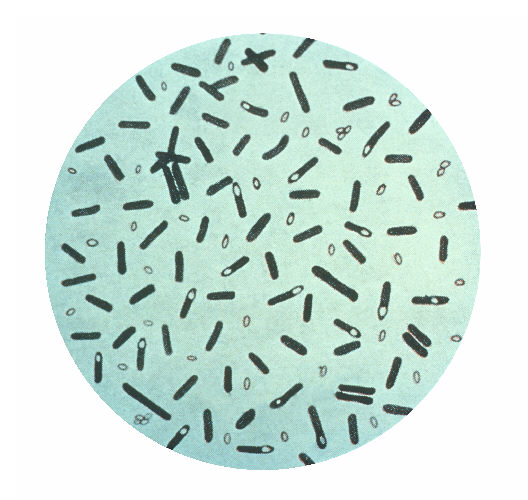
| Shape | Rod |
| Mobility | Yes |
| Flagellar presence | Yes |
| Number of membranes | 1 |

Image source: Wikipedia/Wikimedia
| Ecology, Host, and Life Cycle | |
|---|---|
| Oxygen requirements | Anaerobe |
| Optimal temperature | 37 |
| Temperature range | Mesophilic |
| Habitat | Multiple |
| Biotic relationship | Free living |
| Host(s) | Homo sapiens, Bos, Metazoa |
| Cell arrangement | Pairs - Singles - Chains |
| Sporulation | Not Available |
| Energy source | Chemoorganotroph |
| Pathogenicity | Not Available |
Gene Summary
Adenine Count
1416430 bp
Thymine Count
1471138 bp
Guanine Count
537670 bp
Cytosine Count
573509 bp
Genome Length
3998747 bp
Protein-coding Genes
3614 genes
Non-Coding Genes
109 genes
# of Chromosomes/Plasmids
1
Genes
| Name | Locus Tag | UniProt ID | Strand Orientation | Gene Start/End | Protein Molecular Weight |
|---|---|---|---|---|---|
| acyl-coa dehydratase activase | C7M58_RS17175 | Not Available | Negative | 3659630 - 3660604 | 35174.3 |
| 2-hydroxyglutaryl-coa dehydratase | C7M58_RS17180 | Not Available | Negative | 3660585 - 3661682 | 40805.1 |
| acyl-coa dehydratase activase-related protein | C7M58_RS17185 | Not Available | Negative | 3661685 - 3662578 | 33926.4 |
| ferredoxin | C7M58_RS17190 | Not Available | Positive | 3662821 - 3663015 | 6925.15 |
| n-acetylglucosaminidase | C7M58_RS17195 | Not Available | Positive | 3663252 - 3664640 | 51748.2 |
| m4 family metallopeptidase | C7M58_RS17200 | Not Available | Positive | 3664777 - 3666510 | 64952.3 |
| n-acetylglucosaminidase | C7M58_RS17205 | Not Available | Positive | 3666677 - 3667526 | 31349.4 |
| aaa family atpase | C7M58_RS17210 | Not Available | Negative | 3667663 - 3669981 | 89315.8 |
| iron-containing alcohol dehydrogenase | C7M58_RS17215 | Not Available | Negative | 3670341 - 3671540 | 43688.9 |
| hypothetical protein | C7M58_RS17220 | Not Available | Positive | 3672670 - 3673077 | 15717.8 |
Pathways
1096 pathways
Health Effects
| Health Condition | Relation | Reference |
|---|---|---|
| Wound botulism | Causes | PMC8283217 |
| Botulism | Causes | PMC2693436 |
| Botulism | Causes | PMC13317340 |
| Botulism | Causes | PMC3232984 |
| Botulism | Causes | PMC5113727 |
| Botulism | Causes | PMC7904509 |